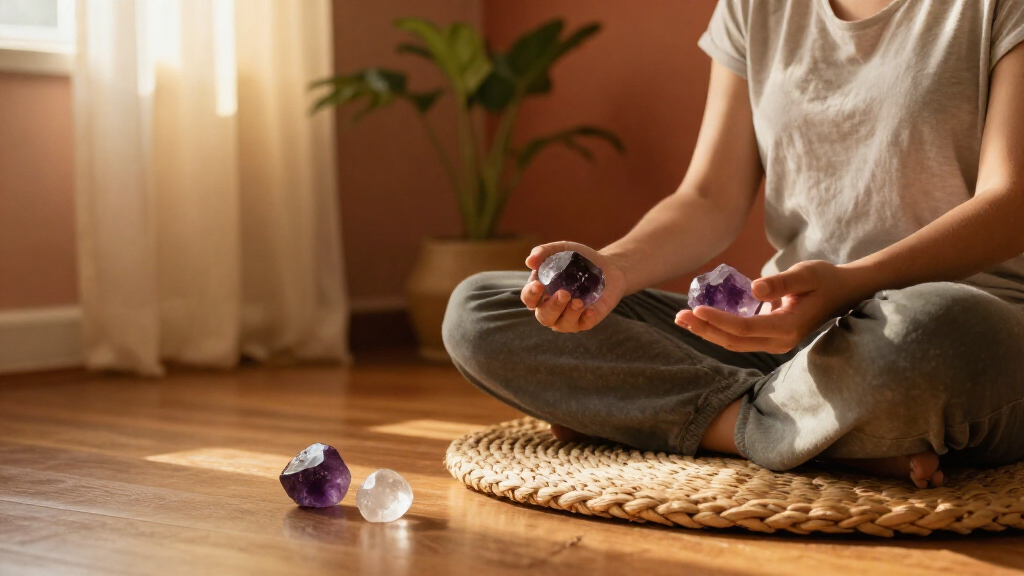

Amethyst and clear quartz are two familiar choices for people who want a crystal to accompany meditation. The practical decision is less about proven effects—there is no reliable scientific evidence that either crystal changes meditation outcomes—and more about which object’s appearance, symbolism, and role help you settle into a consistent practice. Amethyst is often selected for its violet color and traditional associations with calm; clear quartz suits people who want a neutral-looking stone they can assign their own meaning to. Both can serve as a tactile reminder to pause, so choose based on the experience and value you want rather than a promise of special powers.

Turn your quiet moments into listening time
- Thousands of audiobooks, podcasts and originals
- Listen on your phone, tablet or Echo — also offline
- Cancel anytime
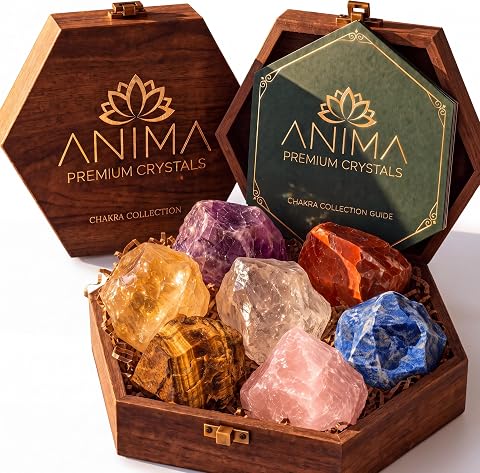
Anima 7-Chakra Healing Crystals Set
- ✔ Crystals included: Red jasper, tiger’s eye, citrine, rose quartz, lapis, amethyst, clear quartz
- ✔ Stone count: 7
- ✔ Crystal size: Approximately 1.4–1.6 inches
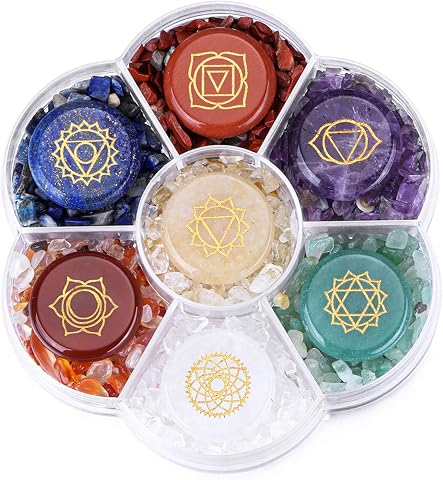
7 Chakra Natural Crystal Stone Set with Engraved Symbols
- ✔ Stone count: 7
- ✔ Included stones: Amethyst, clear quartz, lapis lazuli, green aventurine, yellow aventurine, red agate, red jasper
- ✔ Stone size: 0.98–1.02 inches each

Natural Crystal and Healing Stone Set, 9 Pieces
- ✔ Listed pieces: 9
- ✔ Included items: 7 chakra stones, 1 selenite orgone pyramid, wooden box, 12-page guidebook
- ✔ Stone size: Approximately 1.5–1.8 inches
At a Glance
| Criteria | Amethyst | Clear Quartz | Winner |
|---|---|---|---|
| Meditation symbolism | Traditionally linked with calm, reflection, and spiritual awareness | Often treated as a general-purpose stone or a personal symbol of clarity | A |
| Appearance and visual focus | Distinctive purple tones; color can be a soothing focal point or a distraction | Clear or milky appearance; visually restrained, though inclusions add variation | Depends |
| Versatility | More strongly associated with contemplative or calming intentions | Easy to pair with many personal intentions and meditation styles | B |
| Price and value | Often affordable; price varies with color, size, and workmanship | Commonly affordable; unusually clear, large, or shaped pieces may cost more | Tie |
| Availability and selection | Widely sold in rough, polished, and carved forms | Very widely available in many sizes and finishes | Tie |
| Care and everyday use | Hard, but edges on rough pieces may feel uneven; keep away from harsh impacts | Hard and practical for regular handling, though it can chip or scratch other items | B |
Anima 7-Chakra Healing Crystals Set
For a meditation set we can understand at a glance, Anima is the strongest all-round choice here. It names all seven stones—red jasper, tiger’s eye, citrine, rose quartz, lapis, amethyst, and clear quartz—so we can pick a particular piece without first trying to identify it. That clarity is useful when we want to rotate stones, keep one at a seat, or create a simple arrangement before settling into a session.The stones measure about 1.4 to 1.6 inches, larger than the roughly one-inch stones in the engraved-symbol set. That may make them easier to handle individually, although the bigger pieces take up more room. The included guide and dark wooden gift box also give this set a more complete feel than the engraved set’s plastic box. Compared with the nine-piece option, Anima gives us a fully named selection, but it does not add the pyramid or longer guidebook.We would choose it for a varied practice where knowing which stone is which matters. Its limits are straightforward: it has no engraved chakra symbols, and the product notes that natural crystals can differ in color, shape, and texture. Buyers looking for uniform matching pieces or a compact pocket set may prefer the smaller engraved stones.
Pros:
- Names all seven included crystals
- Includes a guide to crystal properties and cleansing
- Wooden box keeps the set organized
- Larger stones may be easier to pick up than the engraved set’s one-inch pieces
Cons:
- Natural variation means appearance can differ between pieces
- Larger stones take up more space than the engraved set
- No engraved symbols are listed
Best for: Meditators who want seven specifically identified stones, a basic guide, and organized storage in one set.
Not ideal for: Buyers who need engraved chakra markers, very small stones, or a set with an included pyramid.
Bottom line: Choose Anima for a clearly identified, well-organized seven-stone set that balances guidance and handling size.
“Choose Anima for a clearly identified, well-organized seven-stone set that balances guidance and handling size.”
7 Chakra Natural Crystal Stone Set with Engraved Symbols
When a meditation space is small or we prefer holding a modest stone, this set makes the clearest case for itself. Its seven tumbled pieces are about 0.98 to 1.02 inches, considerably smaller than Anima’s 1.4–1.6-inch crystals. Each is engraved with a chakra symbol, giving us a quick visual cue when laying out a sequence or returning stones to their place. The engraving makes the set more immediately legible than the nine-piece set, whose stone identities are not fully specified.The named selection includes amethyst, clear quartz, lapis lazuli, green and yellow aventurine, red agate, and red jasper. That list helps us choose by stone, while the engraved markings add a second reference point. The tradeoff is that a set this small may feel less substantial to hold than Anima’s larger pieces. Its plastic box is also more utilitarian than either wooden box in this roundup, and the listed package does not mention a guidebook.We’d favor it for compact storage, crystal grids, or a simple practice organized around the engraved symbols. We’d skip it if we want larger tactile pieces, a more gift-ready presentation, or written guidance. The product description includes healing and energy claims; those claims are not substantiated, so we treat the stones as personal ritual objects rather than therapeutic tools.
Pros:
- Seven tumbled stones with engraved chakra symbols
- Approximately one inch per stone for compact storage
- Lists the included stones by name
- Suitable for meditation layouts and crystal grids
Cons:
- Smaller pieces may be less comfortable to handle than Anima’s
- Plastic box is less substantial than the wooden boxes in the other sets
- No guidebook is listed in the package contents
Best for: People with limited meditation-space storage who want small tumbled stones with visible chakra symbols.
Not ideal for: Anyone who prefers larger stones to hold, wooden storage, or an included guidebook.
Bottom line: Pick this set when compact size and engraved visual cues matter more than larger stones or a detailed guide.
“Pick this set when compact size and engraved visual cues matter more than larger stones or a detailed guide.”
Natural Crystal and Healing Stone Set, 9 Pieces
This set is the accessory-rich choice: it includes seven chakra stones, a selenite orgone pyramid, a wooden storage box, and a 12-page guidebook with an identification chart. For someone arranging a first meditation space, the extra reading and display piece may provide more to explore than Anima’s shorter guide or the engraved set’s symbol-only approach. Its stones, at about 1.5–1.8 inches, are also the largest stated in this roundup.That added material comes with a meaningful selection drawback: the description does not name all seven stones. This makes it harder to compare the set by crystal type with Anima, whose full list is provided, or with the engraved set, which also names its stones. The guide’s identification chart could be useful, but the listing alone does not let us confirm exactly what the set contains. The stated nine pieces include seven stones and one pyramid, while the remaining piece is not separately clarified in the supplied description.We’d consider this option when a guidebook, display object, and wooden storage matter more than knowing the full stone lineup in advance. We’d pass if our practice depends on selecting specific named stones or if we want the compact footprint of the engraved set. As with the others, natural materials can vary, and the set’s intended spiritual uses should be understood as personal practice rather than proven effects.
Pros:
- Includes a 12-page guidebook and identification chart
- Adds a selenite orgone pyramid to the seven stones
- Wooden box provides storage and display-ready presentation
- Stones are approximately 1.5–1.8 inches
Cons:
- The product description does not identify all seven stones
- The supplied contents description does not clarify the ninth piece
- Larger stones and accessories take more room than the engraved set
Best for: Newcomers who value a guidebook, identification chart, display piece, and wooden storage for a meditation area.
Not ideal for: Buyers who need every stone identified before choosing or want a small, travel-friendly set.
Bottom line: Choose this set for its guide and display extras if you can accept an incompletely specified stone lineup.
“Choose this set for its guide and display extras if you can accept an incompletely specified stone lineup.”
As an Amazon Associate we earn from qualifying purchases.
Key Differences
The clearest distinction is symbolic rather than measurable. Amethyst comes with a recognizable tradition of association with calm and inward reflection. That can make it an easy choice if you want the crystal itself to cue a particular mood. Clear quartz is less tied to one specific intention in popular crystal traditions, so it works well as a blank slate. Neither choice has been shown to improve focus, reduce anxiety, or deepen meditation beyond the ordinary effects of a meaningful object and a regular practice.
Appearance can matter in a quiet practice. Amethyst offers color and natural variation that some people find engaging, while others may find a vivid or sparkling specimen pulls attention outward. Clear quartz is visually simpler, but facets, inclusions, and reflections can still draw the eye. For value, both are usually accessible at modest sizes; paying extra makes sense for a preferred shape, finish, or specimen, not for a claimed meditation benefit. A small, comfortable stone is generally enough if you want a handheld reminder to pause.
Detailed Comparison
Meditation symbolism (Amethyst wins — moderate)
Amethyst wins by a moderate margin if you value established associations: it is commonly linked with calm, reflection, and spiritual awareness. Clear quartz is often used more generally, which leaves the interpretation to you. In practice, choose the association that feels meaningful, while treating it as a personal cue rather than a guaranteed effect.
Appearance and visual focus (minor difference)
This is a matter of preference, so the winner depends on how you meditate. Amethyst’s purple color can provide a distinctive visual anchor, but a bright or intricate piece may distract someone who prefers a plain setting. Clear quartz often looks more restrained, though reflections and inclusions can also catch the eye. If you meditate with eyes open, choose a specimen you find calming to look at.
Versatility (Clear Quartz wins — minor)
Clear quartz wins by a minor margin for people who want one crystal to accompany different routines. Its broad, flexible symbolism makes it easy to use as a reminder for any intention you choose. Amethyst has a more specific calming identity, which is an advantage when that is precisely the association you want, but a narrower fit if your practice changes focus.
Price and value (minor difference)
Neither has a consistent value advantage at the basic end: both are commonly available at affordable prices, and size, finish, and seller affect the cost. A polished or unusually clear piece may cost more, but that extra amount buys appearance or workmanship rather than a demonstrated improvement to meditation. For most beginners, a modest specimen is enough.
Availability and selection (minor difference)
Both are widely sold, often in rough and polished forms, so availability is effectively a tie. Clear quartz is easy to find in many sizes and shapes; amethyst also has broad selection, with color and banding varying by specimen. Compare the actual piece and its price rather than assuming one type is inherently rarer or better.
Care and everyday use (Clear Quartz wins — minor)
Clear quartz has a slight practical edge for regular handling because it is a hard, durable mineral and often has a smooth, uncomplicated finish. Amethyst is also durable enough for ordinary careful use, although rough points or edges can feel less comfortable in the hand. Both can chip if dropped, so a pouch or a designated resting place helps protect the stone and nearby belongings.
Amethyst: Pros and Cons
Pros:
- Distinctive purple color can serve as a personal visual cue.
- Traditional associations with calm and reflection suit contemplative intentions.
- Available in rough and polished forms at a range of prices.
Cons:
- Its specific symbolism may feel less flexible for changing intentions.
- Some specimens have rough edges that are less comfortable to hold.
- There is no established evidence that it produces a special meditation effect.
Clear Quartz: Pros and Cons
Pros:
- Flexible symbolism suits different meditation routines and personal meanings.
- Neutral appearance works for people who prefer a simple object.
- Widely available in many sizes and finishes.
Cons:
- Its broad symbolism may feel less personally evocative than amethyst’s.
- Clear surfaces or inclusions can reflect light and draw attention.
- A premium price for clarity or size does not establish a meditation benefit.
Who Should Choose What
Choose Amethyst if:
- You find purple visually calming and want that color as a meditation cue.
- The traditional association with reflection or calm feels personally meaningful.
- You have tried both and prefer amethyst’s appearance or feel.
Choose Clear Quartz if:
- You want one adaptable crystal for different meditation intentions.
- You prefer a pale, understated stone or want a simple tactile reminder.
- You value broad availability and a wide choice of sizes and finishes.
Skip both if: Skip both if you do not want a symbolic object or would rather keep meditation equipment minimal; a comfortable seat, a timer, or a simple breathing routine may serve your practice just as well.
Value for Money
For most meditators, the better value is whichever modestly priced stone you enjoy handling and can keep nearby. Paying more is reasonable for a particular color, shape, finish, or specimen that makes you more likely to use it. It is not justified by claims that a costlier crystal improves concentration or delivers a stronger meditation effect. If you are unsure, start with an inexpensive piece—or use an object you already own—and spend more only after you know what you like.
Final Verdict
Choose amethyst if its color and calming associations make it a more appealing cue for sitting down to meditate. Choose clear quartz if you want a flexible, understated object that can accompany different intentions. For most beginners, clear quartz is the more adaptable default, but the difference is modest: neither has a proven advantage for meditation itself. The deciding factor should be which stone you find comfortable and meaningful enough to use regularly, not a claim that one carries a stronger effect.
Frequently Asked Questions
Does amethyst or clear quartz work better for meditation?
Neither has been shown to improve meditation outcomes through a special effect. Amethyst may suit someone who likes its calming associations; clear quartz may suit someone who wants flexible symbolism. A stone can act as a personal reminder to pause, but the practice itself matters more.
Which is better for a beginner?
Clear quartz is a straightforward choice if you want a versatile, widely available crystal. Amethyst is equally reasonable if its color or traditional symbolism appeals to you more. Beginners do not need an expensive specimen.
Is it worth paying more for a meditation crystal?
Pay more if you prefer the appearance, finish, or feel of a particular piece and will enjoy using it. A higher price does not establish greater meditation benefits, so avoid paying a premium solely for claims about stronger effects.
Should I hold the crystal or place it nearby?
Either is fine. Holding a smooth stone can provide a tactile cue, while placing one nearby keeps your hands free. Pick the arrangement that feels comfortable and does not distract you.