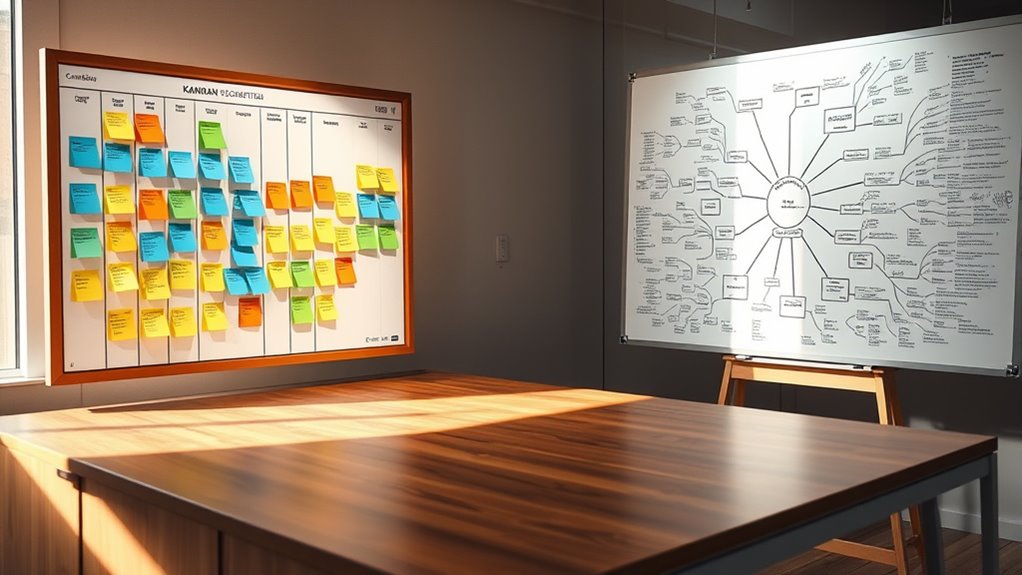

Visual goal mapping helps you turn your ambitions into clear, actionable plans using tools like Kanban boards and mind maps. With Kanban, you can break tasks into columns like “To Do,” “In Progress,” and “Done,” making it easy to prioritize and track progress. Mind maps help you explore ideas and organize sub-goals around a central objective, fostering strategic thinking. Keep exploring to discover how these tools can boost your focus and success.

Turn your quiet moments into listening time
- Thousands of audiobooks, podcasts and originals
- Listen on your phone, tablet or Echo — also offline
- Cancel anytime
Key Takeaways
- Kanban boards organize large goals into manageable tasks, illustrating progress with columns like “To Do,” “In Progress,” and “Completed.”
- Mind maps visually explore ideas, sub-goals, and connections around a central objective, aiding strategic planning and obstacle identification.
- Both tools enhance focus by providing clear visual frameworks, simplifying task prioritization, and tracking milestones effectively.
- Kanban promotes continuous updates for workload management, while mind maps foster creative exploration and holistic understanding.
- Using these visual tools transforms ambitions into actionable plans, reducing stress and boosting motivation through visual clarity.
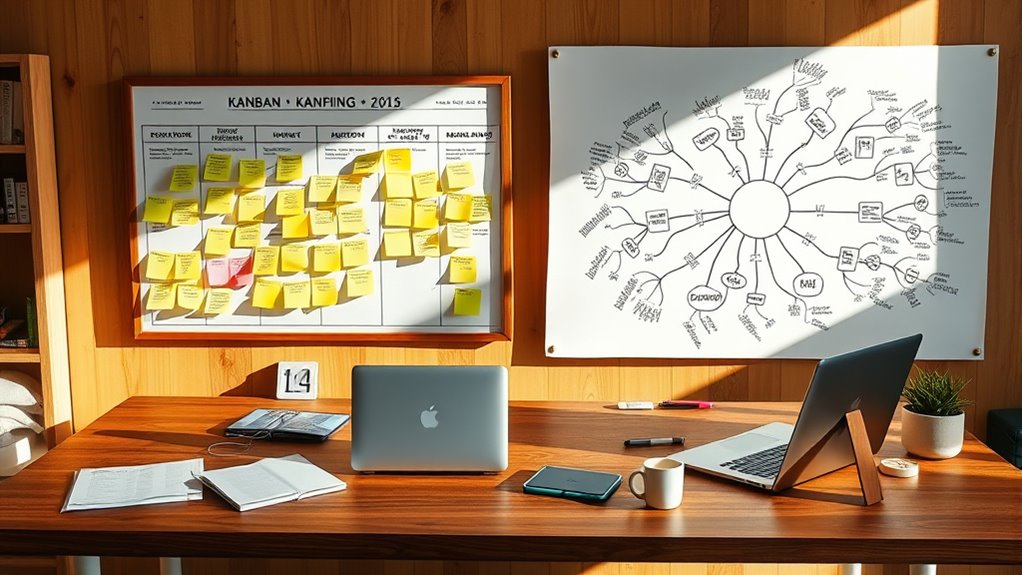
Visual goal mapping transforms your ambitions into clear, actionable images that make your objectives feel more tangible. When you leverage digital visualization tools like Kanban boards and mind maps, you create a visual framework that helps you understand and manage your goals more effectively. These tools aren’t just pretty diagrams; they’re strategic resources that sharpen your focus, streamline your efforts, and boost your motivation. Digital visualization allows you to see your progress at a glance, making complex goals feel less overwhelming and more manageable.
Goal prioritization becomes much easier when you use visual goal mapping. With a Kanban board, you can break down large objectives into smaller, manageable tasks and then organize them into columns such as “To Do,” “In Progress,” and “Completed.” This visual setup helps you identify what’s most urgent and important, so you can focus your energy on high-priority tasks first. It also provides a clear overview of your workload, preventing you from feeling scattered or overwhelmed. By constantly updating your Kanban board, you reinforce your focus on immediate next steps, ensuring that your efforts align with your long-term ambitions.
Mind maps take your goal visualization a step further by allowing you to map out ideas, sub-goals, and related tasks around a central objective. This technique taps into your creative side, helping you uncover connections and pathways you might not initially see. When you create a mind map, you give structure to your thoughts, making it easier to develop strategies and identify potential obstacles. This process encourages a holistic view of your goals, promoting better planning and more informed decision-making. Plus, because mind maps are highly visual and customizable, they keep you engaged and motivated to pursue your objectives.
Both Kanban boards and mind maps serve as powerful tools for maintaining momentum. They make it easier to track progress, adjust strategies, and celebrate milestones. Using digital visualization to keep your goals front and center enhances your ability to stay focused and motivated. As you get into the habit of regularly updating your visual goal maps, you’ll find it easier to prioritize tasks and allocate your time efficiently. This clarity not only reduces stress but also fuels your confidence, knowing exactly where you stand and what steps you need to take next.
In the end, visual goal mapping isn’t just about seeing your goals; it’s about actively engaging with them in a way that makes success more attainable. By harnessing digital visualization through tools like Kanban boards and mind maps, you transform abstract ambitions into concrete, achievable plans, empowering you to turn your dreams into reality. AI technology can further optimize your goal management process by providing intelligent insights and suggestions to improve your workflow.
As an affiliate, we earn on qualifying purchases.
Frequently Asked Questions
How Do I Choose Between Kanban and Mind Maps for My Goals?
You should choose based on your goal’s priority alignment and visual complexity. If you prefer a straightforward, process-oriented view to track tasks, go with a Kanban board. It’s excellent for managing workflow and maintaining focus. If your goals require a broader, more creative overview, mind maps offer visual complexity that helps you connect ideas. Consider how each method aligns with your goals’ priorities and complexity to make the best choice.
Can These Tools Be Integrated Into Existing Project Management Software?
Think of your project management software as a bustling city. You can weave Kanban boards and mind maps into this city by checking their software integration and tool compatibility. Many popular platforms support these tools through plugins or built-in features, allowing seamless collaboration. Before diving in, verify your chosen tools are compatible, so they work smoothly alongside your existing system, turning your goal-setting journey into a well-oiled machine.
What Are Common Mistakes to Avoid When Visualizing Goals?
When visualizing your goals, avoid overcomplicating visuals, which can make your plans confusing and hard to follow. Always ignore priorities at your peril, as it can lead to wasted effort and missed deadlines. Focus on clarity and simplicity, ensuring your visuals highlight what matters most. Keep your goals aligned with your priorities, and regularly review to stay on track. This approach keeps your visualization effective and actionable.
How Often Should I Update My Visual Goal Maps?
You should update your visual goal maps at least weekly to keep your motivation strategies fresh and reinforce habit formation. Regular updates help you stay aligned with your progress, identify obstacles, and adapt your plans. Consistency boosts your commitment and keeps your goals top of mind. Make it a habit to review and refresh your maps regularly, ensuring they remain motivating tools that guide your actions effectively.
Are There Best Practices for Collaborating With Others on These Tools?
You should establish best practices for collaboration by prioritizing clear team communication and customizing your tools to fit your group’s needs. Regularly update and share your Kanban boards or mind maps, encouraging feedback and discussion. Make sure everyone understands how to use the tools effectively, and adjust them as your project evolves. This approach fosters transparency, streamlines teamwork, and keeps everyone aligned toward common goals.
As an affiliate, we earn on qualifying purchases.
Conclusion
Think of your goals as a garden, waiting to bloom. With Kanban boards and mind maps, you hold the tools to plant seeds of intention, nurture growth, and watch your vision flourish. Each task is a ripple in a pond, spreading outward toward success. Embrace these visual maps as your compass—guiding you through the maze of priorities. Your journey of achievement begins with clarity, turning abstract dreams into a vibrant, blossoming reality.
As an affiliate, we earn on qualifying purchases.
As an affiliate, we earn on qualifying purchases.
Halloween Picks
halloween
As an affiliate, we earn on qualifying purchases.