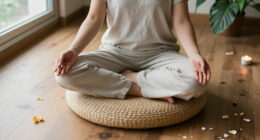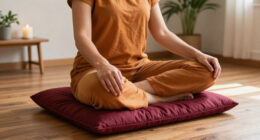
Choosing between a meditation cushion and a meditation mat is less about which one is universally more comfortable and more about what is limiting your practice. If your hips sit low, your back rounds, or your knees feel strained in a cross-legged position, a cushion is usually the more useful first purchase. If your seated posture already feels stable but the floor is hard, cold, or uncomfortable beneath your knees and ankles, a mat addresses that problem more directly.

Turn your quiet moments into listening time
- Thousands of audiobooks, podcasts and originals
- Listen on your phone, tablet or Echo — also offline
- Cancel anytime

hunnidspace Zafu and Zabuton Meditation Cushion Set, Buckwheat Hull and Memory Foam, Adjustable with Removable Velvet Covers, Nav…
- ✔ Set includes: Zafu cushion and Zabuton mat
- ✔ Fill: Buckwheat hulls and shredded memory foam
- ✔ Cover: Removable polyester velvet

Leewadee Meditation Cushion Set with Kapok-Filled Zafu and Roll-Up Zabuton Mat
- ✔ Set includes: Round Zafu cushion and square Zabuton mat
- ✔ Fill: 100% natural kapok fiber
- ✔ Cover: 100% polyester

Hihealer Traditional Tibetan Velvet Meditation Cushion
- ✔ Shape: Round
- ✔ Listed dimensions: 11 inches by 5 inches
- ✔ Cover: Removable velvet
The distinction matters because the products do different jobs. A cushion elevates the pelvis, which can make it easier to sit upright without holding the back rigid. A mat spreads padding across the floor, offering a softer surface beneath the body and a defined space for practice. Some practitioners use both, but buying both is not automatically necessary. The comparison below focuses on posture, comfort, versatility, portability, upkeep, and value so you can choose based on your body and routine rather than a matching set.
At a Glance
| Criteria | Meditation cushion | Meditation mat | Winner |
|---|---|---|---|
| Primary function | Elevates hips and supports seated meditation | Adds a padded layer between the body and floor | Depends |
| Seated posture support | Strong: raises the pelvis to help the spine sit upright | Limited: does not usually raise the hips enough to correct posture | A |
| Floor and knee cushioning | Limited: cushions the seat, not the whole floor | Strong: covers the floor beneath knees, ankles, or lying poses | B |
| Versatility | Best for seated practice; can support some floor positions | Useful for seated, kneeling, and reclined practice | B |
| Portability and storage | Usually compact, though shape and filling affect bulk | Often larger and harder to store than a single cushion | A |
| Care and durability | Removable covers are common; filling may need adjustment or airing | Cover and padding need cleaning and thorough drying | Depends |
| Value as a first purchase | Often the better first buy when posture is the problem | Better value when floor discomfort is the main barrier | Depends |
hunnidspace Zafu and Zabuton Meditation Cushion Set, Buckwheat Hull and Memory Foam, Adjustable with Removable Velvet Covers, Nav…
The hunnidspace Zafu and Zabuton set earns our top spot because it addresses both parts of floor sitting: elevation under the hips and padding beneath the legs. Its Zafu uses buckwheat hulls for a more shapeable seat, while the Zabuton’s shredded memory foam provides a softer surface under knees and ankles. Compared with the Leewadee’s consistently firm kapok fill, this combination gives buyers more choice in how cushioned the setup feels.Adjustability is the set’s clearest advantage. Both cushions have removable filling, so users can change height and firmness rather than having to accept the original feel. That is useful when a seat feels too high, too low, or too yielding, although adjusting fill takes some trial and care. The 32-by-32-inch listed footprint also calls for a dedicated floor area; it is not as compact as using the Hihealer cushion alone.The removable polyester velvet covers can be machine washed, with tumble drying on low specified, which makes routine upkeep more straightforward than with Leewadee’s spot-clean-only covers. Buyers should still follow those care directions rather than assume the whole cushions can be washed. This is the most flexible option for people building a regular home practice, but its square shape, two-piece design, and listed 3-inch thickness may not suit every posture or floor arrangement.
Pros:
- Pairs a buckwheat-filled Zafu with a softer shredded-memory-foam Zabuton for distinct support under hips and legs.
- Removable filling in both pieces allows adjustment to personal height and firmness preferences.
- Removable machine-washable covers simplify care compared with the spot-clean-only Leewadee set.
- Provides a complete two-piece meditation setup rather than a seat cushion alone.
Cons:
- The listed 32-by-32-inch footprint requires more floor space than a standalone cushion.
- Adjusting loose fill may take time, and the covers require the specified wash and low-heat drying care.
- The listed dimensions and 3-inch thickness may not match every user’s posture or cushioning preference.
Best for: Meditators who want a complete seat-and-mat setup and value the ability to adjust both cushion height and firmness.
Not ideal for: People with very limited floor space, anyone seeking a simple carry-and-roll set, or buyers who prefer a uniformly firm, traditional fill.
Bottom line: Choose hunnidspace when you want a full meditation setup with the greatest scope to tune seat height and cushioning.
“Choose hunnidspace when you want a full meditation setup with the greatest scope to tune seat height and cushioning.”
Leewadee Meditation Cushion Set with Kapok-Filled Zafu and Roll-Up Zabuton Mat
Where hunnidspace offers mixed fills and adjustable firmness, Leewadee keeps the feel straightforward: both the round Zafu and square Zabuton use natural kapok fiber. The firm seat is intended to support an upright posture, while the mat cushions knees and ankles from direct floor contact. That pairing makes this a more complete meditation setup than the Hihealer cushion, which supports the seat but does not include a mat.Portability is a particular strength. The Zabuton rolls up with an integrated tie, and the Zafu has a carry handle, giving the set a clearer transport-friendly design than the larger square hunnidspace arrangement. The listed Zabuton measures 28 by 28 inches, which is smaller than hunnidspace’s stated 32-by-32-inch footprint and may be easier to fit into a compact practice space. The tradeoff is that kapok is firm initially and may need a few sessions to break in; buyers seeking a softer, adjustable surface may prefer hunnidspace’s memory foam layer.Care is the main compromise. The polyester covers are not machine washable, and the instructions call for spot cleaning with a damp cloth followed by air drying. That is less convenient than the removable washable covers on both hunnidspace and Hihealer. Still, for someone who wants a traditional firm seat, a mat for lower-body contact, and a set that can be rolled and carried, Leewadee offers a distinct balance of support and portability.
Pros:
- Includes both a firm Zafu and a Zabuton that cushions knees and ankles.
- Roll-up mat with tie and cushion carry handle make the set easier to transport.
- Kapok fill is designed to support an upright seated posture.
- The listed 28-by-28-inch Zabuton is smaller than the hunnidspace set’s stated footprint.
Cons:
- Covers are not machine washable and require spot cleaning and air drying.
- The firm kapok fill may feel hard at first and can require a break-in period.
- Unlike hunnidspace, the fill is not described as removable for adjusting height or firmness.
Best for: Meditators who prefer firm kapok support and want a two-piece set that can be rolled up and carried between practice spaces.
Not ideal for: People who need machine-washable covers, want adjustable fill, or prefer a softer cushion from the start.
Bottom line: Leewadee is the better fit for a firm, traditional meditation set that prioritizes roll-up portability over adjustable softness and easy washing.
“Leewadee is the better fit for a firm, traditional meditation set that prioritizes roll-up portability over adjustable softness and easy washing.”
Hihealer Traditional Tibetan Velvet Meditation Cushion
The Hihealer round cushion is the most focused choice here: it provides an elevated seat, not a full floor-cushioning system. Its buckwheat hull filling is intended to offer stable support while allowing firmness to be adjusted, making it a more customizable standalone seat than Leewadee’s firm, fixed kapok setup. The removable velvet cover is machine washable, another practical advantage for a cushion used regularly on the floor.That compact role is also its central limitation. Unlike hunnidspace and Leewadee, Hihealer does not include a Zabuton to cushion knees and ankles. It is therefore better suited to buyers who already have a mat, sit in a way that does not require added lower-body padding, or want a smaller meditation footprint. The listed size is 11 inches by 5 inches; because those dimensions may not suit every body or posture, shoppers should check them carefully rather than assume the cushion will provide broad support.The product details also list a unit count of two, while describing a round cushion and giving one set of dimensions. That makes it especially important to verify the intended package contents before buying. Compared with the two-piece sets, this option has fewer components and simpler storage, but also less protection from the floor. Choose it for adjustable seating and washable care, not as a substitute for a full Zabuton set when knee or ankle cushioning is a priority.
Pros:
- Buckwheat hull fill offers stable support with adjustable firmness.
- Round cushion is a more compact alternative to the two full sets.
- Removable velvet cover is machine washable.
- Can serve for meditation, yoga, reading, and other floor seating.
Cons:
- Does not include a Zabuton mat for cushioning knees and ankles.
- The listed 11-by-5-inch dimensions may not suit every user or seating posture.
- The listed unit count of two is not clarified by the single cushion description and dimensions.
Best for: People who want a compact buckwheat meditation seat with adjustable support and a washable cover, especially if they already own a floor mat.
Not ideal for: Meditators who need cushioning under their knees and ankles, want a complete seat-and-mat set, or are unsure that the listed dimensions will fit them.
Bottom line: Pick Hihealer when you need an adjustable, washable seat cushion and do not need the full floor coverage offered by the two-piece sets.
“Pick Hihealer when you need an adjustable, washable seat cushion and do not need the full floor coverage offered by the two-piece sets.”
As an Amazon Associate we earn from qualifying purchases.
Key Differences
The cushion and mat solve different comfort problems. For a seated cross-legged practice, hip elevation is often the more consequential change: bringing the pelvis above the knees can reduce the effort needed to keep the torso upright. A mat may make the floor softer, but it generally will not provide the same lift. That makes the cushion the clearer choice when posture is the source of discomfort, especially if you find yourself slumping or shifting to escape pressure.
A mat wins when the contact surface itself is the issue. It can soften pressure under knees and ankles, give you a cleaner-feeling practice area, and provide padding for kneeling or reclining. Its broader coverage is useful, but it takes more room and may not help much if your hips need elevation. If both problems are present, a cushion on a mat can make sense; if only one is present, start with the item built for that job.
For most people buying one item specifically for seated meditation, a cushion is the stronger starting point because it changes the sitting position rather than only softening the floor. A mat is the better value when you already sit comfortably and need coverage or padding for floor-based practice. Neither label guarantees a good fit: height, firmness, shape, mat thickness, floor type, and your preferred posture all affect comfort.
Detailed Comparison
Primary function (major difference)
A cushion is designed to lift the hips and create a more supported seat. A mat covers the floor with a padded layer. The difference is substantial: they are not two versions of the same product, and one cannot reliably replace the other. For seated posture, the cushion wins; for general floor coverage, the mat wins. Choose according to the discomfort you want to solve rather than assuming more padding is always better.
Seated posture support (Meditation cushion wins — major)
The cushion wins by a major margin for many cross-legged sitters. Elevating the hips can help the knees angle downward and make an upright torso feel less forced. A flat mat offers a softer seat but usually adds too little height to change the relationship between hips and knees. A mat can still be comfortable for people who already sit upright without strain, but it is not a substitute for a supportive raised seat.
Floor and knee cushioning (Meditation mat wins — moderate)
The mat wins, particularly when knees, ankles, or the backs of the legs press against a hard floor. Its larger surface spreads padding beyond the sitting area, which a compact cushion cannot do. The gap is moderate to major depending on posture: someone seated on a chair may need little floor padding, while someone kneeling or changing positions may benefit from a mat. Very thin mats may offer only modest relief, so thickness and firmness matter.
Versatility across postures (Meditation mat wins — moderate)
The mat has a moderate advantage for practices that include kneeling, lying down, stretching, or changing position. A cushion can support seated meditation and some kneeling postures, but its small footprint limits what it can cushion. For a session consisting almost entirely of seated meditation, the cushion’s narrower role is not a meaningful drawback. The mat is the more flexible single surface; the cushion is the more targeted seated tool.
Portability and storage (Meditation cushion wins — moderate)
The cushion usually wins by a moderate margin because it occupies less floor space and is easy to keep beside a chair or in a meditation corner. Some cushions are bulky or heavy, so portability varies by design and filling. A mat’s larger surface may roll or fold, but it still needs somewhere to go and can be awkward to carry. If you practice in several locations or have little storage, check actual dimensions and weight before choosing either.
Care and durability (minor difference)
There is no universal winner. Cushions with removable covers can be straightforward to clean, though their filling may compress, shift, or need airing over time. Mats can often be wiped down, but padding and fabric need to dry fully to avoid retaining moisture or odors. Material and construction matter more than the category: inspect whether the cover comes off, what cleaning the maker permits, and whether the filling or padding can be replaced.
Value as a first purchase (major difference)
The winner depends on what is stopping you from sitting comfortably. If your hips, knees, or back struggle in a seated position, the cushion is usually the better first purchase because it addresses posture directly. If posture is already comfortable and the hard floor bothers you, a mat gives more useful coverage. Spending more on a premium design is worthwhile only when its height, firmness, materials, or construction solve a clear need; extra cost alone does not make either option more supportive.
Meditation cushion: Pros and Cons
Pros:
- Raises the hips to support a more upright seated position
- Compact footprint suits small practice spaces
- A targeted option for cross-legged meditation
Cons:
- Does not cushion a broad area of floor
- May not suit every body, sitting style, or preferred firmness
- Filling and height can affect comfort and may require adjustment
Meditation mat: Pros and Cons
Pros:
- Pads a larger area beneath knees, ankles, and the body
- Works for seated, kneeling, and reclined floor practice
- Creates a defined, softer practice surface
Cons:
- Usually offers little hip elevation for posture support
- Takes more space to store and transport
- A thin or soft mat may not relieve pressure as much as expected
Who Should Choose What
Choose Meditation cushion if:
- You sit cross-legged and tend to round your back or struggle to keep your torso upright.
- Your hips feel low or your knees feel uncomfortable in seated meditation.
- You want one compact item for a mostly seated practice.
Choose Meditation mat if:
- Your seated posture is already comfortable, but a hard or cold floor distracts you.
- Your practice includes kneeling, stretching, or lying down as well as sitting.
- You want padding over a wider area rather than elevation under the pelvis.
Skip both if: If floor sitting consistently causes pain or instability, do not assume either product will solve it. Try a chair or another supported posture, and seek qualified medical advice for persistent pain.
Value for Money
Price matters less than buying the right kind of support. A well-matched, modestly priced cushion can be better value than an expensive mat if posture is your main obstacle; a mat is a better use of money if you already sit comfortably and need padding across the floor. Pay more only for a specific benefit you need, such as a removable washable cover, durable materials, adjustable filling, or a useful thickness. A premium design that does not fit your height or posture is poor value regardless of its finish.
Buying both is reasonable when you need both hip elevation and floor cushioning, but it is not the default recommendation. Start with the item that addresses the strongest source of discomfort. Add the other only if a separate problem remains after using the first.
Final Verdict
For most people choosing a single aid for seated meditation, start with a cushion. It is the more direct answer to poor seated alignment and offers a compact, purpose-built seat. Choose a mat instead if your posture is already stable and the floor’s hardness, coldness, or pressure beneath your knees is what interrupts practice. The biggest deciding factor is whether you need your hips raised or a wider area padded. If you need both, pair them; if neither supports comfortable floor sitting, use a chair rather than forcing the posture.
Frequently Asked Questions
Do I need both a meditation cushion and a mat?
No. Buy both only if you need both elevation beneath your hips and padding beneath the rest of your body. For a comfortable seated position on a hard floor, a mat alone may be enough; for posture support, a cushion alone may be enough.
Can a meditation mat replace a cushion?
Usually not when the goal is to raise the hips. A mat can make the floor softer, but it generally does not lift the pelvis as much as a cushion. If you sit upright comfortably without extra elevation, the mat may be all you need.
Which is better for beginners?
For beginners who plan to sit cross-legged, a cushion is often the more helpful starting point because it can make an upright posture easier to maintain. If you already sit comfortably but feel pressure from the floor, choose a mat. A chair is also a valid option if floor sitting is uncomfortable.
How thick should a meditation mat be?
There is no single right thickness. More padding can help on a hard floor, but a very soft or thick surface may feel unstable for some seated positions. Consider where pressure occurs, how firm you want the floor to feel, and whether you need the mat for kneeling or lying down.