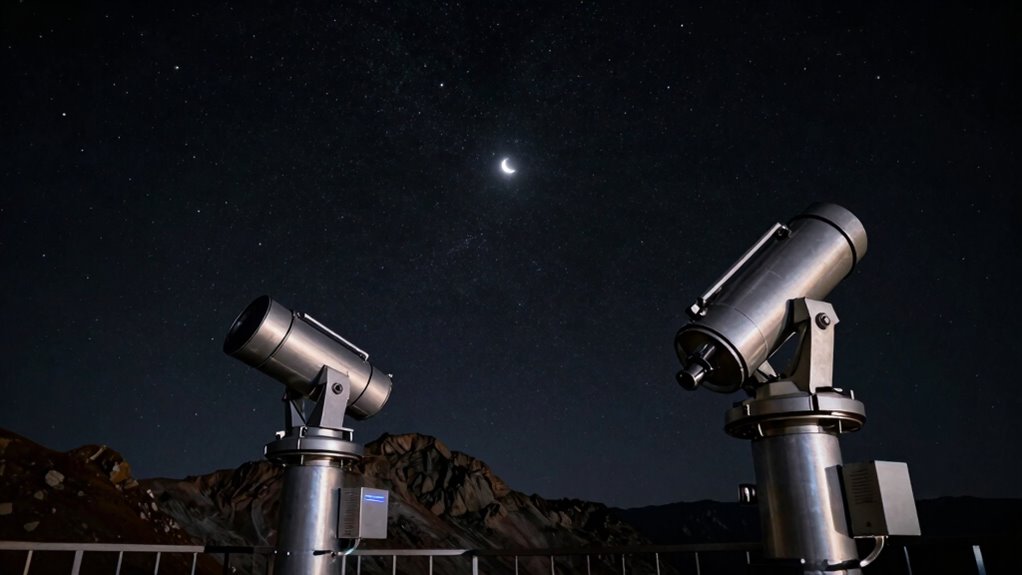

Using a telescope can create a powerful sense of awe as you witness stunning cosmic wonders like nebulae, star clusters, and distant galaxies. This awe sparks your curiosity, motivating you to explore the universe’s vastness and complexity. Seeing celestial objects originate from ancient processes deepens your appreciation and invites questions about cosmic origins. If you keep exploring, you’ll discover how this sense of wonder fuels your desire to learn and connect with the universe’s mysteries.

Turn your quiet moments into listening time
- Thousands of audiobooks, podcasts and originals
- Listen on your phone, tablet or Echo — also offline
- Cancel anytime
Key Takeaways
- Telescopes evoke awe by revealing stunning cosmic phenomena, inspiring curiosity and a desire to explore the universe’s mysteries.
- Observing celestial objects through telescopes deepens appreciation for cosmic origins, motivating further learning and scientific inquiry.
- The awe experienced fosters a primal drive to understand galaxy formation, star life cycles, and the universe’s vast scale.
- Telescopic exploration connects individuals to the universe’s ongoing story, fueling passion for space exploration and research.
- Witnessing cosmic wonders through telescopes transforms curiosity into motivation for skills development and community involvement.
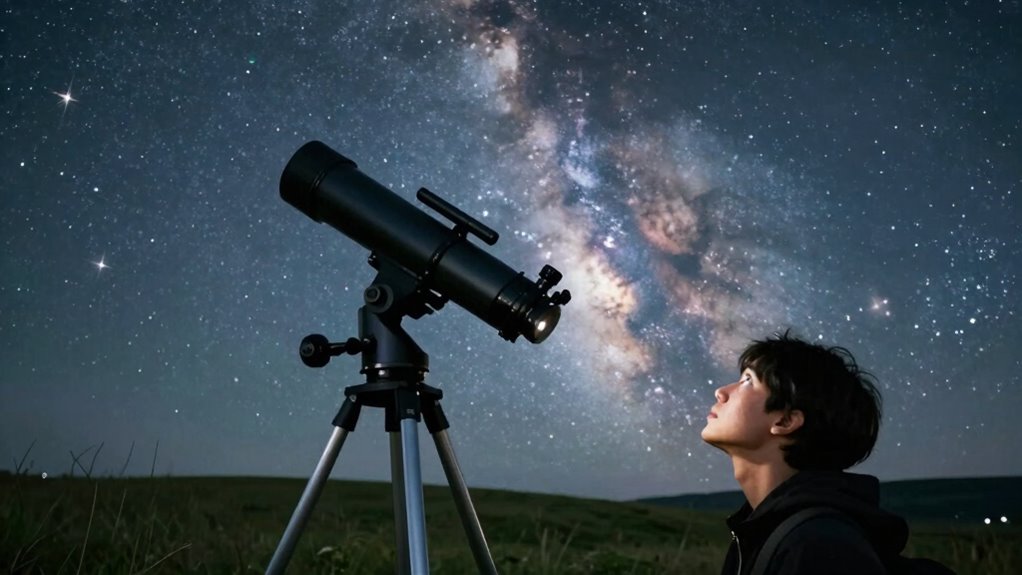
When you look through a telescope, you’re not just seeing distant stars and planets—you’re experiencing a moment of awe that connects you to the vast universe. It’s a feeling that sparks curiosity and fuels your desire to explore the unknown. As you peer into the night sky, you witness galactic wonders—bright nebulae, shimmering star clusters, and swirling galaxies—that remind you of the universe’s incredible scale and complexity. These sights aren’t just beautiful; they’re a source of cosmic inspiration that pushes you to learn more, to understand your place among the stars.
Looking through a telescope ignites awe, inspiring curiosity and a deeper connection to the universe’s vast, wondrous mysteries.
The more you observe, the more you realize that each celestial object has a story—an origin rooted in cosmic processes billions of years old. This understanding deepens your appreciation for the universe’s grandeur. It’s easy to feel small in the face of such vastness, but that feeling often turns into motivation. You’re inspired to ask questions, to seek answers, and to contribute to the ongoing story of discovery. Every glimpse through your telescope becomes a reminder that the universe is still full of secrets waiting to be uncovered, and you’re part of that ongoing quest.
Galactic wonders stir something primal within you—an innate drive to explore and understand. When you see a distant galaxy or a faint nebula, you’re witnessing the beauty of cosmic evolution, the birth and death of stars, and the interconnectedness of all matter in the universe. These sights serve as a catalyst for creative thinking and scientific inquiry. They challenge you to look beyond everyday life and imagine what lies beyond the horizon of current knowledge. This sense of cosmic inspiration can be transformative, fostering a sense of purpose and a desire to contribute to humanity’s understanding of the cosmos.
Your fascination with celestial phenomena isn’t limited to passive observation. It motivates you to learn more about astronomy, astrophysics, and space exploration. The awe you feel from viewing galactic wonders encourages you to pursue new skills, to join communities of fellow stargazers, or even to support scientific research. Understanding the cosmic processes behind these phenomena can deepen your appreciation and fuel your ongoing fascination. You may also become more aware of the universe’s origins, which can strengthen your sense of connection to the cosmos. Additionally, learning about the expansion of the universe can help you appreciate how cosmic phenomena evolve over time and influence our understanding of space. The more you understand about the universe’s origins, the more profound your sense of connection becomes with the universe’s ongoing story. Recognizing the scale and complexity of cosmic structures can inspire a greater sense of wonder and curiosity. Ultimately, the telescope becomes more than a tool—it’s a bridge that connects your curiosity with the universe’s mysteries, inspiring you to keep looking upward, seeking answers, and embracing the endless possibilities of cosmic discovery.
beginners astronomical telescope
As an affiliate, we earn on qualifying purchases.
As an affiliate, we earn on qualifying purchases.
Frequently Asked Questions
How Do Different Types of Telescopes Compare in Performance?
Different types of telescopes, like refractors, reflectors, and compound models, vary in performance based on optical clarity and mount stability. Refractors offer sharp images and excellent optical clarity, making them ideal for detailed viewing. Reflectors provide larger apertures at lower costs, but require sturdy mounts for stability. Compound telescopes combine features, offering good optical clarity and balanced mount stability, suited for versatile observations. Your choice depends on your specific needs and budget.
What Are the Latest Technological Advancements in Telescope Design?
Think of modern telescopes as precision instruments sharpening their vision. Recent advancements include innovative optical coatings that enhance light transmission and reduce glare, making images clearer. Adaptive optics technology actively adjusts for atmospheric distortion, giving you a steadier, more detailed view of distant objects. These innovations drastically improve performance, allowing you to explore the universe with unprecedented clarity and depth, pushing the boundaries of what you can observe and understand.
How Can Amateurs Contribute to Astronomical Discoveries?
You can contribute to astronomical discoveries by engaging in amateur astrophotography, capturing detailed images of celestial objects that can help scientists analyze phenomena. Participating in stargazing community events allows you to share observations, report transient events like supernovae, and collaborate with professionals. Your dedication and observations, combined with modern equipment, can provide valuable data, advancing research and inspiring others in the astronomical community.
What Is the History Behind Some of the Most Famous Telescopes?
Ever wonder how iconic observatories shaped our view of the universe? You should know that historical milestones like Galileo’s early telescope revolutionized astronomy. The Hubble Space Telescope, launched in 1990, pushed boundaries further, revealing distant galaxies. These observatories, from Mount Wilson to Mauna Kea, represent technological leaps. Their histories are intertwined with discovery, inspiring awe and fueling your curiosity to explore the cosmos even more deeply.
How Does Viewing Distant Galaxies Impact Our Understanding of the Universe?
Viewing distant galaxies deepens your understanding of galactic evolution and cosmic phenomena. As you observe these far-off objects, you witness how galaxies form, grow, and change over time, revealing the universe’s dynamic nature. This perspective helps you grasp the vast scales and complex processes shaping the cosmos. By exploring distant galaxies, you gain insight into the origins of the universe and the forces driving its ongoing evolution.
high magnification telescope for stargazing
As an affiliate, we earn on qualifying purchases.
As an affiliate, we earn on qualifying purchases.
Conclusion
Just like a lighthouse guiding ships through darkness, telescopes pierce the night sky, revealing wonders that stir your soul. They’re not just tools; they’re gateways to awe, illuminating your curiosity and fueling your desire to explore. Remember, every glimpse through a telescope is like catching a whisper from the universe—an invitation to dream bigger. Embrace this journey of discovery, and let the stars remind you that the universe’s vastness is a mirror for your limitless potential.
celestial object viewing telescope
As an affiliate, we earn on qualifying purchases.
As an affiliate, we earn on qualifying purchases.
As an affiliate, we earn on qualifying purchases.
Halloween Picks
halloween
As an affiliate, we earn on qualifying purchases.