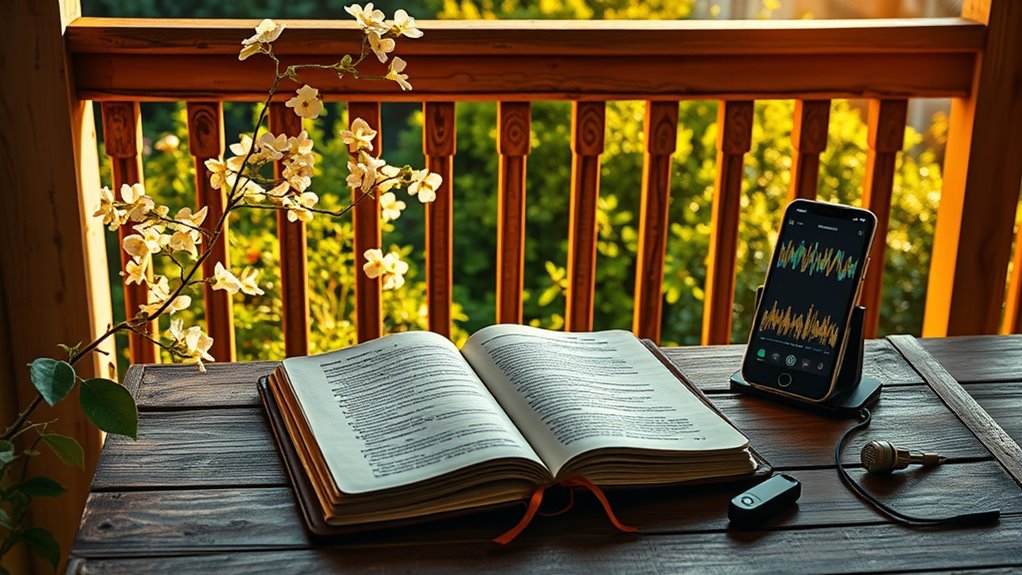

Using multimodal journaling allows you to combine text, images, and audio to create a more expressive and engaging record of your experiences. You can include photos and doodles to capture moments visually, while audio recordings preserve voices, sounds, and moods that words alone can’t convey. This approach helps deepen your self-understanding and emotional connection. Keep exploring this method to discover even more ways it can enrich your personal storytelling.

Turn your quiet moments into listening time
- Thousands of audiobooks, podcasts and originals
- Listen on your phone, tablet or Echo — also offline
- Cancel anytime
Key Takeaways
- Integrate text, images, and audio to create dynamic, storytelling journal entries that capture multiple facets of experiences.
- Use photographs and doodles to visually contextualize moments, enhancing emotional depth alongside written reflections.
- Record voice notes or ambient sounds to preserve tone, mood, and energy, making entries more authentic and vivid.
- Combine media to deepen self-awareness, foster creative expression, and facilitate emotional understanding through multimodal engagement.
- Utilize digital tools that support seamless integration of text, images, and audio for richer, more compelling personal documentation.

In today’s digital age, using multimodal journaling offers a dynamic way to capture your thoughts and experiences. Instead of sticking to just words on a page, you can blend text, audio, and images to create a richer, more engaging record of your life. This approach transforms traditional journaling into a form of digital storytelling, allowing you to tell your story in a way that resonates more deeply. When you incorporate different modes of expression, you give yourself new avenues for emotional expression, helping you process feelings that might be difficult to put into words alone.
By integrating images, you can visually capture moments that words might not fully convey. A photograph of a sunset, a doodle created during a moment of reflection, or a screenshot of a meaningful conversation all add layers of context and emotion to your journal. These visuals don’t just serve as decorations; they become central to your storytelling, enriching your narrative and making it more memorable. When paired with text, images help you tell a more complete story—highlighting details, moods, and reactions that might otherwise be overlooked.
Adding audio elements takes this process even further. Whether it’s recording your voice describing a recent experience or capturing ambient sounds from a special place, audio enables you to preserve the tone, mood, and energy of a moment. Listening back to these recordings can evoke feelings more vividly than written words alone. It’s especially powerful for emotional expression, as your tone of voice, pauses, and intonations reveal nuances that words may miss. This makes your journal a more authentic reflection of your inner world.
Digital storytelling through multimodal journaling isn’t just about creating a beautiful record; it’s also a tool for self-discovery. When you combine different media forms, you engage multiple senses and cognitive pathways, which can deepen your understanding of your experiences. It encourages you to think creatively about how you communicate and how different modes can complement each other. As a result, your journaling becomes more than a mere habit—it becomes an expressive practice that helps you process emotions, celebrate moments, and reflect on your personal growth.
In essence, multimodal journaling empowers you to craft a more nuanced and vibrant narrative of your life. It allows you to document your journey in ways that are authentic, emotionally rich, and uniquely yours. By blending text, images, and audio, you create a compelling digital story that captures the complexity of your experiences and feelings, making your journaling both meaningful and memorable. Additionally, passive voice detection can help you refine your writing style, ensuring your narrative remains clear and engaging.
As an affiliate, we earn on qualifying purchases.
Frequently Asked Questions
How Do I Start With Multimodal Journaling if I’M a Beginner?
Start by exploring simple creative prompts to spark your ideas, like describing your day with a photo, recording a quick audio reflection, or writing a few sentences. Incorporate multimodal elements into your journaling routines gradually — maybe once a week to begin. Focus on expressing yourself freely, combining text, images, and sounds to make your journal more engaging. Over time, you’ll find what works best for your creative flow.
What Tools Are Best for Integrating Audio and Images Into Journals?
Did you know that 65% of people find visual and audio elements boost their memory? For integrating audio and images, try tools like Canva for easy image embedding and Anchor or Voice Memos for audio integration. These platforms make it simple to add multimedia to your journal, enhancing your reflections. You’ll enjoy a richer, more engaging journaling experience that combines text, audio, and images seamlessly.
Can Multimodal Journaling Help Improve Memory Retention?
Yes, multimodal journaling can considerably improve your memory retention by boosting sensory engagement and promoting memory enhancement. When you combine text, audio, and images, you activate multiple senses, making it easier for your brain to encode and retrieve information. This multisensory experience creates stronger neural connections, helping you remember details better. So, incorporate diverse media into your journaling to enhance your overall memory and learning process.
How Often Should I Update or Review My Multimodal Journal?
You should review your multimodal journal at least once a week to maximize benefits. Studies show that consistent review intervals boost memory retention by up to 80%. To stay effective, maintain regular frequency consistency and set specific times for updates. This habit helps reinforce your learning, guarantees your entries stay relevant, and keeps your motivation high. Make reviewing a weekly routine, and you’ll see better long-term recall and personal growth.
Are There Privacy Concerns With Digital Multimodal Journaling?
Yes, there are privacy concerns with digital multimodal journaling. You should prioritize data security by choosing platforms with strong encryption and secure storage. Always read privacy policies carefully to understand how your data is used and protected. Be cautious about sharing sensitive information and consider backing up your journal offline. Taking these steps helps make sure your entries stay private and your personal data remains protected.
audio recording device for journaling
As an affiliate, we earn on qualifying purchases.
As an affiliate, we earn on qualifying purchases.
Conclusion
By blending text, audio, and images, you create a vibrant tapestry of your memories, like a colorful mosaic that captures every whisper of emotion and flicker of detail. This multimodal approach turns your journal into a living canvas, where each element adds depth and dimension. As you revisit your entries, it’s like walking through a gallery of your own life—rich, immersive, and forever alive, reminding you that your story is as vivid as you choose to make it.
As an affiliate, we earn on qualifying purchases.
As an affiliate, we earn on qualifying purchases.
Halloween Picks
halloween
As an affiliate, we earn on qualifying purchases.