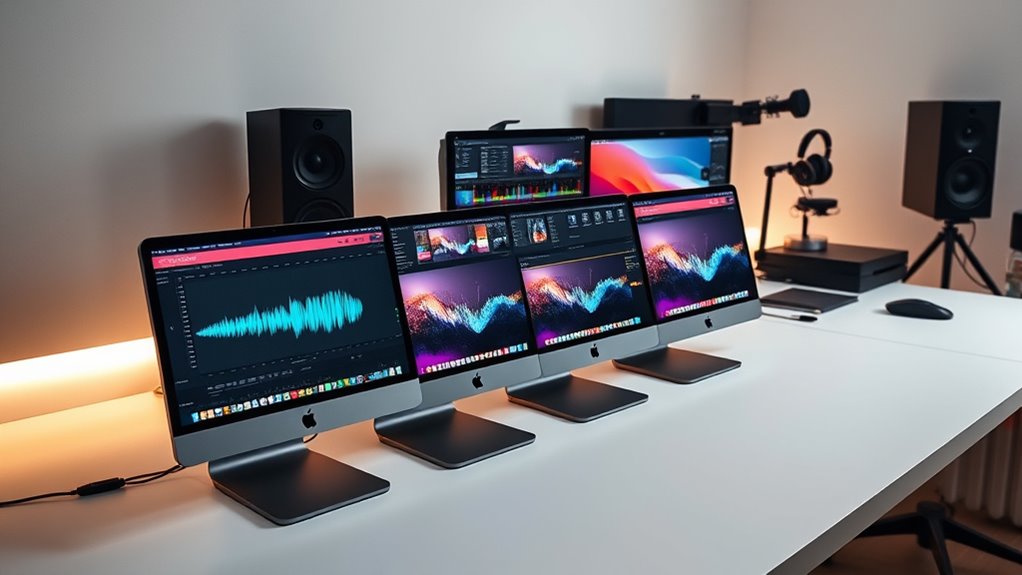

Choosing the right Mac for video editing in 2026 involves balancing performance, portability, and budget. The Apple MacBook Pro 2023 with M2 Max stands out for its portability and high-end display, making it ideal for editors on the go. Meanwhile, the Mac Studio with M5 Max offers desktop-level power and expandability, perfect for intensive workflows. Both deliver exceptional performance, but their tradeoffs—such as price and upgradeability—are key to consider.

Turn your quiet moments into listening time
- Thousands of audiobooks, podcasts and originals
- Listen on your phone, tablet or Echo — also offline
- Cancel anytime
Key Takeaways
- The MacBook Pro 2023 is best for editors needing portability with high-performance display features.
- The Mac Studio with M5 Max excels in raw power and multiple display support, suited for heavy-duty editing tasks.
- Price and upgrade options vary significantly, influencing long-term value and flexibility.
- Connectivity and expandability are more versatile on the Mac Studio, while the MacBook Pro offers all-in-one convenience.
- Both options are premium investments, but choosing depends on your workflow and mobility needs.
| Apple MacBook Pro 2023 with M2 Max Chip (16-inch, 32GB RAM, 1TB SSD) – Silver (Renewed) |  | Best Portable Powerhouse for Video Editing | Processor: M2 Max 12-Core | RAM: 32GB Unified | Storage: 1TB SSD | VIEW ON AMAZON | See Our Full Breakdown |
| Apple 2026 Mac Studio Desktop Computer with M5 Max Chip |  | Best for Desktop-Grade Power and Expandability | Processor: M5 Max chip | Memory: Up to 128GB | Storage: Up to 2x faster, bandwidth up to 614GB/s | VIEW ON AMAZON | See Our Full Breakdown |
| mac studio for video editing | Processor | Storage | RAM | Display |
|---|---|---|---|---|
| Apple MacBook Pro 2023 with M2 | M2 Max 12-Core | 1TB SSD | 32GB Unified | 16.2-inch Liquid Retina XDR |
| Apple 2026 Mac Studio Desktop | M5 Max chip | Up to 2x faster, bandwidth up to 614GB/s | — | — |
More Details on Our Top Picks
Apple MacBook Pro 2023 with M2 Max Chip (16-inch, 32GB RAM, 1TB SSD) – Silver (Renewed)
This model stands out for its combination of high-end performance and mobility. The M2 Max chip with 12 cores and 38 GPU cores ensures smooth editing of 4K and higher-resolution footage, rivaling desktop setups in raw power. Its 16.2-inch Liquid Retina XDR display provides exceptional color accuracy and HDR support, critical for professional color grading. Compared with the Mac Studio, its lower port count and battery reliance may limit sustained multi-tasking, but its portability is unmatched. The renewed condition makes it a more affordable choice, though durability might vary.
Pros:- Powerful M2 Max chip handles demanding editing tasks
- Exceptional 16.2-inch HDR display for color accuracy
- Long battery life supports all-day editing
- Multiple connectivity options including HDMI and SDXC
Cons:- Premium price, even as renewed
- Relatively heavy for portability
- Renewed condition may affect longevity
Best for: Video editors who need a powerful, portable device for on-the-go editing and color grading
Not ideal for: Users requiring maximum expandability or multi-monitor setups in a fixed workspace
- Processor:M2 Max 12-Core
- RAM:32GB Unified
- Storage:1TB SSD
- Display:16.2-inch Liquid Retina XDR
- GPU Cores:38
- Battery Life:Up to 22 hours
Our verdict“A top choice for mobile professionals who want high-end performance in a sleek, portable package.”
Apple 2026 Mac Studio Desktop Computer with M5 Max Chip
The Mac Studio with M5 Max chip delivers desktop-level performance tailored for professional video editing. Its processing power, supported by the M5 Max’s architecture, outperforms many portable options, especially for large projects involving 4K or higher resolutions. The ability to support multiple external displays and the fastest data transfer speeds makes it ideal for power users. While it lacks portability, its compact size and quiet thermal design make it a versatile workspace centerpiece. Its high price and limited upgradeability are tradeoffs that may matter to some.
Pros:- Exceptional processing with M5 Max chip
- Supports multiple external displays and fast data transfer
- Compact, quiet, and efficient thermal design
- High memory capacity up to 128GB
Cons:- High price point can be prohibitive
- Limited upgrade options due to integrated components
- Requires external peripherals for display and input
Best for: Professional editors working primarily at a desk who need maximum processing power and multi-display support
Not ideal for: On-the-go editors or those with tight budgets seeking portable solutions
- Processor:M5 Max chip
- Memory:Up to 128GB
- Storage:Up to 2x faster, bandwidth up to 614GB/s
- Ports:4 Thunderbolt 5, 2 USB-C, 2 USB-A, HDMI, SDXC
- Wireless:Wi-Fi 7, Bluetooth 6
- Dimensions:7.7-inch square
Our verdict“The ultimate desktop powerhouse for serious video editors who prioritize performance over portability.”
How We Picked
Our selection process focused on performance benchmarks relevant to video editing, including CPU and GPU power, memory capacity, and storage speed. We compared models based on their suitability for demanding editing workflows, considering factors like display quality, connectivity options, portability, and upgradeability. Cost was also factored in to ensure recommendations provide value for different user needs. The goal was to highlight options that excel either in portability or raw processing power, rather than general-purpose computers.
| mac studio for video editing | Processor |
|---|---|
| Apple MacBook Pro 2023 with M2 | M2 Max 12-Core |
| Apple 2026 Mac Studio Desktop | M5 Max chip |
Factors to Consider When Choosing Mac Studio For Video Editing
When selecting a Mac for video editing in 2026, consider your workflow needs—whether you prioritize portability or raw power. The core specs to evaluate include CPU and GPU performance, RAM capacity, storage bandwidth, and connectivity options. Think about your typical projects: large 4K or higher-resolution footage demands the best processing and memory. Additionally, weigh the importance of display quality, expandability, and budget constraints. Here’s how to match each product to your editing style.
Performance and Power
For demanding video editing tasks, both CPU and GPU matter. The MacBook Pro’s M2 Max offers impressive mobile performance, suitable for most professional workflows, but the Mac Studio’s M5 Max chip is geared toward intensive editing and rendering workloads. If you work with complex projects frequently, the desktop’s higher processing capacity provides a clear advantage. However, if you need to work on location or travel often, the portability of the MacBook may outweigh raw power.
Display and Connectivity
The MacBook Pro’s Liquid Retina XDR display delivers excellent color accuracy and HDR support, essential for color grading and detailed editing. Its connectivity options are robust for a portable device, including HDMI and SDXC slots. The Mac Studio, on the other hand, relies on external displays but supports multiple monitors with high bandwidth, making it ideal for multi-screen workflows. Connectivity on the desktop is more flexible, but you’ll need external peripherals for input and display.
Portability vs. Upgradeability
Portability is a key factor for many video editors, making the MacBook Pro the better choice if you need to edit on the move. Its built-in display and battery support mobility, although it comes with a weight tradeoff. Conversely, the Mac Studio sacrifices portability for a more customizable, upgradeable experience—though note that internal components are mostly non-upgradable. Budget considerations also play a role, as the desktop tends to be more expensive but offers greater long-term performance and expandability.
Frequently Asked Questions
Is the MacBook Pro with M2 Max suitable for 4K video editing?
Yes, the MacBook Pro with M2 Max is highly capable of handling 4K video editing thanks to its powerful CPU and GPU cores, along with a high-quality display that supports HDR. It manages complex timelines and effects smoothly, making it a reliable choice for mobile editors or those who need to work away from their desk. However, for extremely large projects or multi-camera editing, a desktop might still offer better performance margins.
Can the Mac Studio support multiple external displays?
Absolutely, the Mac Studio with M5 Max can support multiple external displays—up to four 6K monitors—making it ideal for multi-tasking and complex editing setups. This flexibility is especially beneficial for professional workflows that require extensive screen real estate. Keep in mind, you’ll need compatible cables and possibly external adapters depending on your monitor configurations.
How does storage speed impact video editing performance?
Faster storage bandwidth, like the up to 614GB/s bandwidth supported by the Mac Studio, reduces load times and accelerates rendering, especially when working with large 4K or higher-resolution files. For portable options like the MacBook Pro, a high-quality SSD ensures quick access to project files, but desktop solutions generally provide superior speed, which can significantly cut down editing and exporting times.
Which Mac is better for someone who moves between different editing sites?
The MacBook Pro with M2 Max is clearly better suited for editors who need mobility, offering a built-in display, long battery life, and all-in-one design. It allows editing in various locations without sacrificing too much power. The Mac Studio, while more powerful, is designed for a fixed workspace and would require external peripherals, making it less practical for frequent site changes.
Are these Macs future-proof for upcoming video editing demands?
Both models are equipped with cutting-edge Apple silicon chips and high-performance specs that should serve well for several years. The Mac Studio’s higher expandability and memory capacity give it an edge for future-proofing, especially as software demands increase. However, the MacBook Pro’s portability and integrated features make it a practical choice for evolving workflows, provided it meets your current needs.
Conclusion
For professionals who prioritize mobility and high-quality display features, the MacBook Pro with M2 Max offers an excellent balance of power and portability. It’s ideal for editors who work in multiple locations or need a compact yet capable device. Conversely, the Mac Studio with M5 Max is better suited for those with a dedicated workspace who require maximum processing power, multiple display support, and long-term expandability. Budget and workflow flexibility will ultimately guide which option fits best.
Halloween Picks
halloween
As an affiliate, we earn on qualifying purchases.