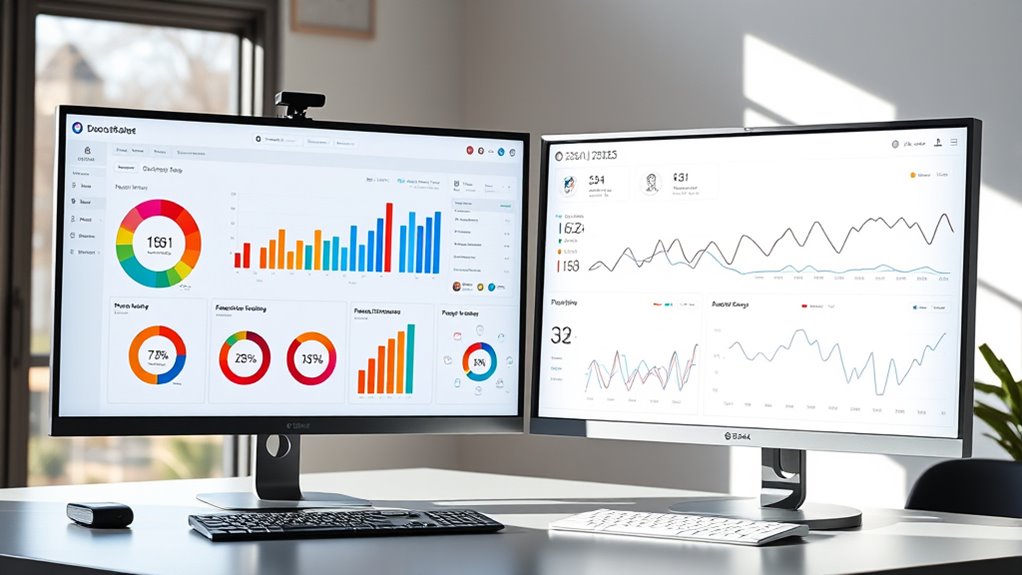

If you’re looking to track your success in 2025, I recommend focusing on dashboards that balance excellent design with practical features. The best personal KPI dashboards prioritize clear visualizations, customizable metrics, and seamless data integration while safeguarding your privacy and security. They should be easy to use across devices and support real-time updates. Keep these factors in mind, and you’ll find the perfect tools to monitor your progress — and there’s more to discover if you keep exploring.
Key Takeaways
- Choose dashboards that focus on relevant, measurable, and actionable KPIs aligned with personal goals.
- Prioritize designs emphasizing clarity, minimal clutter, and effective visual storytelling for better insight.
- Ensure seamless data integration from sources like CSV, Excel, or SQL with robust security measures.
- Select dashboards with intuitive interfaces, customizable features, and responsiveness across devices.
- Maintain data privacy through encryption, access controls, and transparent privacy policies to build user trust.
The Big Book of Dashboards
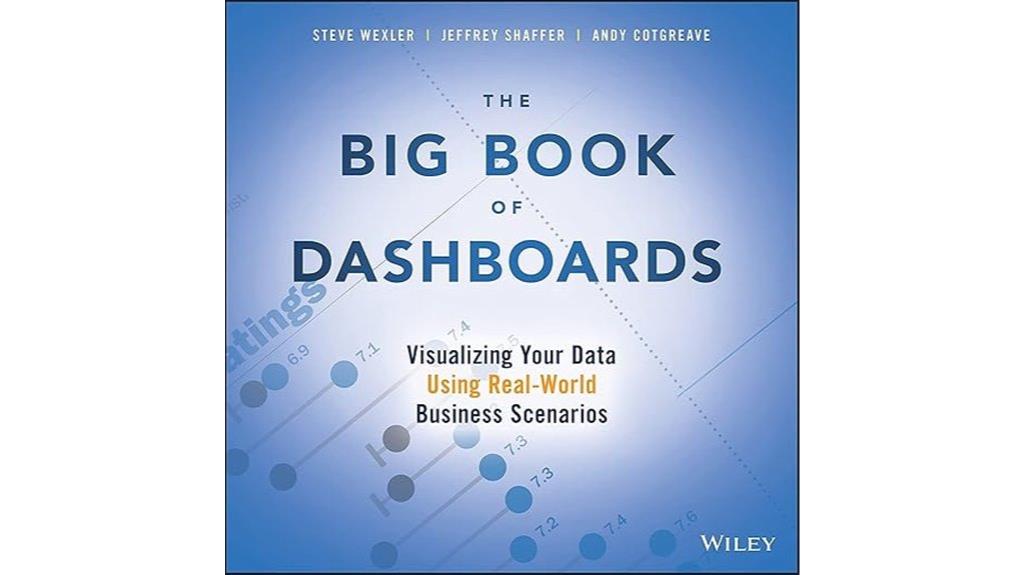
If you’re an experienced Tableau user looking to sharpen your dashboard design skills, “The Big Book of Dashboards” is an ideal resource. It offers practical insights on creating clear, impactful visualizations, emphasizing storytelling over technical steps. I’ve found its real-world examples—from hospital dashboards to sports metrics—particularly helpful. The book stresses balancing aesthetics with usability, teaching how to avoid clutter and choose effective color schemes. While it doesn’t provide detailed tutorials, its focus on design principles and best practices has profoundly improved my dashboards. It’s a repeatable reference that helps me craft visuals that communicate complex data effortlessly.
Best For: experienced Tableau users seeking to enhance their dashboard design skills through practical insights and real-world examples.
Pros:
- Provides actionable design principles that improve visual storytelling and data clarity.
- Features diverse, real-world dashboard examples across various industries to inspire customization.
- Emphasizes balancing aesthetics with usability, helping users create engaging and effective visuals.
Cons:
- Lacks step-by-step tutorials or detailed technical instructions for creating specific visuals.
- Some layout issues and references to unseen screenshots may hinder comprehension.
- May be challenging for beginners without prior Tableau experience or foundational visualization skills.
Measuring Success: A Practical Guide to KPIs

KPI dashboards are an ideal tool for professionals seeking a clear, real-time view of performance metrics without getting lost in complex data. To make sense of these metrics, I turn to “Measuring Success: A Practical Guide to KPIs,” which offers a straightforward approach that’s easy to grasp. It emphasizes practical application, with actionable insights that I can implement immediately. The book’s logical structure—covering mission, strategy, goals, and improvement—helps me set realistic targets and track progress effectively. Its accessible style makes it suitable for both beginners and seasoned professionals, ensuring I stay focused on what truly matters for success.
Best For: professionals and managers seeking a practical, easy-to-understand guide to measuring success through KPIs and performance metrics.
Pros:
- Clear, logical structure that simplifies understanding of performance management concepts
- Practical application with actionable insights suitable for immediate implementation
- Accessible to both beginners and experienced professionals, with a straightforward style
Cons:
- Some readers may find the content superficial or lacking in depth
- The focus on practicality may overlook more complex or nuanced measurement strategies
- Not ideal for those seeking highly technical or detailed analytical guidance
Factors to Consider When Choosing Personal KPI Dashboards

When choosing a personal KPI dashboard, I focus on how well the metrics align with my goals and whether the data sources are compatible. I also consider if the dashboard offers clear visuals and customization options to suit my preferences. Most importantly, I look for an easy-to-use interface that keeps me engaged without frustration.
Relevance of Metrics
Choosing the right metrics is essential because they must directly reflect your personal goals and responsibilities. When selecting KPIs, focus on those that are specific, measurable, and actionable, ensuring they accurately track your progress. Relevant metrics keep you focused on what truly matters, preventing information overload and helping you prioritize key areas of growth or productivity. Regularly reviewing and updating your metrics is crucial, as your priorities may shift over time. Using outdated or irrelevant KPIs can lead to wasted effort and decreased motivation, so it’s vital to choose indicators that align with your current goals. This approach keeps your dashboard meaningful, motivating, and effective in guiding your personal development toward success.
Data Source Compatibility
Have you considered how well your dashboard can connect to all your essential data sources? Ensuring seamless integration is critical for real-time updates or scheduled data refreshes. I look for dashboards that support common formats like CSV, Excel, JSON, or SQL, so I know my data will be compatible. Security is also a top concern—proper protocols protect sensitive information and control access. Additionally, I evaluate whether the data sources offer enough granularity and historical data for meaningful KPI analysis. Automation features are a bonus, reducing manual input and minimizing errors. A dashboard that effortlessly connects with my databases, spreadsheets, or APIs, while maintaining security and data depth, helps me stay accurate, efficient, and truly informed about my progress.
Visual Clarity Needs
Clear visual clarity is crucial for a personal KPI dashboard because it guarantees I can quickly grasp my most important metrics without confusion. A clear visual hierarchy, using size, color, and placement, helps me instantly identify key KPIs and their importance. Consistent color schemes for categories and performance levels make the dashboard easier to read and reduce mental effort. I avoid clutter, excessive labels, and unnecessary details so that KPIs stay the main focus and remain easy to interpret at a glance. Intuitive visualizations like gauges or traffic-light indicators provide instant performance updates without deep analysis. Prioritizing simplicity and steering clear of complex or ambiguous graphics ensures I can make quick, informed decisions, making the dashboard truly effective for tracking my progress.
Customization Flexibility
When selecting a personal KPI dashboard, the ability to personalize it to my specific needs makes all the difference. Customization flexibility lets me tailor the dashboard to my roles, goals, and workflows, making it more relevant and useful. I can modify layouts, visualizations, and data sources, ensuring the dashboard grows with my changing priorities. The ability to integrate various data formats and sources supports extensive performance tracking without hassle. High customization options help me focus only on the most important metrics, avoiding clutter. Plus, adaptable dashboards align visual design with my personal or team preferences, boosting engagement and understanding. Overall, flexible customization ensures my dashboard remains practical, dynamic, and aligned with my evolving success metrics.
Ease of Use
Choosing a personal KPI dashboard that’s easy to use hinges on several key factors. First, an intuitive interface with clear navigation makes it simple to access and interpret KPIs without needing extensive training. Visual clarity, achieved through well-placed labels, effective color coding, and minimal clutter, helps me quickly grasp the data. Customizable features are essential, allowing me to tailor the dashboard to my specific goals, which reduces complexity. A responsive design that adapts seamlessly across devices ensures I can use it anytime, anywhere. Interactive elements like filters and drill-downs provide deeper insights without overwhelming the main view. When these elements come together, the dashboard becomes a powerful, user-friendly tool that keeps me focused and efficient in tracking my success.
Privacy Considerations
Privacy considerations are crucial when selecting a personal KPI dashboard because sensitive performance data must be protected from unauthorized access. I look for dashboards with robust privacy settings that let me control who can view my data and prevent accidental exposure. It’s important to anonymize or mask PII to stay compliant with data protection laws. Secure storage and encryption are essential to guard against breaches and leaks. I also regularly review and update permissions to ensure ongoing security. Transparency about data collection, usage, and sharing helps build trust and aligns with ethical standards. Prioritizing these privacy features ensures my performance data remains confidential and protected, giving me confidence in my dashboard choices and helping me focus on tracking success without worry.
Frequently Asked Questions
How Often Should I Update My Personal KPI Dashboards?
I update my personal KPI dashboards weekly to stay on top of my progress and make timely adjustments. Depending on your goals, you might find monthly updates sufficient or even weekly if you’re working on fast-changing projects. The key is consistency—regular updates help you spot trends early and keep your motivation high. Find a rhythm that works for you, and stick with it to guarantee continuous growth and success.
Can I Customize Dashboards for Different Life Areas?
Absolutely, you can customize dashboards for different life areas—after all, who wants a one-size-fits-all approach to success? I do it all the time; my work, fitness, and personal growth dashboards are uniquely tailored. It keeps me focused and motivated. Plus, customizing means I avoid drowning in irrelevant data, making tracking more enjoyable. So yes, go ahead—make your dashboards as eclectic as your life.
What Tools Are Best for Visualizing Personal KPIS?
If you’re looking for tools to visualize your personal KPIs, I recommend using platforms like Notion, Airtable, or Google Data Studio. These tools offer flexible customization, easy data integration, and clear visual options like charts and graphs. I personally find Notion great for combining tracking with note-taking, while Airtable’s database features help organize complex data. Google Data Studio is excellent for detailed, interactive dashboards. Give them a try and see which suits your style best!
How Do I Set Realistic Targets for My KPIS?
Like a trusty compass guiding a sailor, setting realistic KPI targets starts with honest assessment of your current performance. I recommend breaking down big goals into smaller, achievable milestones, considering your resources, time, and past results. Be specific and flexible—adjust as you learn. Remember, setting overly ambitious targets can be as frustrating as a ship lost at sea, so aim for steady progress that challenges yet motivates you.
Are There Privacy Concerns With Online KPI Dashboards?
Absolutely, there are privacy concerns with online KPI dashboards. I always make sure to choose platforms with strong security measures, like encryption and two-factor authentication. I avoid sharing sensitive information unless it’s necessary, and I review privacy policies carefully. Staying cautious helps protect my data from breaches or unauthorized access. If you’re concerned, consider offline or self-hosted options to keep your KPIs private and secure.
Conclusion
Choosing the right personal KPI dashboard can subtly shape your journey toward success in 2025. When you prioritize relevance, compatibility, and ease, you gently set the stage for meaningful progress. Remember, the best tools adapt to your evolving needs, guiding you without overwhelming. By thoughtfully selecting your dashboard, you create a quiet but powerful foundation for growth, ensuring your path remains clear and inspiring as you pursue your goals.