
TL;DR

Turn your quiet moments into listening time
- Thousands of audiobooks, podcasts and originals
- Listen on your phone, tablet or Echo — also offline
- Cancel anytime
Building an AI workstation used to be cheaper, but rising component prices and quality concerns now tip the scale. Prebuilt systems offer tested reliability, faster setup, and often comparable costs, making them a strong choice in 2026.
Imagine you’re eyeing a machine that can crunch through massive AI models—fast, quiet, reliable. Now, ask yourself: do you want to spend hours hunting for parts, risking compatibility issues, or just click ‘order’ and get back to training? The build-vs-buy decision for AI workstations isn’t what it used to be. Build vs Buy a Prebuilt AI Workstation. In 2026, the landscape shifted—costs, hardware, and support options all play a role. This article lays out what you need to know to make that call, whether you’re a hobbyist, researcher, or small business.
We’ll cut through the hype and look at real-world scenarios, latest tech, and practical tips. The goal: help you pick the option that matches your skills, budget, and project demands. Ready? Let’s go.
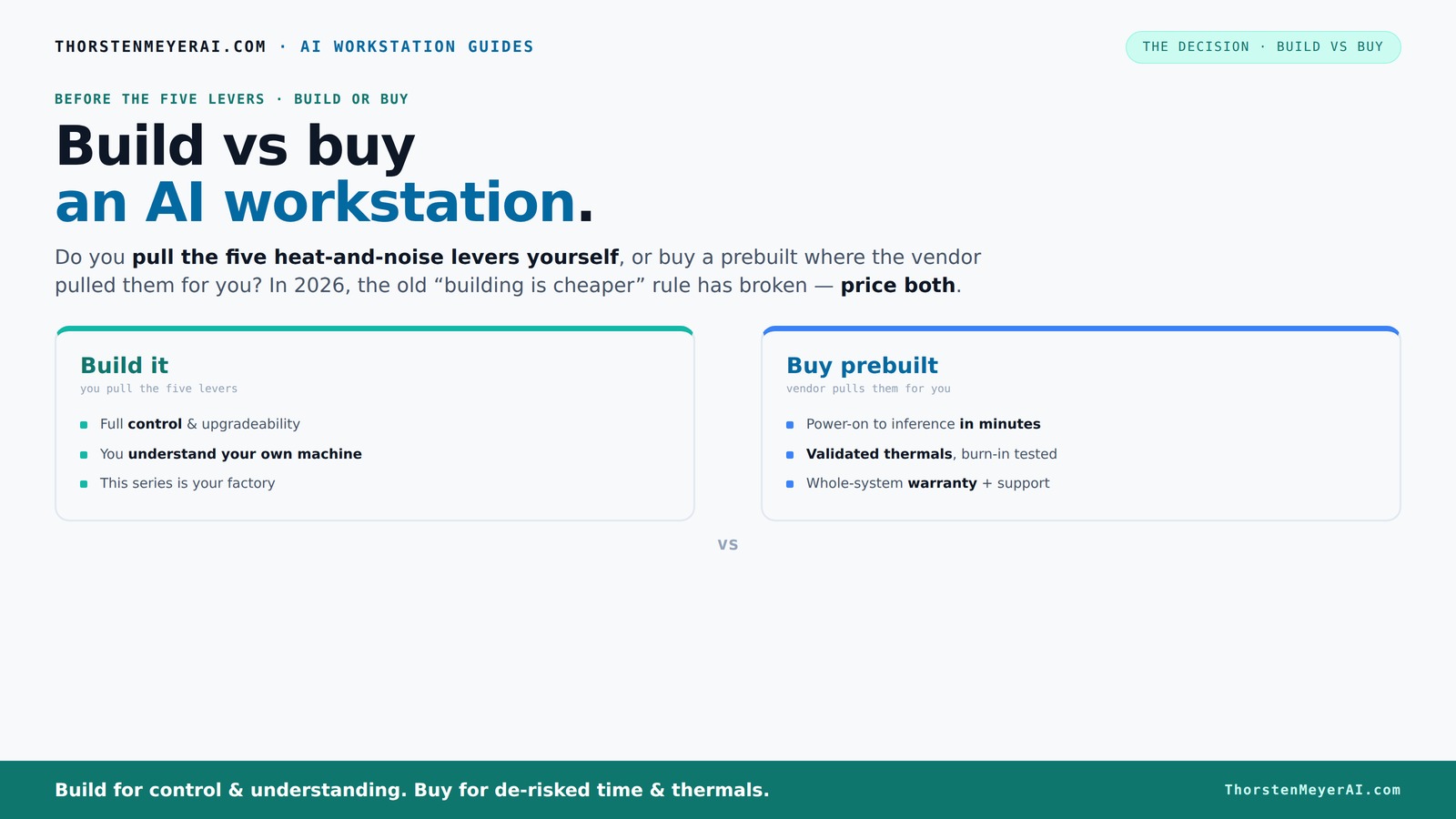
Build vs buy
an AI workstation.
The real question behind this whole series: do you pull the five heat-and-noise levers yourself, or buy a prebuilt where the vendor pulled them for you? And in 2026, the old “building is cheaper” rule has broken. Match your situation in Part 3.
Key Takeaways
- Component shortages in 2026 have closed the price gap between building and buying, so always price both options for your specific setup.
- Prebuilt AI workstations offer validated thermals, reliable performance, and support, making them ideal for quick deployment and heavy workloads.
- Building your own system grants full control, potential savings, and better upgradability—perfect if you enjoy hardware tinkering.
- Decide based on your skills, schedule, and future needs—there’s no one-size-fits-all answer anymore.
- Always compare total costs, including time, effort, and support, before making the leap.
As an affiliate, we earn on qualifying purchases.
Why the old rule of ‘Build cheaper, buy faster’ no longer holds
Building your own AI workstation was once the clear winner on price—no question. But in 2026, that’s no longer true, thanks to supply chain chaos and component shortages. GPU prices—particularly NVIDIA’s RTX 40 series and data center chips—have skyrocketed, often due to high demand from AI workloads and crypto mining booms, making them more expensive and less available. DDR5 RAM and SSDs aren’t immune; their prices have surged as well, driven by manufacturing delays and increased demand for high-speed storage and memory.
This shift means that the cost advantage of DIY builds has diminished significantly. You might want to consider building vs buying depending on your needs. For example, components that once made a $1,000 build feasible now push the price well above $1,250 or more, especially when factoring in the need for quality cooling and power supplies. Meanwhile, prebuilt vendors like Lambda and Puget leverage their buying power and supply chain efficiencies to keep their prices competitive—even sometimes cheaper than assembling yourself—by negotiating bulk discounts and optimizing component selection at scale. This trend effectively levels the playing field, making the traditional rule of ‘build cheaper’ less valid.
Beyond just costs, this shift has important implications. It means that your decision should now consider not only the initial price but also factors like time investment, thermal management, reliability, and support. The tradeoff isn’t just about dollars—it’s about the total ownership experience. If you’re short on time or technical expertise, prebuilt options might save you headaches, whereas DIY can still offer customization and a learning opportunity but at a potentially higher hidden cost in troubleshooting and setup time.
high performance GPU for AI training
As an affiliate, we earn on qualifying purchases.
As an affiliate, we earn on qualifying purchases.
The five levers of a high-power AI workstation—who pulls them?
Thermal management in high-end AI workstations is critical—not just for performance, but also for longevity and noise levels. The five levers—undervolting the GPU, matching the cooling solution, optimizing airflow, tuning fan curves, and proper placement—are essential tools to balance performance, acoustics, and hardware health. For more on optimizing your setup, visit Build vs Buy a Prebuilt AI Workstation. Who manages these levers makes a difference in your overall experience and system stability.
If you buy a prebuilt, the vendor typically handles these aspects. They test the system extensively, adjusting fan curves, cooling solutions, and thermal paste application to ensure optimal thermals and noise levels out of the box. For instance, brands like Lambda or BIZON often run burn-in tests and employ custom cooling solutions, including water-cooling options, to keep systems quiet during heavy workloads. This proactive management means you get a system that’s tuned for performance and silence, backed by support if something goes wrong.
Build your own, on the other hand, and you become the thermal manager. You choose components—such as a GPU with a quiet or water-cooled option—and configure airflow within your case. You might undervolt your GPU to reduce heat and noise, or set custom fan curves to optimize cooling during specific workloads. This process requires understanding your hardware, testing different configurations, and troubleshooting thermal issues that arise from poor airflow or inadequate cooling choices. While this approach demands more effort and technical skill, it offers the advantage of precise control, allowing you to tailor thermal and acoustic performance to your specific needs and preferences. It’s a tradeoff: you gain customization and insight but accept the responsibility for maintaining thermal stability and noise levels.
In addition, understanding the implications of thermal management choices helps you optimize your system for longevity and efficiency. Proper cooling can extend hardware lifespan, reduce maintenance costs, and improve overall system stability, which is crucial for intensive AI workloads that run continuously. Learn more about build vs buy AI workstations. Conversely, neglecting thermal considerations can lead to overheating, throttling, or hardware failure, undermining your investment. Therefore, mastering these levers, whether you delegate or do it yourself, is essential for maximizing your AI workstation’s performance and reliability.
professional AI workstation build kit
As an affiliate, we earn on qualifying purchases.
As an affiliate, we earn on qualifying purchases.
Frequently Asked Questions
Is it really cheaper to build my own AI workstation in 2026?
Not necessarily. Due to component shortages and bulk buying, prebuilt systems often match or beat DIY prices for high-end setups. Always compare costs for your specific configuration.How difficult is it to assemble a high-end AI machine myself?
It requires technical skills and patience. If you’re familiar with PC building, it’s straightforward. For guidance, see Build vs Buy a Prebuilt AI Workstation. Otherwise, professional assembly services can help, or you can learn step-by-step online.What’s more important: price, support, or customization?
It depends on your priorities. If you value quick setup and support, a prebuilt is ideal. If you want full control and upgradability, building your own makes sense.Can I upgrade a prebuilt AI workstation later?
Often yes, but it varies by model. Check for accessible slots and compatibility before buying. Some vendors design systems for easier upgrades.In a nutshell, which should I choose: build or buy?
If you enjoy hardware work and want a tailored machine, build. If you prefer reliability, support, and speed, buy. Both options are viable in 2026—choose what fits your needs best.As an affiliate, we earn on qualifying purchases.
Conclusion
The choice isn’t just about saving money or time anymore—consider your options carefully.it’s about what you value most. In 2026, prebuilt systems stand tall with power, testing, and support, but building your own can be more rewarding if you crave control and learning.
Think about your project needs, your skills, and how much effort you’re willing to invest. Either way, the right machine is out there—ready to push the boundaries of your AI work.
Fall Picks
fall essentials
As an affiliate, we earn on qualifying purchases.