TL;DR

Turn your quiet moments into listening time
- Thousands of audiobooks, podcasts and originals
- Listen on your phone, tablet or Echo — also offline
- Cancel anytime
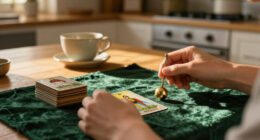
Tarot cards, originally created as a card game in the 15th century, have evolved into a prominent tool for divination and spiritual guidance. This article traces their artistic and cultural development over centuries.
Tarot cards have transitioned over centuries from a popular 15th-century card game to a widely recognized tool for divination and spiritual insight, according to recent art history studies and exhibitions. This transformation underscores the cultural and artistic evolution of tarot, which now holds a significant place in contemporary spirituality and popular culture.
Historically, tarot originated in the 15th century in Europe as a card game called ‘tarocchi,’ with no initial association with mysticism or divination. Over time, especially in the 18th and 19th centuries, tarot decks began to incorporate symbolic artwork and esoteric themes, aligning with spiritual and mystical traditions. Notable figures like Antoine Court de Gébelin and Éliphas Lévi contributed to framing tarot as a tool for hidden knowledge and divination, influencing its modern perception. Today, tarot decks are produced with diverse artistic styles, ranging from traditional to contemporary, reflecting their dual roles as artistic objects and spiritual tools. Recent exhibitions and scholarly research have further emphasized this duality, highlighting how tarot’s visual art has become central to its mystique and cultural relevance.Why Tarot’s Artistic History Matters Today
The evolution of tarot from a simple card game to a spiritual and artistic phenomenon illustrates how cultural artifacts can acquire new meanings over time. For many, tarot serves as a bridge between art, spirituality, and personal insight, making its history relevant in understanding contemporary practices. Recognizing its artistic roots also enhances appreciation for the decks’ visual symbolism and cultural diversity, which continue to influence modern spirituality and popular culture. This history underscores the importance of preserving the artistic integrity of tarot while acknowledging its evolving role in society.
As an affiliate, we earn on qualifying purchases.
Historical Milestones in Tarot’s Artistic and Spiritual Development
Tarot’s origins trace back to the 15th century in Italy and France, where it was primarily used as a card game called ‘tarocchi.’ Its association with mysticism began in the 18th century, when writers and occultists started interpreting the imagery as containing hidden knowledge. The 19th century saw the publication of influential decks like the Rider-Waite-Smith, which combined artistic symbolism with spiritual themes. In recent decades, tarot decks have expanded in artistic diversity, with contemporary artists creating decks that blend traditional symbolism with modern artistic styles. Exhibitions and academic studies in 2024 continue to explore this artistic trajectory, emphasizing how tarot’s visual art has become integral to its function as a spiritual tool.
“Tarot’s transformation reflects a fascinating journey from entertainment to spiritual practice, with its artistic imagery playing a central role in this evolution.”
— Dr. Emily Carter, art historian
As an affiliate, we earn on qualifying purchases.
Unexplored Aspects of Tarot’s Artistic and Spiritual Transition
While the historical timeline of tarot’s evolution is well-documented, questions remain about how contemporary interpretations influence its spiritual efficacy and cultural perception. It is also unclear how future artistic innovations will shape tarot’s role in society, and whether new decks will continue to blend art and mysticism in novel ways. Researchers are still exploring how these developments impact users’ experiences and beliefs.
As an affiliate, we earn on qualifying purchases.
Future Directions in Tarot’s Artistic and Cultural Role
Scholars and artists plan to further investigate tarot’s ongoing artistic evolution through upcoming exhibitions and academic publications. There is also interest in how digital art and virtual platforms will influence tarot deck design and accessibility. As tarot continues to evolve, its intersection with contemporary art and spirituality is expected to deepen, potentially broadening its cultural relevance and artistic diversity.
As an affiliate, we earn on qualifying purchases.
Key Questions
How did tarot originally become associated with divination?
Although tarot originated as a card game, its association with divination began in the 18th century when occultists and writers started interpreting its symbolism as containing hidden spiritual knowledge.
Are all tarot decks artistic or spiritual in nature?
Not necessarily. While many decks are designed with artistic and spiritual themes, some are purely artistic works or modern reinterpretations that do not emphasize mysticism.
What role does art play in the modern perception of tarot?
Art enhances the visual appeal and symbolic richness of tarot decks, making them not only tools for divination but also collectible art objects that reflect cultural and personal expression.
Will digital platforms change how tarot is used or perceived?
Digital tarot apps and online decks are expanding accessibility and may influence how users engage with tarot, blending traditional symbolism with new technological formats.
What is the significance of recent exhibitions on tarot’s art history?
They highlight the importance of visual symbolism in understanding tarot’s cultural evolution and reinforce its status as both an artistic and spiritual phenomenon.
Source: rss
Fall Picks
fall essentials
As an affiliate, we earn on qualifying purchases.