TL;DR

Turn your quiet moments into listening time
- Thousands of audiobooks, podcasts and originals
- Listen on your phone, tablet or Echo — also offline
- Cancel anytime
Meditation cushions and mats solve different comfort problems: a cushion raises your hips, while a mat pads the floor beneath your knees, ankles, or feet. Choose support based on how you sit, your body, and your floor; a chair, folded blanket, or bench can work just as well.
You can spend a small fortune on a beautifully stitched meditation set and still find yourself shifting around after five minutes. The better starting point is simpler: notice what feels uncomfortable, then choose support for that specific spot.
Meditation cushions and mats can help you sit steadily, but they do different jobs. A cushion lifts your hips; a mat softens the floor beneath your legs. In this guide, you’ll learn how to tell them apart, compare common materials, and test a setup before spending money. You’ll also see why a chair, bench, or folded blanket can be the right answer.
Comfort matters more than tradition. Your seat should help you breathe freely and pay attention—not pressure you to hold a posture that hurts. A few practical adjustments can turn a chilly, hard patch of floor into a welcoming place to sit.
A cushion raises your hips; a mat pads the floor beneath your knees, ankles, or feet.
Try folded blankets or household pillows before buying a dedicated seat.
Choose material by feel, weight, adjustability, care, and durability—not by label alone.
A chair or bench is a valid meditation seat if it helps you sit steadily and comfortably.
Change position when pain or numbness appears; persistent symptoms deserve attention.
Know What a Cushion and Mat Actually Do
Meditation cushions and mats serve different purposes: a cushion raises your hips, while a mat pads the floor beneath your knees, ankles, or feet. They are practical supports for seated meditation, not requirements for a “proper” practice. Their purpose is not to make you copy a traditional-looking pose or to force your body into one.
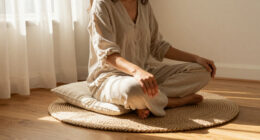
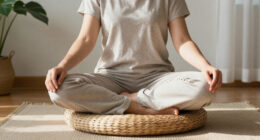
A raised seat can help your pelvis tilt slightly forward, giving your spine room to settle upright without making you rigid. That can reduce the effort of holding your torso up, leaving more attention for your practice. The right height matters: too little lift may leave your hips low and knees strained, while too much can make you feel perched or unstable. A flat mat—often called a zabuton—adds a softer layer between your legs and a hard floor. It can ease pressure at contact points, but it will not raise your hips or fix a posture that feels cramped. A round cushion, commonly called a zafu, is one familiar option, but crescent cushions and firm folded blankets can serve a similar role.
Imagine sitting cross-legged on polished wood. Your hips feel low, and your ankles press against the floor. A cushion may ease the first problem; a mat may soften the second. If you sit comfortably in a chair already, you may need neither. Separating these discomforts helps you avoid buying a full set when one simple support—or none—is enough.
Choose support for the discomfort you actually feel. Buying both pieces can make sense when you need both lift and floor padding, but one does not replace the other. A bench or stable chair is also a reasonable choice, especially if floor sitting bothers your knees or hips.
Popular right now

Samsung 65-Inch QN70FA Neo QLED 4K Smart TV with 8-Foot WireLogic Ruby Ultra High Speed HDMI Cable (2025)

Dyson V8 Cyclone Cordless Vacuum

Bose QuietComfort Headphones (2nd Gen), Wireless Over-Ear Noise-Cancelling Headphones, Eucalyptus Green
As an affiliate, we earn on qualifying purchases.
Find a Sitting Position You Can Hold Comfortably
Meditation cushions and mats work best when they help you feel stable, breathe easily, and sit without straining. For floor sitting, raising your hips above your knees often helps, but your proportions and mobility determine how much support feels right. The goal is not a fixed shape; it is a position you can maintain without bracing against discomfort. You do not need to sit cross-legged, and you do not need to stay in one position if discomfort builds.
Try this simple test at home before ordering anything:
- Start with your usual position. Sit on the floor, a chair, or a bench for a few minutes and notice where pressure or strain appears.
- Change one thing. Sit on a firm folded blanket to raise your hips, or place a folded towel beneath your knees. Changing just one variable makes it easier to tell what helped.
- Check your posture and breath. You should feel supported, not perched or sunk deep enough to slump. If you have to hold your breath or tense your back to stay upright, the height or firmness may not suit you.
- Stay briefly, then adjust. If your knees ache, your legs go numb, or discomfort increases, change position or add support. A short test is useful, but comfort can change as you sit longer.
For example, if your knees hover above the floor when you sit cross-legged, a mat alone may not solve the problem. A higher seat can let your hips rotate more comfortably; small supports beneath your knees can reduce the effort of holding your legs up. If your feet go numb in a kneeling posture, try a chair instead. The best adjustment depends on where the pressure starts, not on which posture looks most familiar.
Pain and numbness are signals to adjust, not tests of dedication. A steady chair with both feet supported can be more useful than a floor posture you endure while counting the minutes. Being able to settle comfortably makes it easier to return to practice, which matters more than holding one position at all costs.
Compare Cushion and Mat Materials Before You Buy
Meditation cushions and mats feel different depending on their filling, cover, and construction. Buckwheat hulls shift to fit your shape, kapok tends to feel light and firm, and foam or polyester fiber can offer a simple, lightweight seat. These differences affect more than first impressions: weight matters if you carry a cushion, firmness affects how stable you feel, and compressibility determines whether it keeps its support over time. None is best for everyone; your preference for firmness, weight, and care matters more than a label.
| Material or feature | What you may like | What to check |
|---|---|---|
| Buckwheat hulls | Adjustable support that molds around you | They can be heavy and may need occasional refilling |
| Kapok | Light weight and a relatively firm feel | It may compress with use |
| Foam or fiberfill | Convenience and easy portability | Adjustability and shape retention depend on construction |
| Removable cover | Easier cleaning after regular use | Check washing instructions and whether the filling stays dry |
Buckwheat hulls can be added or removed in some designs, so you may fine-tune the height rather than replace the cushion if it feels too full. That adjustability comes with extra weight and the possibility of occasional maintenance. A lighter kapok or foam seat may be easier to move, but if its filling compresses, the height and support can change with use. Check whether the cover opens and whether replacement filling is available if those tradeoffs matter to you.
Picture taking your seat to a weekly class on the bus. A heavy hull-filled cushion may feel supportive once you arrive, but its weight could make a lighter option more appealing. At home, the same weight may not matter at all. The room and routine you have are part of the material choice, not an afterthought.
Check care details before you buy. A washable cover can be handy after a dusty season or a spilled cup of tea, but that does not mean the filling can go in the washing machine. If the filling gets wet, it may need to be removed and dried separately according to the care instructions. Natural material labels also do not automatically promise long life or responsible sourcing; construction, care, and how long you use the item all count.
Choose the Right Setup for Your Room and Routine
Meditation cushions and mats should fit where and how you practice. A thin mat may be enough on carpet, while a bare wooden floor can call for more padding under your legs. Your sitting style, body proportions, storage space, and willingness to carry gear all shape a useful choice. These practical details determine whether equipment gets used regularly or becomes something you have to move and store before every session.
- If you sit cross-legged: Test a raised cushion and notice whether your knees feel supported. If your knees remain high and tense, a mat alone is unlikely to change that; consider adjusting seat height or supporting the knees.
- If you kneel: A bench or a cushion that suits kneeling may feel better than a round seat. A bench can take pressure off the ankles, but it still needs a stable surface and a height that does not strain your knees.
- If you use a chair: Choose one that stays steady and lets your feet rest comfortably. If your feet dangle, a small footrest can help you feel grounded without needing a special meditation chair.
- If you practice on a hard floor: Try extra padding where your knees or ankles meet the ground. More padding can soften pressure, though a very thick or unstable layer may make it harder to feel balanced.
- If you travel to class: Check the weight, folding design, and carry handle before buying. A supportive seat that is unpleasant to carry may not be the practical choice for a regular commute.
- If you share a small room: Consider where you will store a thick mat or bulky cushion. Easy-to-store equipment may be more useful than a larger set that stays out of reach.
For instance, a person who meditates beside a bed on carpet may find that a folded blanket gives enough lift and warmth. Someone who attends a studio class each Saturday may prefer a compact cushion with a handle rather than a large home set. In both cases, the setup is shaped by the surroundings as much as by the body.
Test the height and firmness before committing. Stack folded blankets to approximate a cushion’s height, then sit for several minutes. That small experiment can tell you more than a product photo—and it may show that your current household pillows are already enough. If the temporary support slips or compresses, that is useful information too: you may want a firmer, more stable option rather than simply adding more height.
Spend Only on Support You’ll Use
Meditation cushions and mats are optional tools, not a measure of how serious your practice is. You can begin with a firm chair, folded blanket, or household cushion, then buy dedicated gear if you find that it makes sitting more comfortable or helps you keep a regular routine. A higher price does not guarantee a better fit. Starting simply also helps you identify what you actually need before paying for features that may not solve your problem.
Product designs now include crescent shapes, contoured seats, adjustable fillings, folding mats, and carry handles. These features can suit different bodies and routines, but they do not prove that a particular product improves meditation itself. A cushion can support physical comfort for some people; it is not a meditation method or a promise of better results. For instance, adjustable filling may be worthwhile if you are still finding your preferred height, while a carry handle adds little value if the cushion stays at home.
Consider a beginner who practices for ten minutes in a quiet corner after breakfast. If a folded blanket lets them sit steadily, buying an expensive set may add little. If they keep shifting because their ankles press into a hard floor, a mat could solve a real, specific problem. In other words, the useful purchase is the one that removes a barrier to practice—not the one with the longest feature list.
Ask what the purchase will change. Look for a removable cover, clear washing instructions, refillable filling if adjustability matters, and a size you can store. Weigh those benefits against cost, maintenance, and how often you expect to use the item. Material claims vary, so check sourcing details or certifications when those claims influence your choice instead of relying on broad words on a label.
Make Adjustments Instead of Pushing Through Discomfort
Comfort is a better guide than a traditional-looking pose. If your legs go numb, your knees hurt, or discomfort grows during a session, change position, add support, or switch to a chair or bench. A meditation cushion is meant to help you sit more comfortably, not to convince you that pain is something you must overcome. Continuing to sit through worsening symptoms can distract you from practice and may make it harder to tell which position is actually working.
For example, you may start cross-legged and feel fine for three minutes, then notice a sharp pull near one knee. Try sitting higher, place a folded blanket beneath the knee, or choose a chair. You can also move gently during practice; there is no need to freeze in place to make the session count. If a change reduces the discomfort, notice what helped. If it does not, try a different position rather than piling on supports that still leave you strained.
Pay attention to how the discomfort changes. Temporary pressure may ease after a small adjustment, while increasing pain or recurring numbness calls for a different setup. A cushion may address pressure caused by the floor, but it cannot diagnose or reliably treat an underlying issue. If symptoms persist or concern you, consider seeking appropriate medical advice rather than trying to solve them with a new cushion alone.
A useful seat supports attention; it does not demand that you ignore your body.
That principle applies whether you use a buckwheat cushion, a kitchen chair, or a folded quilt. Pick a position that lets you settle, and give yourself permission to move when your body asks for it. The ability to adjust is part of making a practice sustainable, not a failure to sit correctly.
Frequently Asked Questions
Do I need a meditation cushion?
No. You can meditate on a chair, bench, folded blanket, or another steady seat. A dedicated cushion is useful only if it improves your comfort or makes your routine easier.
What is the difference between a zafu and a zabuton?
A zafu is usually a raised cushion for sitting, while a zabuton is a flat mat that cushions the knees, ankles, or feet. People often place a zafu on a zabuton, but you can use either one by itself.
How high should a meditation cushion be?
There is no universal height. Look for a stable seat that supports your hips without making you feel perched or causing your knees to strain. Try folded blankets at different heights before buying.
Is it okay to meditate in a chair?
Yes. Choose a stable chair that lets you sit comfortably, with your feet supported if possible. Sitting on the floor is not required.
What should I do if my legs go numb or my knees hurt?
Change position, add support, or try a chair or bench instead. Do not push through increasing pain or numbness; if symptoms persist or worry you, consider getting appropriate medical advice.
Which cushion filling should I choose?
Buckwheat hulls are adjustable but can be heavy, kapok is light and relatively firm, and foam or fiberfill can be convenient. Choose according to the feel, weight, maintenance, and support you prefer.
Conclusion
Choose the seat that supports your body, not the pose that looks most traditional. Test your setup with folded blankets, notice where pressure appears, and add a cushion or mat only if it solves a real comfort problem.
Your meditation spot does not need a matching set or a perfect silhouette. A steady chair, a soft patch of floor, and enough room to breathe can be a fine place to begin.