For a smartwatch that keeps daily goals visible, I would start with the Garmin vívoactive 5 for progress-oriented health and training insights, the Garmin Venu 4 for broader sports coverage and longer battery life, or the Apple Watch SE 3 for customizable faces and a strong iPhone fit. These watches differ less in whether they track activity than in how they help you turn numbers into habits: some emphasize training and recovery, while others put everyday health and phone convenience first.

Turn your quiet moments into listening time
- Thousands of audiobooks, podcasts and originals
- Listen on your phone, tablet or Echo — also offline
- Cancel anytime
One distinction matters before choosing: the supplied product details describe smartwatch features, displays, and tracking tools, but do not identify specific downloadable watch-face designs or confirm which goal metrics each face can show. I rank these as goal-tracking smartwatch options based on their stated tracking and guidance features, not on unverified face layouts. The key tradeoffs are goal insight versus notification convenience, longer battery life versus a more compact case, and ecosystem compatibility versus flexibility.
Key Takeaways
- Best balance for visible progress: Garmin vívoactive 5 combines Body Battery, sleep coaching, recovery features, and more than 30 sports apps.
- Best for broad activity goals: Garmin Venu 4 lists more than 80 sports apps and up to 12 days of battery life, but its 45 mm case is the largest here.
- Best for iPhone-centered routines: Apple Watch SE 3 offers customizable faces and safety features, but its stated battery life is up to 18 hours.
- Best compact Android pick: Samsung Galaxy Watch9 has a 40 mm case and personalized fitness and sleep guidance; it is listed for Android, not iPhone.
- Best smaller Garmin: Garmin Venu 3S has sleep coaching, nap detection, and long stated battery life in a 41 mm case, though some connected features depend on a phone or services.
| Garmin vívoactive 5, Health & Fitness GPS Smartwatch, 42mm, Ivory |  | Best Overall for Goal Context | Case size: 42 mm | Display: Color AMOLED | Battery life: Up to 11 days; up to 5 days with always-on display | VIEW ON AMAZON | See Our Full Breakdown |
| Garmin Venu 4 GPS Smartwatch, 45 mm, Slate with Black Silicone Band |  | Best for Broad Sports Goals | Case size: 45 × 45 × 12.5 mm | Case material: Stainless steel | Battery life: Up to 12 days | VIEW ON AMAZON | See Our Full Breakdown |
| Apple Watch SE 3 GPS 44mm Smartwatch |  | Best for Customizable iPhone-Focused Faces | Display size: 44 mm | Battery life: Up to 18 hours | Fast charging: Up to 8 hours of battery in 15 minutes | VIEW ON AMAZON | See Our Full Breakdown |
| Garmin Venu 3S GPS Fitness Smartwatch, 41 mm, French Gray | 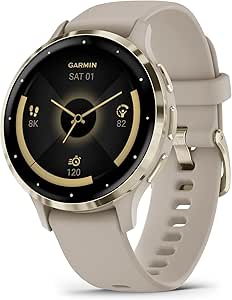 | Best Compact Garmin for Sleep and Activity Goals | Case size: 41 mm | Display: Bright color display | Battery life: Up to 10 days in smartwatch mode | VIEW ON AMAZON | See Our Full Breakdown |
| Samsung Galaxy Watch9 Bluetooth Smartwatch, Graphite, 40mm |  | Best Compact Android Pick | Case size: 40 mm | Display size: 1.34 inches | Connectivity: Bluetooth | VIEW ON AMAZON | See Our Full Breakdown |
| goal tracking smartwatch face | Case size | Battery life | GPS | Sports apps |
|---|---|---|---|---|
| Garmin vívoactive 5 | 42 mm | Up to 11 days; up to 5 days with always-on display | Built-in | More than 30 |
| Garmin Venu 4 GPS Smartwatch | 45 × 45 × 12.5 mm | Up to 12 days | Built-in | More than 80 |
| Apple Watch SE 3 GPS 44mm Smar | — | Up to 18 hours | — | — |
| Garmin Venu 3S GPS Fitness Sma | 41 mm | Up to 10 days in smartwatch mode | Built-in | More than 30 |
| Samsung Galaxy Watch9 Bluetoot | 40 mm | — | Built-in | — |
More Details on Our Top Picks
Garmin vívoactive 5, Health & Fitness GPS Smartwatch, 42mm, Ivory
The vívoactive 5 earns my top spot because its stated features make daily activity easier to interpret, rather than stopping at a record of movement. Body Battery relates sleep, naps, stress, and workouts to an energy estimate, while sleep coaching, HRV status, workout benefit, and recovery time add context to routines. For someone trying to keep several habits on track, that mix provides more useful prompts than a watch focused mainly on a single health reading or phone notifications.
It also has more than 30 built-in sports apps, built-in GPS, and wheelchair mode that tracks pushes rather than steps. That breadth makes it a more inclusive and training-oriented pick than the Apple Watch SE 3 as described here, while the Venu 4 offers a larger catalog of more than 80 sports apps and a longer stated battery window. The vívoactive’s up to 11 days in smartwatch mode is a strong middle ground, though always-on display use is listed at up to five days.
The limitation for a “watch face” buyer is that the supplied details do not confirm which metrics can appear on the face itself. I would choose this for its tracking and coaching system, then verify that the face layout supports the goal I want to glance at. Its health values are estimates, and features such as notifications, music, and payments may depend on a paired phone, subscription, or supported service. The Ivory 42 mm design is not as compact as the 40 mm Galaxy Watch9, but it remains smaller than the Venu 4.
Pros:- Body Battery connects sleep, naps, stress, and workouts to an energy estimate.
- Sleep coaching, HRV status, workout benefit, and recovery time support goal adjustments.
- More than 30 sports apps include wheelchair activity options.
- Up to 11 days of smartwatch-mode battery life, or up to five days with always-on display.
Cons:- The supplied details do not specify which goal metrics can be displayed on individual faces.
- Health metrics are estimates, and some connected features depend on a phone or supported services.
Best for: People who want activity, sleep, and recovery context in one watch, including wheelchair users who want dedicated tracking options.
Not ideal for: Buyers who require a confirmed specific face layout, medical-grade readings, or the broadest sports-app selection in this group.
- Case size:42 mm
- Display:Color AMOLED
- Battery life:Up to 11 days; up to 5 days with always-on display
- GPS:Built-in
- Sports apps:More than 30
- Health and training:Body Battery, sleep coaching, nap detection, HRV status, recovery time
- Wheelchair support:Push tracking and wheelchair activities
- Compatibility:Android and iOS devices
Our verdict“I would choose the vívoactive 5 for the strongest blend of everyday progress context, coaching, and battery life among these five.”
Garmin Venu 4 GPS Smartwatch, 45 mm, Slate with Black Silicone Band
If a goal means building consistency across different kinds of workouts, the Venu 4 has the widest listed activity selection here: more than 80 built-in sports apps. Its up to 12-day battery life also edges out the vívoactive 5 and Venu 3S on stated smartwatch-mode endurance, which can be helpful for people who want frequent tracking without making charging part of every day. This is the strongest choice for a varied training calendar, not necessarily the best fit for someone who simply wants a compact daily tracker.
The 45 mm case is its clearest compromise. It is larger than the 42 mm vívoactive 5 and 41 mm Venu 3S, and notably bigger than Samsung’s 40 mm option. The stainless steel case and built-in flashlight give it a more substantial feature set, but the dimensions may be less comfortable for smaller wrists or overnight wear. Although it tracks health, sleep, and activity, the provided description does not spell out the same specific recovery and sleep-coaching details supplied for the other Garmins.
For goal tracking, I see the Venu 4 as the better pick than the vívoactive 5 when breadth of sports and battery life matter most; the vívoactive is easier to recommend for explicitly described Body Battery and recovery guidance. Calls also require pairing with a smartphone, and health metrics are estimates rather than medical measurements. As with the rest of this roundup, I would check that the watch-face choices can surface the exact progress metric you want before buying.
Pros:- More than 80 built-in sports apps support a broad range of activity goals.
- Up to 12 days of battery life is the longest stated interval in this lineup.
- Stainless steel case and built-in flashlight add practical everyday utility.
- Built-in GPS and sleep, health, and activity tracking.
Cons:- The 45 mm case is the largest listed and may feel bulky for smaller wrists or sleep wear.
- Calls require a paired smartphone, and health data are estimates.
- The supplied details do not describe specific watch-face complications or recovery metrics.
Best for: People rotating among many sports who want a large display, a durable-feeling stainless steel case, and fewer charging interruptions.
Not ideal for: Small-wrist buyers, anyone prioritizing detailed stated recovery coaching, or shoppers who need medical-grade health readings.
- Case size:45 × 45 × 12.5 mm
- Case material:Stainless steel
- Battery life:Up to 12 days
- Water resistance:50 meters
- GPS:Built-in
- Sports apps:More than 80
- Band:Black silicone
- Connectivity:Bluetooth
Our verdict“I recommend the Venu 4 for varied sports goals and long battery intervals, provided its 45 mm size suits your wrist.”
Apple Watch SE 3 GPS 44mm Smartwatch
The Apple Watch SE 3 is the clearest choice here for someone whose goal tracking needs to sit alongside an iPhone-centered daily routine. The listing specifically highlights customizable watch faces, workout and sleep tracking, and health metrics. That makes it the most direct match for shoppers who prioritize changing the look of the face and integrating progress checks with a familiar phone setup. Compared with the Garmin options, however, the supplied description gives less detail about training load, recovery, or how goals are translated into coaching.
Its safety features are another differentiator: fall and severe car crash detection can help connect to emergency services. Fast charging is useful when the stated up to 18-hour battery life needs a top-up, with the product details saying up to eight hours of battery can be gained in 15 minutes. That remains a more frequent charging pattern than the multi-day Garmin options, and regular charging can interrupt continuous wear for sleep or activity tracking.
This watch makes more sense than the Galaxy Watch9 for buyers seeking the stated customizable-face experience in an Apple-focused setup, while Samsung’s 40 mm model is the smaller Android-oriented alternative and lists personalized fitness and sleep guidance. Apple’s listing mentions temperature sensing, Vitals, Cycle Tracking insights, and sleep apnea notifications, but some health features carry disclaimers. I would not treat those features as a substitute for professional advice, and I would verify the exact face complications available for any goal metric that must stay visible.
Pros:- Customizable watch faces and band options support personal presentation.
- Tracks workouts, sleep, and health metrics, with listed Vitals and Cycle Tracking insights.
- Fall and severe car crash detection can help connect to emergency services.
- Fast charging can provide up to eight hours of battery in 15 minutes.
Cons:- Battery life is listed as up to 18 hours, much shorter than the Garmin options.
- The provided connectivity details center on iPhone and Wi-Fi.
- Some health features have product-detail disclaimers, and exact face metrics are not specified.
Best for: iPhone users who want customizable faces, workout and sleep tracking, and safety features in one watch.
Not ideal for: People seeking multi-day battery life, detailed training and recovery guidance, or compatibility with Android phones.
- Display size:44 mm
- Battery life:Up to 18 hours
- Fast charging:Up to 8 hours of battery in 15 minutes
- Connectivity:GPS, iPhone, and Wi-Fi
- Tracking:Workouts, sleep, and health metrics
- Listed health features:Temperature sensing, Vitals, Cycle Tracking insights, sleep apnea notifications
- Safety:Fall and severe car crash detection
- Model number:MJL94LW/A
Our verdict“I would pick the Apple Watch SE 3 when face customization and an iPhone routine outweigh longer battery life and deeper stated training context.”
Garmin Venu 3S GPS Fitness Smartwatch, 41 mm, French Gray
The Venu 3S is the Garmin I would shortlist when a smaller case matters but I still want a real mix of exercise and sleep tracking. At 41 mm, it is more compact than the vívoactive 5 and Venu 4, while the listed battery life reaches up to 10 days in smartwatch mode. That combination makes it more attractive for day-and-night wear than the Apple Watch SE 3 if charging frequency is a concern, though Apple explicitly emphasizes customizable faces in a way the Garmin listing does not.
For goals that depend on recovery habits, the Venu 3S lists sleep coaching, nap detection, stress tracking, and HRV status, alongside more than 30 sports apps and built-in GPS. It also includes wheelchair activities, which gives it a broader activity fit than a basic step-focused watch. Against the vívoactive 5, it offers a smaller case but the latter has the more detailed supplied description of Body Battery, workout benefit, and recovery time. The Venu 3S is the size-led alternative, not the strongest documented coaching package.
Some conveniences depend on conditions outside the watch: calls and messages require a compatible smartphone, music services need a premium subscription, and Garmin Pay depends on supported countries and payment networks. The product information also does not identify exact face options or goal readouts, so a specific glanceable target should be checked separately. I would skip it if the 45 mm Venu 4’s broad sports catalog is the priority or if the product’s service dependencies do not fit your routine.
Pros:- 41 mm case is smaller than the vívoactive 5 and Venu 4.
- Up to 10 days of smartwatch-mode battery life supports longer stretches of wear.
- Sleep coaching, nap detection, stress tracking, and HRV status add context to routine goals.
- More than 30 sports apps include wheelchair activities.
Cons:- Some features need a compatible smartphone or supported service.
- Music services may require a premium subscription; Garmin Pay availability varies.
- Exact watch-face goal metrics are not listed.
Best for: People who want a relatively compact Garmin with sleep, nap, stress, and activity tracking plus multi-day battery life.
Not ideal for: Buyers who want the most explicitly detailed recovery tools, the widest sports-app catalog, or phone-free access to every connected feature.
- Case size:41 mm
- Display:Bright color display
- Battery life:Up to 10 days in smartwatch mode
- GPS:Built-in
- Sports apps:More than 30
- Health features:Sleep coaching, nap detection, stress tracking, HRV status
- Compatibility:iPhone and Android smartphones
- Band and case:Silicone band; fiber-reinforced polymer case
Our verdict“I recommend the Venu 3S for buyers who want Garmin’s sleep and activity tracking in a smaller case, with the caveat that the vívoactive 5 documents more recovery detail.”
Samsung Galaxy Watch9 Bluetooth Smartwatch, Graphite, 40mm
The Galaxy Watch9 is the smallest listed option, with a 40 mm case, built-in GPS, and personalized fitness and sleep guidance. That size makes it appealing to Android users who want progress tracking on a compact watch rather than the 45 mm Venu 4. Compared with the Garmin Venu 3S, Samsung’s description adds blood pressure measurement and AI assistance, while Garmin provides more specific sleep and activity tools such as nap detection and a stated sports-app count.
For goal tracking, the most useful part of the listing is its combination of activity tracking and personalized guidance, not the blood pressure feature alone. Blood pressure measurement requires calibration with a separately sold cuff, so it is not a ready-to-use standalone measurement. The product details do not specify its battery life, which makes it harder to compare day-to-day continuity against Garmin’s multi-day claims or Apple’s stated 18-hour figure.
The main compatibility boundary is straightforward: it is listed for Samsung and other Android smartphones, with iPhone support not listed. That makes it a poor fit for an iPhone household even if the compact case appeals. Tap to Pay and built-in GPS add practical convenience, while the breathable sports band is intended for comfortable daily wear. I would choose it over the Apple Watch SE 3 when Android compatibility and a smaller case come first, but I would choose a Garmin when battery life and explicitly described training context carry more weight. Exact face layouts and displayed goal metrics are not provided, so verify those before relying on a particular glance view.
Pros:- Compact 40 mm case suits buyers who prefer a smaller watch.
- Personalized fitness and sleep guidance supports everyday routines.
- Built-in GPS and Tap to Pay add practical features.
- Tracks activity, sleep, blood pressure, and heart health.
Cons:- Blood pressure measurement requires calibration with a separately sold cuff.
- Android compatibility is listed; iPhone compatibility is not.
- Battery life and specific face-level goal metrics are not supplied.
Best for: Android users who prefer a 40 mm watch and want activity, sleep, and heart-health tracking with personalized guidance.
Not ideal for: iPhone users, buyers who need an uncalibrated blood pressure reading, or shoppers who want a clearly stated battery-life figure.
- Case size:40 mm
- Display size:1.34 inches
- Connectivity:Bluetooth
- Operating system:One UI 9.0
- GPS:Built-in
- Compatibility:Samsung and other Android smartphones
- Tracked metrics:Sleep, blood pressure, activity, and heart health
- Color and band:Graphite case; black breathable sports band
Our verdict“I would choose the Galaxy Watch9 for a compact Android-first routine, but not if iPhone support, known battery endurance, or cuff-free blood pressure tracking is required.”
How We Picked
I ranked these five watches for readers who want goals to remain part of the daily glance at their wrist. I looked at the supplied information for activity tracking, training or sleep guidance, health context, battery life, display and case size, and phone compatibility. I gave more weight to features that can help a wearer interpret progress or plan a next step than to general smartwatch extras alone.
The ranking is not a test of individual watch-face designs. The product information does not list the exact faces, their complication layouts, or whether each can display a chosen daily target at a glance. I avoid claiming that a particular face shows steps, workouts, or recovery unless the provided details support it. Instead, I compare each watch’s stated capabilities as a goal-tracking platform and call out where a buyer should confirm face customization and supported metrics before purchasing.
Battery life and compatibility also affect whether a goal display remains useful in everyday wear. A longer interval between charges can make continuous tracking more practical, while a compact case may be easier to wear overnight for sleep data. I have treated health readings as wellness estimates where the product details say so, not as medical measurements. My order favors a broadly useful progress-and-guidance mix, then gives distinct places to models that serve a particular ecosystem, size, or training style.
| goal tracking smartwatch face | Battery life | Sports apps | Compatibility | Connectivity |
|---|---|---|---|---|
| Garmin vívoactive 5 | Up to 11 days; up to 5 days with always-on display | More than 30 | Android and iOS devices | — |
| Garmin Venu 4 GPS Smartwatch | Up to 12 days | More than 80 | — | Bluetooth |
| Apple Watch SE 3 GPS 44mm Smar | Up to 18 hours | — | — | GPS, iPhone, and Wi-Fi |
| Garmin Venu 3S GPS Fitness Sma | Up to 10 days in smartwatch mode | More than 30 | iPhone and Android smartphones | — |
| Samsung Galaxy Watch9 Bluetoot | — | — | Samsung and other Android smartphones | Bluetooth |
Factors to Consider When Choosing Goal Tracking Smartwatch Faces
When I compare watches for goal tracking, I separate the watch’s tracking system from the face that presents it. A device can collect useful information without confirming that a chosen face will show a target in the way you want. Use the points below to choose the right platform first, then verify the face and complication details for your intended goal.
Check which goals the watch helps interpret
Step counts and workout records show activity, but coaching and context can help explain what to do next. The vívoactive 5 has the most clearly described mix here: Body Battery, sleep coaching, HRV status, workout benefit, and recovery time. The Venu 3S lists sleep coaching, nap detection, stress tracking, and HRV status, while the Galaxy Watch9 highlights personalized fitness and sleep guidance. The Venu 4 gives the broadest stated sports-app selection, but its supplied details provide less specificity about recovery guidance. I would match these tools to the actual behavior you want to improve instead of assuming more metrics always mean better goal support.
Verify the face can show your chosen metric
A title about smartwatch faces can suggest a particular layout, but the product details here do not confirm the exact faces or which complications they support. Before buying, check whether the face can show the specific progress item you care about, such as activity completion, workout status, or sleep context, and whether it updates without opening an app. Apple Watch SE 3 explicitly lists customizable faces, but customization alone does not confirm every metric is available on every face. I would apply the same verification step to the Garmin and Samsung models rather than treating broad tracking claims as proof of a particular glanceable display.
Balance case size with overnight wear
Case size can shape how often you wear a watch, especially while sleeping. The Galaxy Watch9 is the smallest at 40 mm, followed by the 41 mm Venu 3S and 42 mm vívoactive 5. The Venu 4’s 45 mm case gives it a larger form factor, which may suit people who want more screen area but can feel less comfortable on smaller wrists. The Apple model is listed as 44 mm. If sleep tracking is part of a goal, comfort through the night matters just as much as the number of sensors on the spec sheet.
Treat battery life as part of the tracking routine
Longer battery intervals may make regular wear and overnight tracking easier, while frequent charging creates predictable gaps. Garmin lists up to 12 days for Venu 4, 11 days for vívoactive 5 in smartwatch mode, and 10 days for Venu 3S. The vívoactive 5’s stated figure falls to five days with its always-on display. Apple lists up to 18 hours but also notes fast charging; Samsung’s supplied details do not state battery life. These figures are manufacturer claims and can vary with settings, so I would compare them as guidance, not a guarantee of identical real-world use.
Match the watch to your phone and services
Compatibility affects whether a watch can support your routine beyond tracking. Samsung lists its Galaxy Watch9 for Android phones, while Apple’s listing centers on iPhone and Wi-Fi. Garmin Venu 3S supports iPhone and Android, and the vívoactive 5 description also identifies Android and iOS compatibility. Connected calling, notifications, payments, and music may depend on a paired phone, compatible service, supported region, or subscription. I would check those requirements before counting a convenience feature as part of my daily goal setup.
Use health data as guidance, not diagnosis
Health readings can add context to activity goals, but they are not interchangeable with clinical measurements. Garmin says the relevant health metrics are estimates, and the Samsung blood pressure function requires calibration with a separately sold cuff. Apple’s listing also includes disclaimers for some health features. If a health measure is central to a care plan, I would follow professional guidance rather than treating a smartwatch reading as a medical result. For everyday routines, the stronger question is whether the watch helps you notice patterns and make sensible adjustments.
Frequently Asked Questions
Which watch in this comparison is best for goal tracking?
I rank the Garmin vívoactive 5 first because its listed tools connect activity with sleep, stress, energy estimates, and recovery. That gives it a broader progress context than a watch that mainly records workouts or health readings. The Venu 4 is a stronger fit for people whose goals span many sports, while the Apple Watch SE 3 is more appealing when customizable faces and an iPhone-centered setup matter most.
Do these products guarantee a watch face that shows my exact goal?
No. The supplied information does not list exact face designs or confirm which goal metrics appear on each face. Apple specifically says its faces are customizable, but that does not establish support for every complication or target. I recommend checking the current face gallery and compatible metrics for the exact model before buying if a particular progress number must be visible at a glance.
Which model is better for tracking sleep and recovery?
The vívoactive 5 has the most detailed stated combination of sleep coaching, nap detection, HRV status, Body Battery, workout benefit, and recovery time. The Venu 3S is a smaller alternative with sleep coaching, nap detection, stress tracking, and HRV status. The Galaxy Watch9 also lists personalized sleep guidance, but provides fewer specifics in the supplied description about recovery tools.
Which watch has the longest stated battery life?
The Garmin Venu 4 has the longest stated interval at up to 12 days. The vívoactive 5 lists up to 11 days in smartwatch mode, dropping to up to five days with the always-on display, and the Venu 3S lists up to 10 days. Apple lists up to 18 hours with fast charging, and the provided Galaxy Watch9 details do not include a battery-life figure. Actual use can differ with settings and feature use.
Can I use all the health metrics as medical measurements?
No. The Garmin product details describe health metrics as estimates, and Samsung says its blood pressure measurement requires calibration with a separately sold cuff. Apple’s listing includes disclaimers for some health features. These watches can provide wellness information and help identify patterns, but I would not use their readings to diagnose a condition or replace advice from a qualified health professional.
Conclusion
For a balanced progress-and-recovery routine, I would choose the Garmin vívoactive 5. If I wanted the widest stated choice of sports and the longest battery interval, I would move to the Garmin Venu 4, provided its 45 mm case felt comfortable. iPhone users who value customizable faces and safety features should look at the Apple Watch SE 3, while Android users who want a compact case can shortlist the Galaxy Watch9. For a smaller Garmin with sleep and activity tools, the Venu 3S is the better size-focused pick. Before deciding, I would confirm that the face can show the exact goal metric I want; the supplied product details do not establish that for any specific face.