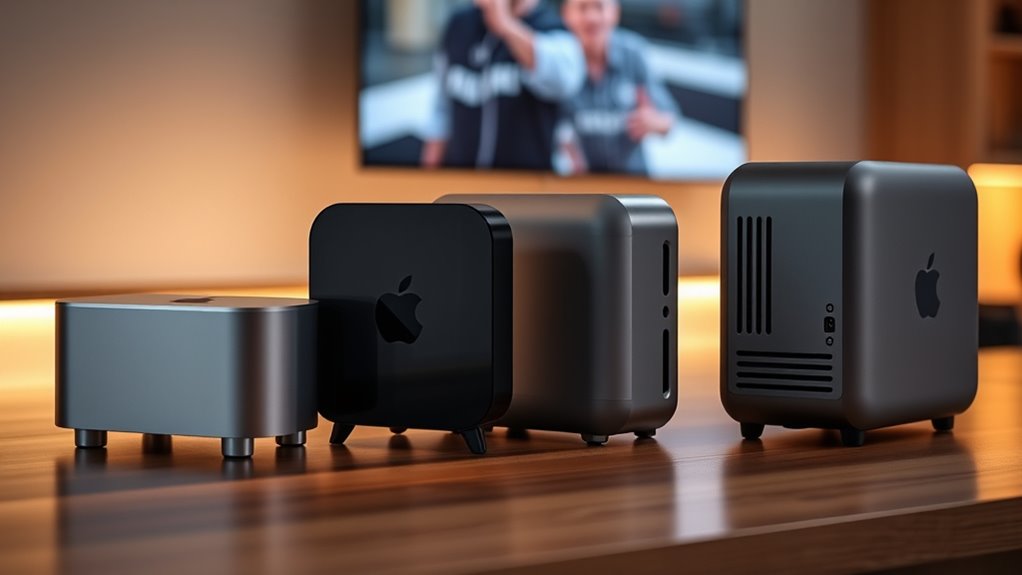
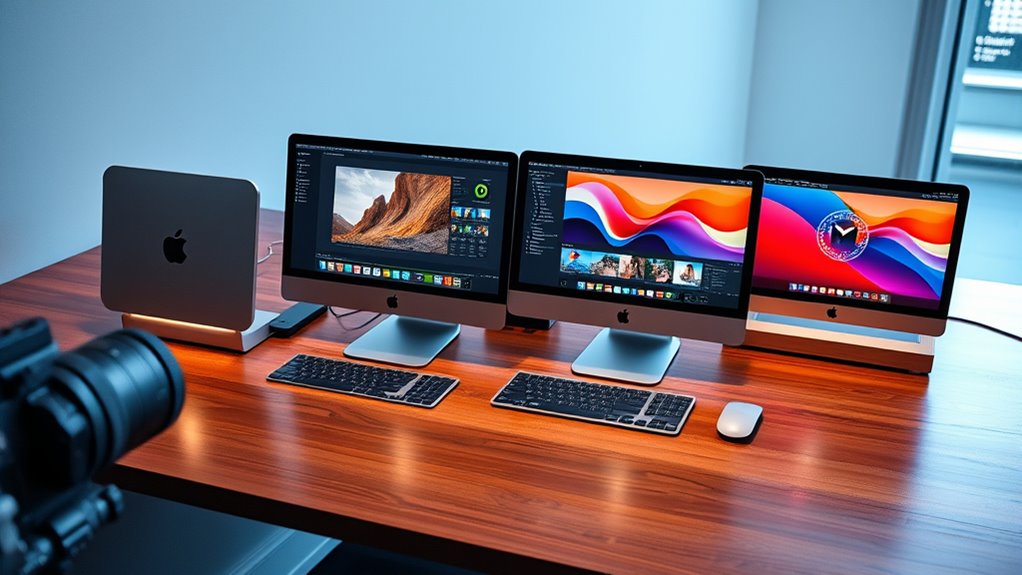
Choosing a Mac mini as a media server starts with the setup around the computer: a single mini may need rack-friendly expansion, while a multi-server library benefits from tidy, accessible mounting. My two picks serve those different jobs. The Sonnet xMac mini Server is the better fit when PCIe cards, such as 10 Gigabit Ethernet or fiber channel, are part of the plan. The Sonnet RackMac mini 2U takes the lead for organizing one to three 2024-or-newer Mac minis in a standard rack.

Turn your quiet moments into listening time
- Thousands of audiobooks, podcasts and originals
- Listen on your phone, tablet or Echo — also offline
- Cancel anytime
The tradeoff is straightforward: the xMac adds useful expansion but is a heavy, Thunderbolt 3-dependent chassis for one Mac mini; the RackMac keeps several minis accessible but does not add PCIe slots, and its USB SSDs are separate purchases. I’ve ranked them by how well each enclosure solves a distinct media-server need, not as if both were interchangeable computer upgrades.
Key Takeaways
- Choose the xMac when a single media-server Mac mini needs two PCIe slots for networking, storage, or production cards.
- Choose the RackMac mini 2U when rack organization and mounting up to three 2024-or-newer minis matter more than internal expansion.
- The xMac requires a Mac mini with Thunderbolt 3; check the host connection before choosing it.
- The RackMac has space beneath each computer for a USB SSD, but the drives are not included.
- Neither enclosure replaces the Mac mini itself: choose the computer, storage, networking, and media-server software to suit your library.
| Sonnet xMac mini Server 1U Rackmount Thunderbolt 3 PCIe Expansion Chassis |  | Best Overall for PCIe Expansion | Form factor: 1U rackmount | Expansion: 2 PCIe slots | Host connection: Thunderbolt 3 | VIEW ON AMAZON | See Our Full Breakdown |
| Sonnet RackMac mini 2U Rackmount Enclosure for 1–3 Mac mini (2024+) |  | Best for Multi-Mini Rack Setups | Compatible devices: Apple Mac mini (2024+) | Capacity: 1–3 Mac mini computers | Rack height: 2U | VIEW ON AMAZON | See Our Full Breakdown |
| mac mini as a media server | Weight | Form factor | Expansion | Host connection |
|---|---|---|---|---|
| Sonnet xMac mini Server 1U Rac | 19.2 pounds | 1U rackmount | 2 PCIe slots | Thunderbolt 3 |
| Sonnet RackMac mini 2U Rackmou | 6 pounds | — | — | — |
More Details on Our Top Picks
Sonnet xMac mini Server 1U Rackmount Thunderbolt 3 PCIe Expansion Chassis
For a media server built around one Mac mini that needs serious connectivity, the xMac is the more capable enclosure in this comparison. It places the mini in a 1U rackmount chassis and adds two PCIe expansion slots. That matters if the server needs a supported card for 10 Gigabit Ethernet, fiber channel, or pro video workflows: instead of treating the mini’s built-in connections as the whole system, you can build around a more specialized rack setup.
Its Thunderbolt 3 host connection is both the route to that expansion and the main compatibility limit. The connected Mac mini must have Thunderbolt 3, so this is not a safe universal choice for a mini that lacks that connection. Compared with the RackMac mini 2U, the xMac does more to expand one computer but does not offer room to mount two or three minis. Pick it for a single server with a clear card requirement, not simply because the words “server” and “rackmount” appear in its name.
Day-to-day details are useful for a rack installation: there are front and rear USB 3.0 ports, plus HDMI and Gigabit Ethernet passthrough. Two quiet fans and a user-replaceable 150W power supply speak to serviceability and operation inside a rack. Still, the steel-and-alloy chassis weighs 19.2 pounds, a notable burden beside the RackMac’s six-pound enclosure. It also cannot make a media library faster on its own; the right Mac mini, storage, and network remain separate decisions.
I would rank this first for a media server whose next bottleneck is expansion or higher-capacity networking. If the goal is just to mount several recent minis neatly, the RackMac is the more direct and lighter solution. If no PCIe card is planned, the xMac’s biggest distinction may go unused.
Pros:- Adds two PCIe slots for compatible networking, storage, and pro-video cards.
- Provides front and rear USB 3.0, with HDMI and Gigabit Ethernet passthrough.
- Includes two quiet fans and a user-replaceable power supply.
- Uses a 1U rackmount form factor for a single mini-based server.
Cons:- Requires a Mac mini with Thunderbolt 3 connectivity.
- At 19.2 pounds, it is substantially heavier than the RackMac enclosure.
- It mounts one Mac mini rather than offering the RackMac’s capacity for up to three.
Best for: A media-server builder with a Thunderbolt 3 Mac mini who expects to add PCIe networking, fiber-channel, or pro-video hardware.
Not ideal for: A buyer who needs to mount multiple minis, has a mini without Thunderbolt 3, or wants a lightweight enclosure without PCIe expansion needs.
- Form factor:1U rackmount
- Expansion:2 PCIe slots
- Host connection:Thunderbolt 3
- USB ports:3 total; USB 3.0
- Rear connectivity:Gigabit Ethernet, HDMI, USB 3.0
- Power supply:150W, user-replaceable
- Cooling:2 fans
- Weight:19.2 pounds
Our verdict“I’d choose the xMac for a compatible single-mini media server whose rack setup benefits from PCIe cards, not for simple multi-mini storage.”
Sonnet RackMac mini 2U Rackmount Enclosure for 1–3 Mac mini (2024+)
The RackMac mini 2U addresses a different media-server problem: how to mount and access several Mac minis neatly. Its steel 2U enclosure fits one to three 2024-or-newer minis in a standard rack. For someone separating a media library, home services, and other server tasks across small computers, that capacity can make the rack easier to organize than a collection of loose desktop units.
Compared with the xMac, the RackMac prioritizes mounting density and access over PCIe expansion. It does not provide the two PCIe slots that make the xMac attractive for add-in networking or production cards. Instead, it offers front and rear port access, front-panel power buttons, and front-to-back airflow. Those details reduce the need to reach behind the rack to power a mini or connect a cable. The enclosure also leaves space beneath each computer for a USB SSD, giving a compact storage option, though the SSDs are sold separately.
Its 6-pound weight is much easier to handle than the 19.2-pound xMac, and cushioned support is designed to secure the computers during transport, including in portable or shallow racks. That makes it a better fit for a rack that may move or has limited depth. The tradeoff is strict model compatibility: the product is specified for Apple Mac mini models from 2024 onward. Owners of older minis should not treat it as the more flexible alternative.
I’d rank this first when the core need is a tidy home for multiple recent minis, not a hardware expansion platform. One mini can go in the RackMac too, but a buyer with a single server that needs PCIe cards gets more specialized utility from the xMac. Before choosing, count the computers you intend to install and plan separately for the USB SSDs and media-library backup.
Pros:- Holds one to three compatible Mac minis in a 2U rackmount enclosure.
- Offers front and rear port access plus front-panel power buttons.
- Uses front-to-back airflow and cushioned support for transport.
- Leaves space beneath each mini for a USB SSD.
Cons:- Compatible with 2024-or-newer Mac mini models, limiting use with older computers.
- USB SSDs are sold separately.
- Does not add the PCIe expansion provided by the xMac.
Best for: A buyer organizing one to three 2024-or-newer Mac minis in a standard, portable, or shallow rack.
Not ideal for: An owner of an older Mac mini, or a media-server builder who needs PCIe slots for expansion cards.
- Compatible devices:Apple Mac mini (2024+)
- Capacity:1–3 Mac mini computers
- Rack height:2U
- Dimensions:5.2 in D × 19 in W × 3.4 in H
- Enclosure material:Stainless steel
- Weight:6 pounds
- Access:Front and rear ports; front power buttons
- Warranty:2-year limited warranty
Our verdict“I’d pick the RackMac mini 2U to consolidate multiple recent Mac minis in a rack when easy access matters more than PCIe expansion.”
How We Picked
I compared these two enclosures as parts of a Mac mini media-server setup, rather than judging them as complete servers. Neither product is the computer or the media library: the Mac mini, storage drives, network, and server software still shape the actual playback and serving experience. My focus is what each enclosure contributes to a dependable, manageable installation.
My ranking reflects the two clearest buyer needs in this pair. The xMac ranks first for expansion, because its two PCIe slots open up options such as 10 Gigabit Ethernet and fiber channel that can matter when a media library is large or the server shares a production rack. The RackMac ranks first for multi-mini organization, with room for as many as three compatible computers, front and rear port access, and front power buttons.
I also weighed fit and practical compromises. Host compatibility is a gating issue for the xMac: it requires Thunderbolt 3. The RackMac is designed for 2024-or-newer Mac mini models, so it is not the flexible pick for an older mini. I treated its separate USB SSDs as an added setup requirement, and the xMac’s 19.2-pound weight as a real drawback for moving or rearranging a rack. I do not treat either model as a substitute for planning backups, network capacity, or cooling for the complete system.
Factors to Consider When Choosing Mac Mini As A Media Server
The right enclosure depends on the job you expect the Mac mini to do. I’d choose between these models by checking host compatibility, expansion needs, and rack capacity before focusing on appearance or port placement.
Start with the Mac mini you own
The xMac requires a host with Thunderbolt 3, while the RackMac is specified for 2024-or-newer Mac minis. These are not interchangeable compatibility notes. Check the exact computer model and its connections first; an enclosure that cannot support the host is the wrong foundation for the server, regardless of its rack features.
Decide whether PCIe expansion earns its place
The xMac’s two PCIe slots are its central advantage. They suit a server that needs a compatible 10 Gigabit Ethernet, fiber-channel, or pro-video card. That can matter when the mini connects to fast shared storage or joins a rack with other production equipment. If your plan relies on the computer’s existing connections and does not call for a PCIe card, the RackMac’s mounting and access features may be more useful than expansion hardware you will not install.
Match enclosure capacity to your server plan
The RackMac can hold one to three minis, so it is the clear choice for consolidating several compatible computers in 2U of rack space. Multiple machines can divide different services or workloads, though each still needs its own setup and network planning. The xMac is a single-mini solution focused on adding cards. Do not choose its 1U profile as a substitute for multi-computer capacity.
Plan the storage outside the enclosure choice
The RackMac leaves room beneath each computer for a USB SSD, but those drives are not included. The xMac’s PCIe slots may offer another path for compatible expansion, but an expansion chassis does not automatically supply the disks or backup plan for a media library. Work out where the primary files live, how they connect to the Mac mini, and how copies will be protected before finalizing the rack layout.
Treat access, cooling, and portability as practical needs
Front and rear port access helps when a server is installed where the back of the rack is awkward to reach. The RackMac adds front-panel power buttons and front-to-back airflow; its cushioned support is intended to secure computers during transport. The xMac has two quiet fans and a replaceable power supply, but weighs 19.2 pounds. Choose according to where the server will sit and whether it will stay put or move.
Frequently Asked Questions
Which enclosure is better for a Mac mini media server?
I’d choose the xMac if the server needs PCIe expansion, especially a compatible networking or production card. I’d choose the RackMac mini 2U if the main goal is to mount and access up to three recent minis together. The better fit depends on whether the setup needs expansion or multi-computer organization.
Can the xMac work with any Mac mini?
No. The xMac uses Thunderbolt 3 to connect to its host, so the Mac mini must support that connection. Confirm the exact mini model and its ports before choosing this chassis. The RackMac has a different compatibility limit: it is specified for Mac mini models from 2024 onward.
Does the RackMac include the USB SSDs?
No. The RackMac provides space beneath each computer for a USB SSD, but the drives are sold separately. I’d treat this as a layout convenience, not included media storage. Choose the drive capacity and backup approach for the library you plan to serve.
Does either enclosure include a Mac mini or media-server software?
The supplied product descriptions cover enclosures, not a complete server package. Plan on providing a compatible Mac mini and media-server software separately. The enclosure affects mounting, connectivity, and access; it does not decide how your library is organized or which devices can play it.
Should I choose the xMac if I only need to mount one mini?
Not automatically. The xMac makes the most sense for a single mini when its two PCIe slots solve a real expansion need. If the priority is mounting a recent mini with convenient front and rear access, the RackMac can hold one as well. Compare the host compatibility, expansion plan, and enclosure weight before deciding.
Conclusion
My pick depends on the shape of the server. For a single Thunderbolt 3 Mac mini with planned PCIe expansion, I’d choose the Sonnet xMac mini Server; its card support gives it the strongest specialist role here, though the weight and host requirement narrow its audience. For someone consolidating one to three 2024-or-newer minis, I’d choose the RackMac mini 2U for its capacity, accessible controls, and transport-minded support, while budgeting separately for USB SSDs. If neither PCIe expansion nor multi-mini rack mounting solves a current need, start with the Mac mini, storage, network, and backup plan instead of buying an enclosure for features you will not use.
Fall Picks
fall essentials
As an affiliate, we earn on qualifying purchases.