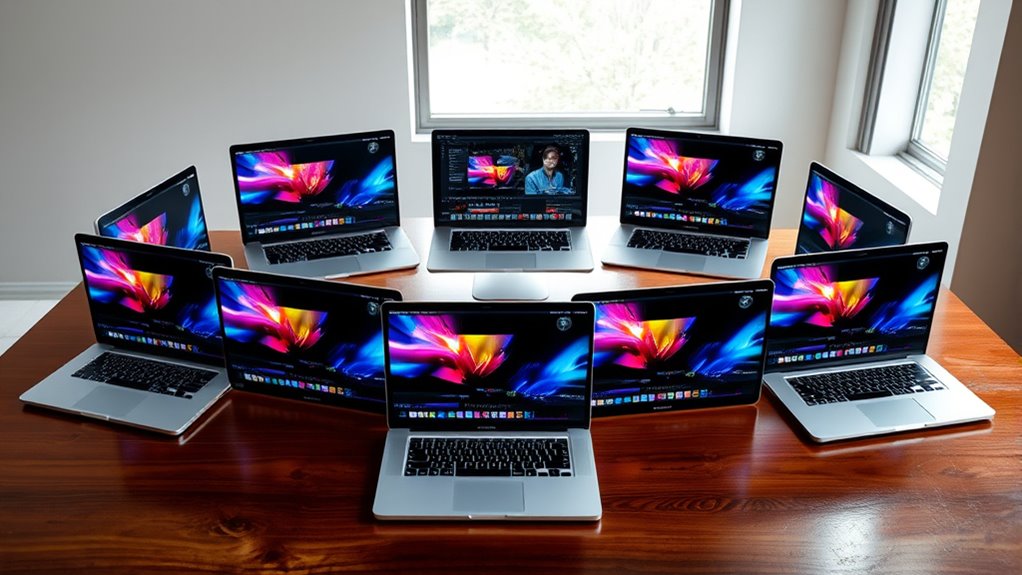
For a MacBook Pro for data science and AI, I’d start with the 16-inch M5 Pro with 64GB memory: it balances a larger workspace and generous memory for demanding local work. The 14-inch M5 Pro with 48GB suits buyers who need substantial memory in a more portable laptop, while the M5 Max with 128GB is the specialist choice for heavier local workloads. The main tradeoffs are memory capacity, screen size, storage, and how much model training you expect to run on the laptop rather than in the cloud. A base M5 can handle learning and many everyday data tasks, but its 16GB memory puts a tighter ceiling on multitasking and larger models. Read on for the full breakdown and a guide to matching a configuration to your workload.

Turn your quiet moments into listening time
- Thousands of audiobooks, podcasts and originals
- Listen on your phone, tablet or Echo — also offline
- Cancel anytime
Key Takeaways
- The 16-inch M5 Pro with 64GB is the most balanced pick in this lineup for data work that benefits from both a roomy display and memory headroom.
- The 14-inch M5 Pro with 48GB offers the strongest portable balance; its memory capacity matters more for many data workflows than moving up to a larger chassis.
- Both M5 Max models pair 128GB memory with a 40-core GPU, making them the clear choices for heavier local AI experiments, while the 4TB version favors large datasets and model files.
- The two 16GB M5 configurations differ only in SSD capacity here: the 1TB version gives more room for datasets and environments, but neither increases working memory.
- Several M5 Pro options share 24GB memory and 1TB storage, so screen size and portability—not a major memory advantage—are the key distinction between the 14-inch and 16-inch choices.


| macbook pro for data science and ai | GPU | Display | Storage | Unified memory |
|---|---|---|---|---|
| Apple 16.2-inch MacBook Pro wi | 20-core | 16.2-inch Liquid Retina XDR | 1TB SSD | 24GB |
| Apple 2026 MacBook Pro Laptop | 16-core | 14.2-inch Liquid Retina XDR | 1TB SSD | 24GB |
| Apple 14.2-inch MacBook Pro wi | 10-core | 14.2-inch Liquid Retina XDR | 512GB SSD | 16GB |
| Apple MacBook Pro 14.2-inch wi | 16-core | 14.2-inch Liquid Retina XDR (title specification; listing details conflict) | 1TB SSD | 48GB |
| Apple MacBook Pro 16.2-inch wi | 40-core | 16.2-inch Liquid Retina XDR | 4TB SSD | 128GB |
| Apple 14.2-inch MacBook Pro wi | 10-core | 14.2-inch Liquid Retina XDR | 1TB SSD | 16GB |
| Apple MacBook Pro 16.2-inch wi | 40-core | 16.2-inch Liquid Retina XDR | 2TB SSD | 128GB |
| Apple MacBook Pro 16.2-inch wi | 20-core | 16.2-inch Liquid Retina XDR | 1TB SSD | — |
| Apple 2026 MacBook Pro Laptop | 20-core | 16.2-inch Liquid Retina XDR | 1TB SSD | 48GB |
More Details on Our Top Picks
Apple 16.2-inch MacBook Pro with M5 Pro, 18-core CPU, 20-core GPU, 24GB memory, 1TB SSD, Wi-Fi 7, Space Black
I’d make this the best overall fit for data science when a large workspace matters as much as processing power. Its 18-core CPU and 20-core GPU suit parallel analysis, visualization, and GPU-accelerated tasks, while the 16.2-inch XDR display gives notebooks, charts, and reference material more room than the 14.2-inch M5 Pro model. Compared with the M5 Max configuration in this lineup, it has less memory and GPU headroom, so it is a more balanced choice than a machine aimed at very large local models or intensive GPU workloads.
The 24GB unified memory and 1TB SSD provide a useful working base, and Thunderbolt 5, HDMI, and SDXC reduce reliance on adapters at a desk. The tradeoff is that 24GB can limit larger datasets and simultaneous tools, while the bigger chassis is less convenient for frequent travel. I’d choose this over the compact M5 Pro for screen space, but not for maximum local AI capacity.
Pros:- 18-core CPU and 20-core GPU provide strong capacity for parallel analysis and GPU-assisted work
- 16.2-inch Liquid Retina XDR display gives notebooks and visualizations more working space
- 1TB SSD provides room for projects, environments, and datasets
- Thunderbolt 5, HDMI, and SDXC offer versatile connection options
Cons:- 24GB unified memory may constrain large local models and memory-heavy workloads
- The 16.2-inch chassis is less portable than the 14.2-inch options
- The supplied product details do not specify a battery runtime
Best for: Data scientists who work at a desk, value a spacious built-in display, and run moderate-to-demanding analysis without needing very large local AI models.
Not ideal for: Researchers loading large models or datasets into memory, or commuters who prefer a smaller, lighter laptop; the 24GB configuration and 16.2-inch size are the limiting factors.
- Processor:Apple M5 Pro
- CPU:18-core
- GPU:20-core
- Display:16.2-inch Liquid Retina XDR
- Unified memory:24GB
- Storage:1TB SSD
- Wireless:Wi-Fi 7, Bluetooth 6
- Ports:Three Thunderbolt 5, MagSafe 3, SDXC card slot, HDMI, headphone jack
Our verdict“Choose this M5 Pro when you want a large-screen data science workstation with strong general performance, but step up to an M5 Max for memory-intensive local AI.”
Apple 2026 MacBook Pro Laptop with M5 Pro Chip, 14.2-inch Liquid Retina XDR Display, 24GB RAM, 1TB SSD, Space Black
This is the portable M5 Pro choice for people who need more than entry-level performance but do not want the 16.2-inch model’s footprint. Its 15-core CPU and 16-core GPU pair with 24GB of unified memory and a 1TB SSD, giving analysts a capable setup for notebooks, data preparation, and moderate machine-learning tasks. Against the 16.2-inch M5 Pro with an 18-core CPU and 20-core GPU, this version gives up some processing and graphics capacity in exchange for a smaller display and easier carry.
The 14.2-inch XDR screen is useful for mobile work, though dense code, charts, and side-by-side windows have less room than on the larger model. Thunderbolt 5, HDMI, and SDXC help it serve as a docked workstation, while the listed all-day battery life suits work away from an outlet. I’d skip it for memory-hungry local AI: 24GB is less forgiving than the 48GB M5 Pro configuration in this roundup.
Pros:- M5 Pro chip balances demanding professional workloads with a compact form
- 24GB unified memory and 1TB SSD provide a capable baseline for projects and tools
- 14.2-inch Liquid Retina XDR display is easier to carry than the 16.2-inch option
- Thunderbolt 5, HDMI, and SDXC support flexible desk and field setups
Cons:- 24GB memory is a constraint for large local models and substantial datasets
- 15-core CPU and 16-core GPU have less headroom than the 16.2-inch M5 Pro configuration
- The smaller screen can feel tight for simultaneous coding, documentation, and visualization
Best for: Data scientists and AI developers who travel often and want M5 Pro performance, 1TB storage, and a compact 14.2-inch machine.
Not ideal for: Users training or running large local models, or people who need a broad built-in workspace for multiple code and visualization windows.
- Processor:Apple M5 Pro
- CPU:15-core
- GPU:16-core
- Display:14.2-inch Liquid Retina XDR
- Unified memory:24GB
- Storage:1TB SSD
- Battery life:All-day
- Connectivity:Wi-Fi 7, Bluetooth 6, Thunderbolt 5, MagSafe 3, SDXC, HDMI, headphone jack
Our verdict“Pick this compact M5 Pro for mobile data work, but choose the 48GB M5 Pro or M5 Max if local AI memory capacity is the priority.”
Apple 14.2-inch MacBook Pro with M5 chip, 10-core CPU and GPU, 16GB memory, 512GB SSD, Space Black
I’d choose this as the entry point for data science when the workload is mostly coursework, scripting, exploratory analysis, and cloud-based AI services. The 10-core M5 CPU and GPU offer a capable foundation, and the 14.2-inch XDR display plus a useful port selection make it more workstation-like than a basic laptop. Compared with the 14.2-inch M5 Pro, however, this model has a less powerful chip, 16GB rather than 24GB of memory, and half the SSD capacity.
Those limits matter once projects involve larger datasets, several development tools, or local model inference. Its 512GB SSD can also fill quickly with data and environments, so cloud storage or external drives may become part of the workflow. Support for up to two external displays helps when docked, but I’d steer professionals toward an M5 Pro model for heavier sustained work. This is the sensible starting configuration, not the lineup’s long-term choice for demanding AI workloads.
Pros:- M5 chip with 10-core CPU and GPU supports everyday analysis and learning projects
- 14.2-inch Liquid Retina XDR display provides a strong workspace in a compact format
- Three Thunderbolt 4 ports, HDMI, and SDXC reduce the need for extra adapters
- Supports up to two external displays for a docked setup
Cons:- 16GB unified memory limits large datasets and local AI workloads
- 512GB SSD leaves less space for datasets, environments, and project archives
- M5 Pro options offer more CPU and GPU capacity for sustained professional work
Best for: Students, new data analysts, and Python learners working with moderate datasets, cloud notebooks, and introductory machine-learning projects.
Not ideal for: Practitioners running large local models, keeping several large datasets on-device, or expecting sustained GPU-heavy work; the 16GB memory and 512GB SSD leave less room to grow.
- Chip:Apple M5
- CPU:10-core
- GPU:10-core
- Display:14.2-inch Liquid Retina XDR
- Unified memory:16GB
- Storage:512GB SSD
- External displays:Supports up to two
- Ports:Three Thunderbolt 4, MagSafe 3, SDXC card slot, HDMI, headphone jack
Our verdict“Choose this for learning and moderate data analysis, but move to an M5 Pro configuration when projects demand more memory or GPU capacity.”
Apple MacBook Pro 14.2-inch with M5 Pro, 15-core CPU, 16-core GPU, 48GB Memory, 1TB SSD, Space Black
The standout reason to choose this configuration is 48GB of unified memory in a 14.2-inch MacBook Pro. That extra capacity can keep larger datasets, development tools, and more demanding local inference workflows in memory, where the 24GB M5 Pro models may need more careful workload management. The 15-core CPU and 16-core GPU are not as strong on paper as the 18-core CPU and 20-core GPU in the 16.2-inch M5 Pro, so this pick prioritizes memory headroom and portability over maximum processing throughput.
Its 1TB SSD and Thunderbolt 5, HDMI, and SDXC connections make it practical as a mobile workstation. There is a significant caveat: the listing has conflicting model details, including descriptions of a 16-inch model and 18-core CPU that do not match the title’s 14.2-inch, 15-core configuration. I’d verify the exact configuration before buying. If the title’s specs are accurate, it makes more sense for memory-bound work than the 24GB alternatives.
Pros:- 48GB unified memory offers more room for large datasets and memory-intensive workflows than 24GB models
- 1TB SSD provides practical project storage
- 14.2-inch format is more portable than the 16.2-inch M5 Pro alternative, according to the title
- Thunderbolt 5, HDMI, and SDXC support a flexible workstation setup
Cons:- Product details conflict on display size and processor configuration, so the exact model needs verification
- The listed 16-core GPU has less capacity than the 20-core GPU in the 16.2-inch M5 Pro
- A 14.2-inch display offers less room for code and visualizations than the larger model
Best for: Data scientists who need more memory for large datasets, multitasking, or local inference but still prefer a 14.2-inch laptop.
Not ideal for: Buyers who need verified, unambiguous specifications or prioritize GPU throughput over memory; the listing contains conflicting processor and display information.
- Processor:Apple M5 Pro, 15-core CPU
- GPU:16-core
- Unified memory:48GB
- Storage:1TB SSD
- Display:14.2-inch Liquid Retina XDR (title specification; listing details conflict)
- Resolution:3456 × 2234
- Refresh rate:120Hz
- Ports:Three Thunderbolt 5, MagSafe 3, SDXC, HDMI, headphone jack
Our verdict“Consider this only if the seller confirms the 14.2-inch, 48GB configuration, since its memory advantage is useful but the conflicting listing details create buying uncertainty.”
Apple MacBook Pro 16.2-inch with M5 Max, 18-Core CPU, 40-Core GPU, 128GB Memory, 4TB SSD, Space Black
This is the local-AI and GPU-workstation pick in the group. The M5 Max pairs an 18-core CPU and 40-core GPU with 128GB of unified memory, giving demanding projects far more room for large models, datasets, and concurrent tools than any M5 Pro configuration here. Its 4TB SSD also reduces pressure to move active project files to external storage. Compared with the 16.2-inch M5 Pro with 24GB memory, this is a major step up in memory and GPU capacity, not a value-minded upgrade for ordinary notebook work.
The 16.2-inch XDR display and support for up to four external displays suit a fixed research or development setup, while Thunderbolt 5, HDMI, and SDXC help connect peripherals. The tradeoffs are the larger form factor and substantial capacity that many users will not use. The listing does not provide weight or battery runtime, and demanding AI work can still depend on software support and workload fit. I’d reserve this for people who specifically need high local memory and GPU capacity.
Pros:- M5 Max with 40-core GPU is the strongest listed option for GPU-heavy work
- 128GB unified memory supports large local workloads and substantial multitasking
- 4TB SSD provides extensive space for datasets and project files
- Supports up to four external displays and includes Thunderbolt 5, HDMI, and SDXC
Cons:- The 16.2-inch format is less portable than the 14.2-inch MacBook Pro options
- Its high memory and GPU capacity may go unused in cloud-based or lighter workflows
- Product details do not specify weight or battery runtime
Best for: AI researchers, machine-learning engineers, and data scientists who run demanding local models or GPU-heavy workflows and need extensive on-device memory and storage.
Not ideal for: Students, cloud-first developers, and analysts with modest datasets; the 128GB memory, 40-core GPU, and 4TB SSD are more capacity than their workflows require.
- Chip:Apple M5 Max
- CPU:18-core
- GPU:40-core
- Display:16.2-inch Liquid Retina XDR
- Unified memory:128GB
- Storage:4TB SSD
- Brightness:1600 nits peak; 1000 nits sustained
- External displays:Supports up to four
- Wireless:Wi-Fi 7, Bluetooth 6
Our verdict“Choose this M5 Max when large local AI workloads justify its 128GB memory and 40-core GPU, otherwise an M5 Pro model is a more balanced fit.”
Apple 14.2-inch MacBook Pro with M5 Chip, 10-Core CPU and GPU, 16GB Memory, 1TB SSD, Space Black
For data scientists who value a portable workstation for notebooks, analysis, and smaller on-device AI tasks, this 14.2-inch MacBook Pro pairs the M5 chip with a useful 1TB SSD. Its storage gives datasets and project files more room than the otherwise similar 512GB M5 configuration elsewhere in the roundup. The XDR display can make charts and code easier to inspect, while the included SDXC, HDMI, and Thunderbolt 4 ports reduce the need for adapters at a desk or on the move.
The main compromise is 16GB of unified memory: it is a more restrictive fit for large datasets, several heavy tools at once, or local model work than the 48GB and 64GB M5 Pro options. I’d choose this for portability and moderate workloads, not as a substitute for the 128GB M5 Max when memory-hungry AI work is central.
Pros:- Compact 14.2-inch format is easier to carry than the 16.2-inch models.
- 1TB SSD offers more project and dataset space than the 512GB M5 alternative.
- Liquid Retina XDR display reaches 1600 nits peak brightness.
- HDMI, SDXC, MagSafe 3, and three Thunderbolt 4 ports support varied desk and field setups.
Cons:- 16GB unified memory can constrain larger datasets and local AI workloads.
- M5 has a 10-core GPU, well below the 20-core M5 Pro and 40-core M5 Max options.
- Thunderbolt 4 is an older connectivity generation than the Thunderbolt 5 ports on the M5 Pro and M5 Max models.
Best for: Data science students and mobile analysts who run notebooks, SQL, visualization, and modest local AI workloads while carrying their laptop regularly.
Not ideal for: Researchers working with large local models, memory-heavy dataframes, or multiple demanding applications who would benefit from the 48GB-or-more configurations.
- Chip:Apple M5
- CPU:10-core
- GPU:10-core
- Display:14.2-inch Liquid Retina XDR
- Unified memory:16GB
- Storage:1TB SSD
- Peak brightness:1600 nits
- Ports:Three Thunderbolt 4, MagSafe 3, SDXC card slot, HDMI, headphone jack
Our verdict“Choose this compact M5 model for portable analysis and modest AI tasks, but step up to an M5 Pro configuration for memory-intensive work.”
Apple MacBook Pro 16.2-inch with M5 Max, 18-Core CPU, 40-Core GPU, 128GB Memory, 2TB SSD, Space Black
This is the most capable choice here for workloads that can use substantial memory and GPU resources: the 40-core GPU and 128GB unified memory give local model experimentation, large in-memory datasets, and parallel creative or analytical work far more headroom than the M5 Pro alternatives. The 2TB SSD also leaves more room for datasets and model files than the 1TB configurations. Compared with the 64GB M5 Pro model, this M5 Max is aimed at buyers who can put its extra resources to work, not simply anyone who wants a larger screen.
The cost of that capacity is a larger, less portable 16.2-inch chassis. It also may be excessive for cloud-first workflows or typical notebook analysis, where the 48GB M5 Pro model is a more restrained fit. The listed configuration includes Thunderbolt 5 and supports up to four external displays, making it better suited to a demanding fixed workstation setup.
Pros:- 128GB unified memory provides substantial capacity for large in-memory workloads.
- 40-core GPU is the strongest listed GPU configuration in this batch.
- 2TB SSD provides more local capacity than the 1TB alternatives.
- Thunderbolt 5 connectivity and support for up to four external displays suit a multi-display workstation.
Cons:- The 16.2-inch chassis is less convenient to carry than the 14.2-inch M5 model.
- Its M5 Max resources may go underused in cloud-based or lighter data workflows.
- A large memory and GPU configuration does not remove software compatibility limits for tools built around other hardware ecosystems.
Best for: AI practitioners and data scientists who need substantial unified memory for local models, large datasets, or GPU-intensive workflows and want a laptop-based workstation.
Not ideal for: Cloud-first analysts, frequent travelers, and buyers whose workloads fit comfortably within an M5 Pro system; the size and high-end hardware may be more than they need.
- Chip:Apple M5 Max
- CPU:18-core
- GPU:40-core
- Display:16.2-inch Liquid Retina XDR
- Unified memory:128GB
- Storage:2TB SSD
- Ports:Three Thunderbolt 5, MagSafe 3, SDXC card slot, HDMI, headphone jack
- Wireless:Wi-Fi 7, Bluetooth 6
Our verdict“Pick this M5 Max when local AI, GPU-heavy work, and large memory demands justify its less portable 16.2-inch form.”
Apple MacBook Pro 16.2-inch with M5 Pro, 18-core CPU, 20-core GPU, 64GB Memory, 1TB SSD, Space Black
The case for this configuration is its pairing of the M5 Pro with 64GB of unified memory. That memory gives larger dataframes and multiple active tools more breathing room than the 48GB M5 Pro option, without moving all the way to the M5 Max’s 128GB and 40-core GPU. For data science work that is memory-bound rather than dominated by local GPU model training, this is a more focused balance: the 20-core GPU and 18-core CPU support demanding professional workflows, while the 16.2-inch display makes code, charts, and side-by-side windows easier to view.
Compared with the 14.2-inch M5, it is less convenient to carry, and its 1TB SSD is smaller than the M5 Max’s 2TB drive. Buyers who need maximum GPU capacity should look to that M5 Max; those who want a large screen and more memory for everyday professional analysis may not need its extra hardware.
Pros:- 64GB unified memory offers more headroom than the 48GB M5 Pro alternative.
- 18-core CPU and 20-core GPU suit demanding professional analysis and development.
- 16.2-inch Liquid Retina XDR display provides room for code and visualizations.
- Thunderbolt 5, HDMI, and SDXC support flexible workstation connections.
Cons:- The 16.2-inch size is less portable than the 14.2-inch MacBook Pro.
- 1TB SSD provides less local storage than the 2TB M5 Max configuration.
- The 20-core GPU and 64GB memory do not match the M5 Max’s resources for the largest local AI workloads.
Best for: Data scientists who run memory-intensive analysis, keep several development tools open, and prefer a spacious screen without stepping up to an M5 Max.
Not ideal for: Frequent travelers seeking a compact machine, or AI researchers who specifically need the M5 Max’s 40-core GPU and 128GB memory.
- Processor:Apple M5 Pro, 18-core CPU
- GPU:20-core
- Display:16.2-inch Liquid Retina XDR
- Memory:64GB
- Storage:1TB SSD
- Peak brightness:1600 nits
- Ports:Three Thunderbolt 5, MagSafe 3, SDXC, HDMI, headphone jack
- Wireless:Wi-Fi 7, Bluetooth 6
Our verdict“Choose this M5 Pro configuration if you need 64GB memory and a large display for professional analysis but do not need M5 Max-level GPU capacity.”
Apple 2026 MacBook Pro Laptop with M5 Pro Chip, 16.2-inch Liquid Retina XDR Display, 48GB RAM, 1TB SSD, Wi-Fi 7, Space Black
This 16.2-inch MacBook Pro takes a middle position between the 24GB M5 Pro configurations in the wider roundup and the 64GB model listed here. Its 48GB unified memory provides more room for larger datasets and simultaneous development tools than a 24GB system, while the M5 Pro’s 18-core CPU and 20-core GPU avoid the extra scale of the M5 Max. That makes it a sensible fit for professional data work and moderate on-device AI when a large workspace matters.
Against the 64GB M5 Pro, the tradeoff is less memory headroom for unusually large in-memory workloads; against the 128GB M5 Max, it gives up both memory and GPU capacity. Its 1TB SSD is shared with the 64GB model, and the large display adds bulk compared with the 14.2-inch M5. I’d shortlist it for buyers seeking a balanced M5 Pro setup, not maximum local AI capacity.
Pros:- 48GB unified memory exceeds the 24GB M5 Pro configurations in the roundup.
- M5 Pro combines an 18-core CPU with a 20-core GPU for demanding professional workflows.
- 16.2-inch Liquid Retina XDR display offers a spacious workspace.
- Thunderbolt 5, HDMI, SDXC, Wi-Fi 7, and Bluetooth 6 support modern workstation setups.
Cons:- Less memory headroom than the 64GB M5 Pro and 128GB M5 Max options.
- The 16.2-inch design is bulkier to carry than the 14.2-inch M5 model.
- 1TB SSD may require external storage for extensive datasets and local model collections.
Best for: Professional analysts and data scientists who want a large-screen M5 Pro laptop with more memory than entry configurations, but do not need 64GB or M5 Max resources.
Not ideal for: People who frequently carry a laptop or run very large local models and memory-bound datasets that favor the 64GB M5 Pro or 128GB M5 Max.
- Display:16.2-inch Liquid Retina XDR
- Processor:Apple M5 Pro, 18-core CPU
- GPU:20-core
- Unified memory:48GB
- Storage:1TB SSD
- Connectivity:Wi-Fi 7, Bluetooth 6
- Ports:Three Thunderbolt 5, MagSafe 3, SDXC, HDMI, headphone jack
- Battery:All-day battery life
Our verdict“Pick this 48GB M5 Pro when you want a spacious professional data science laptop without paying the portability penalty of the M5 Max’s heavier workload focus.”

How We Picked
I ranked these configurations around the needs that most affect data science and AI work: unified memory capacity, chip tier, screen size, and storage. Memory can limit how many tools, notebooks, datasets, and model workloads run together; the M5 Pro and M5 Max tiers offer more headroom than the base M5 configurations listed here. I also weighed portability against workspace: a 14-inch model is easier to carry, while a 16-inch display gives more room for code, charts, and side-by-side notebooks.
The order favors configurations that offer a useful balance for a wide range of workloads, then moves toward more specialized choices. That puts the 16-inch M5 Pro with 64GB ahead as a versatile high-memory workstation, followed by portable M5 Pro options and the M5 Max systems for local compute needs. The 16GB M5 models rank lower for heavier AI work, though their lower memory ceiling does not make them poor learning or general development machines. Where configurations differ mainly by screen size or SSD capacity, I treat that as a fit decision rather than a performance upgrade.
| macbook pro for data science and ai | Processor | Ports |
|---|---|---|
| Apple 16.2-inch MacBook Pro wi | Apple M5 Pro | Three Thunderbolt 5, MagSafe 3, SDXC card slot, HDMI, headphone jack |
| Apple 2026 MacBook Pro Laptop | Apple M5 Pro | — |
| Apple 14.2-inch MacBook Pro wi | — | Three Thunderbolt 4, MagSafe 3, SDXC card slot, HDMI, headphone jack |
| Apple MacBook Pro 14.2-inch wi | Apple M5 Pro, 15-core CPU | Three Thunderbolt 5, MagSafe 3, SDXC, HDMI, headphone jack |
| Apple MacBook Pro 16.2-inch wi | — | — |
| Apple 14.2-inch MacBook Pro wi | — | Three Thunderbolt 4, MagSafe 3, SDXC card slot, HDMI, headphone jack |
| Apple MacBook Pro 16.2-inch wi | — | Three Thunderbolt 5, MagSafe 3, SDXC card slot, HDMI, headphone jack |
| Apple MacBook Pro 16.2-inch wi | Apple M5 Pro, 18-core CPU | Three Thunderbolt 5, MagSafe 3, SDXC, HDMI, headphone jack |
| Apple 2026 MacBook Pro Laptop | Apple M5 Pro, 18-core CPU | Three Thunderbolt 5, MagSafe 3, SDXC, HDMI, headphone jack |
Factors to Consider When Choosing Macbook Pro For Data Science And Ai
Choosing a MacBook Pro for data science and AI means matching the machine to the work you will actually run locally. I’d separate memory needs from storage needs, then decide how much portability and display space matter in your daily workflow.
Match Unified Memory to Your Workload
Memory is often the limit that appears before the processor feels slow: notebooks, browser tabs, data frames, development tools, and model workloads can all compete for it. 16GB is a constrained starting point for learning, lightweight analysis, and cloud-based AI, but it leaves less room for simultaneous tools or larger local datasets. The 24GB and 48GB options give more breathing room, while 64GB and 128GB better suit sustained multitasking and local experimentation. A common mistake is buying extra SSD capacity while leaving memory too low for the intended workload. If you expect to run models locally, choose memory for the largest workload you expect to handle, not just your current one.
Decide What “AI Work” Means for You
AI can mean anything from writing code against hosted services to fine-tuning or running models on your own machine. Cloud notebooks and remote GPU instances shift most compute demands away from the Mac, so an M5 Pro with ample memory may be a more sensible fit than the most powerful local configuration. Local inference and model experimentation put more pressure on memory and GPU resources, which makes the M5 Max options more relevant. A MacBook Pro is not a substitute for every dedicated GPU workstation, especially for large-scale training. Before paying for a higher chip tier, list the frameworks and model sizes you plan to use and check their support for Apple silicon.
Choose Screen Size Around Your Working Style
A 16-inch display gives more room to keep a notebook, terminal, and documentation visible together, which can reduce window switching during analysis. A 14-inch model is easier to carry between classes, offices, and meetings, and can be paired with an external display at a desk. Screen size changes workspace, not memory capacity: the two 24GB M5 Pro choices in this roundup illustrate that distinction. Don’t assume the larger laptop is automatically the better data science choice if portability matters more to you. Think about where you work most often and whether you routinely connect an external monitor.
Size SSD Capacity for Data You Keep Locally
Storage holds datasets, project files, environments, cached artifacts, and model weights; these can accumulate faster than ordinary documents. The 512GB configuration is easiest to outgrow if you keep multiple datasets or models on the laptop, while 1TB is a more comfortable baseline for mixed development use. Choose 2TB or 4TB when local files are central to your workflow, not as a replacement for sufficient memory. External drives and remote storage can help, but moving large files adds friction and may not suit every project. Leave room for operating system updates and working copies rather than calculating capacity from a single project.
Pay for Headroom You Can Use
Higher memory and chip tiers make sense when they remove a real constraint, such as repeatedly closing applications, reducing dataset size, or sending local experiments to a remote machine. If coursework and analysis rely mainly on cloud services, the base M5 may cover the essential work without the added headroom of an M5 Pro or M5 Max. Longer ownership favors some extra memory, since memory capacity is fixed at purchase and cannot be upgraded later. Still, maximum specifications are not automatically good value for a workflow that rarely uses local compute. Prioritize the part you cannot easily work around—often memory first, then GPU tier or SSD space.
Check Software and Workflow Compatibility
MacBook Pro hardware is only useful if your data stack runs well on macOS and Apple silicon. Check package support, container requirements, and whether a course or employer expects Windows- or Linux-specific tools. Some workloads are smoother on remote Linux or cloud infrastructure, even when you write and test code locally on the Mac. Confirm that your preferred libraries use the available GPU acceleration path; more GPU cores do not help a framework that cannot use them. This quick compatibility check can prevent paying for local capability your software stack cannot access.
Frequently Asked Questions
Is 16GB memory enough for data science and AI on a MacBook Pro?
It can be enough for learning programming, smaller datasets, standard analysis, and workflows that send model computation to the cloud. It is less comfortable when notebooks, development tools, browsers, and local models all need memory at once. In this lineup, both 16GB M5 models are better suited to lighter workloads than the 24GB-and-up M5 Pro options. If you expect to keep the laptop for several years or run models locally, I would favor more memory before increasing SSD capacity. Cloud compute can extend what a 16GB machine can do, but it does not remove every local memory limit.
Should I choose the 48GB M5 Pro or the 128GB M5 Max?
Choose the 48GB M5 Pro if your work centers on analysis, development, and moderate local experimentation, or if portability matters in the 14-inch configuration. The 128GB M5 Max is aimed at workloads that can use its larger memory pool and stronger GPU, such as heavier local AI experiments. Extra capacity only helps when your software and workload can use it; it does not make every notebook or data task faster. If you rely on hosted GPUs for demanding training, the M5 Pro may be the more balanced choice. Decide based on local model size and concurrency rather than the word “AI” alone.
Is the 16-inch MacBook Pro worth choosing over the 14-inch for coding?
The 16-inch model is useful if you often work without an external monitor and want code, output, and documentation visible at once. The 14-inch model is a better fit for frequent travel, classes, or shared workspaces where carrying a larger laptop is inconvenient. This roundup includes both sizes with similar M5 Pro memory and storage configurations, so the screen choice does not automatically mean a memory advantage. An external monitor can give a 14-inch setup more workspace at a desk. Pick the larger display for daily screen comfort, not as a substitute for choosing the right chip and memory.
Do I need 2TB or 4TB storage for machine learning?
Not necessarily: storage needs depend on how many datasets, model files, and project environments you keep locally. A 1TB configuration is a practical starting point for many mixed workflows, while 2TB or 4TB helps when large files are a regular part of your work. The 4TB M5 Max configuration is the best fit here for buyers who want substantial local capacity alongside high memory, but it is not required for cloud-based work. Keep in mind that SSD space cannot compensate for too little unified memory when a workload needs more active data in RAM. External or remote storage can lower local capacity needs, though it may add time and connectivity dependencies.
Can a MacBook Pro replace a desktop GPU workstation for AI?
It can handle development, data preparation, and some local inference or experimentation, particularly in the higher-memory M5 Max configurations. It will not replace every desktop or cloud system used for large-scale model training, and software support can shape what GPU acceleration is available. Many practitioners use a laptop for coding and analysis while sending heavy jobs to remote infrastructure. That approach makes an M5 Pro with sufficient memory a strong everyday machine without requiring maximum local specifications. If your work must run offline or depends on large local models, prioritize the M5 Max options and verify compatibility with your chosen tools.
Conclusion
For most data science and AI buyers, I recommend the 16-inch M5 Pro with 64GB memory as the best overall blend of workspace and headroom in this group. The best value for lighter workloads is the 14-inch M5 with 16GB and 1TB SSD; it suits beginners who use cloud tools and want extra local storage, though it is not my pick for sustained local AI work. For a portable step up, the 14-inch M5 Pro with 48GB is a strong choice. The best premium option is either 128GB M5 Max, with the 4TB model for large local file libraries and the 2TB version for buyers who need the same compute tier but less built-in storage. If you mainly train models remotely, choose a capable M5 Pro rather than paying for local GPU capacity you will rarely use; if local experimentation is central, prioritize the M5 Max and its memory headroom.
Halloween Picks
halloween
As an affiliate, we earn on qualifying purchases.