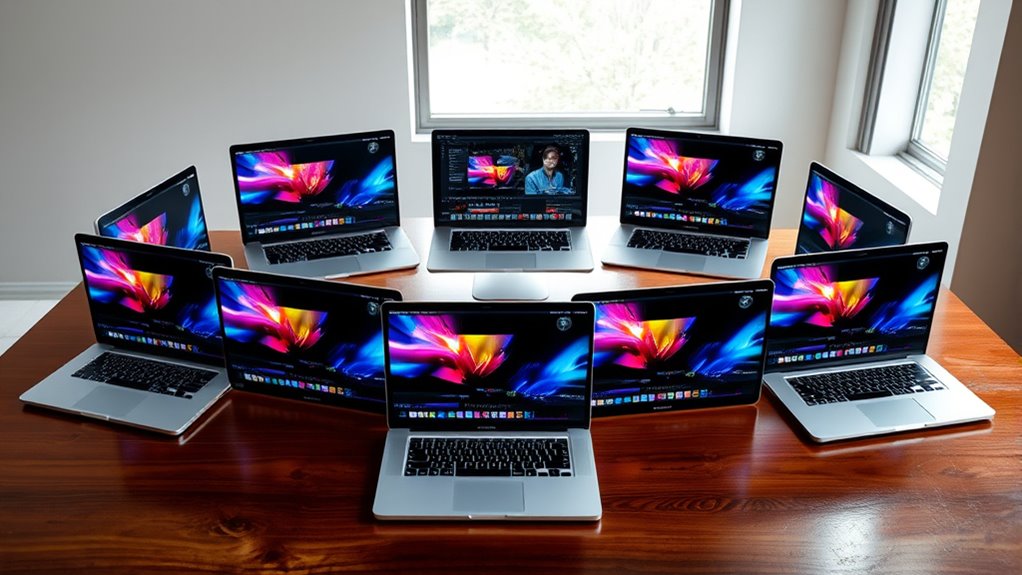
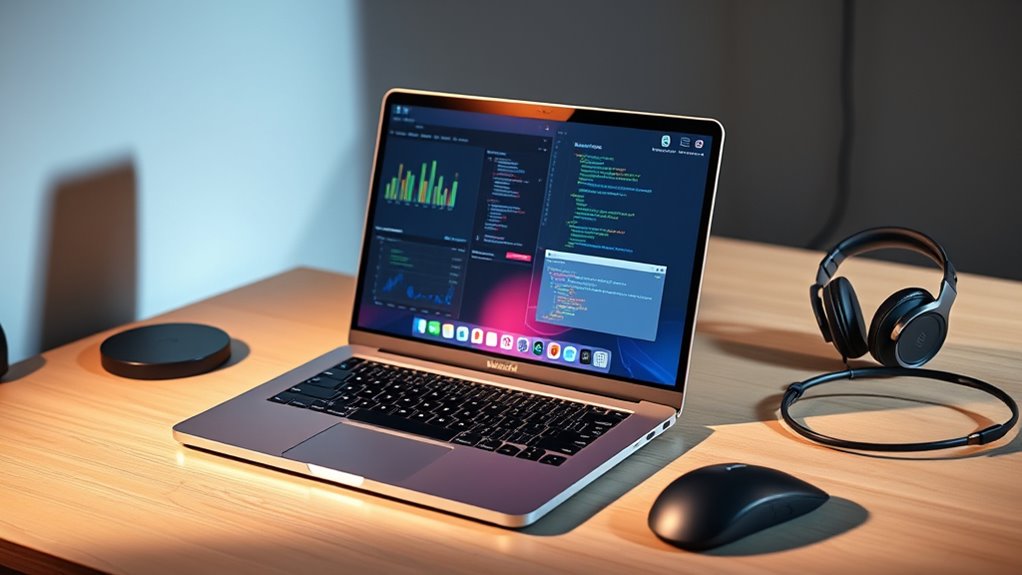
For most editors, I’d choose the 2026 16-inch MacBook Pro with M5 Pro, 48GB RAM, and 1TB SSD as the best overall balance of screen space, memory, and editing headroom. The M5 Max with 128GB RAM and 4TB SSD is the standout for demanding effects-heavy work, while the 2023 M3 Pro with 36GB RAM offers a capable renewed alternative for buyers who do not need the newest chip. The main tradeoffs are processing power versus portability, unified memory versus internal storage, and new hardware versus the uncertainty of a renewed model. I compare all 10 options by editing workload, configuration, and likely longevity; read on for the full breakdown.

Turn your quiet moments into listening time
- Thousands of audiobooks, podcasts and originals
- Listen on your phone, tablet or Echo — also offline
- Cancel anytime
Key Takeaways
- The 16-inch M5 Pro with 48GB RAM and 2TB SSD is the strongest balanced choice for editors who want room for demanding timelines and media without stepping up to an M5 Max configuration.
- The M5 Max with 128GB RAM and 4TB SSD is the clear specialist pick for memory-heavy projects, large media libraries, and intensive effects; most casual editors will not need that much capacity.
- The 24GB M5 Pro and 48GB M5 Pro configurations serve different workloads. The lower-memory model is a sensible fit for routine editing, while 48GB gives more breathing room for complex timelines and concurrent creative apps.
- Renewed models trade newer hardware for a potentially lower-cost route. The 2023 M3 Pro with 36GB RAM and the 2021 M1 Pro with 32GB RAM look more suitable for serious editing than the older 13-inch 2020 model with 16GB RAM.
- Screen size and portability change the recommendation. The 16-inch systems favor workspace and longer editing sessions, while the 14-inch M5 and M5 Max models suit mobile setups with different levels of performance headroom.


| macbook pro for video editing | Processor | Memory | Storage | Display |
|---|---|---|---|---|
| Apple 2026 MacBook Pro 16.2-in | Apple M5 Pro, 18-core CPU and 20-core GPU | 48GB unified memory | 1TB SSD | 16.2-inch Liquid Retina XDR, 1600 nits peak brightness |
| Apple 2024 MacBook Pro 16-inch | Apple M4 Max | 48GB unified memory | 1TB SSD | 16-inch Liquid Retina XDR |
| Apple 2020 MacBook Pro | 2.0GHz Intel Core i5 | 16GB | 512GB SSD | 13.3-inch Retina, 2560 x 1600 |
| Apple MacBook Pro 16.2-inch La | Apple M5 Max, 18-core CPU | 128GB unified memory | 4TB SSD | 16.2-inch Liquid Retina XDR |
| Apple MacBook Pro 16-inch | Apple M3 Pro, 12-core CPU and 18-core GPU | 36GB unified memory | 1TB SSD | 16.2-inch Liquid Retina XDR, 3456 x 2234 |
| Apple 2021 MacBook Pro with M1 | Apple M1 Pro, 10-core CPU and 16-core GPU | 32GB RAM | 512GB SSD | 16.2-inch Liquid Retina XDR, 3456 × 2234, ProMotion 120Hz |
| Apple 2026 MacBook Pro Laptop | Apple M5 Pro, 18-core CPU and 20-core GPU | 24GB unified memory | 1TB SSD | 16.2-inch Liquid Retina XDR |
| Apple 2025 MacBook Pro Laptop | Apple M5, 10-core CPU and 10-core GPU | 16GB unified memory | 1TB SSD | 14.2-inch Liquid Retina XDR |
| Apple 16-inch MacBook Pro with | Apple M5 Pro, 18-core CPU and 20-core GPU | 48GB unified memory | 2TB SSD | 16.2-inch Liquid Retina XDR |
| Apple 2026 MacBook Pro Laptop | Apple M5 Max, 18-core CPU and 32-core GPU | 36GB unified memory | 2TB SSD | 14.2-inch Liquid Retina XDR |
More Details on Our Top Picks
Apple 2026 MacBook Pro 16.2-inch (M5 Pro, 18-core CPU, 20-core GPU, 48GB RAM, 1TB SSD, Space Black)
I’d put this M5 Pro configuration first for editors who need a strong workstation without stepping up to the most specialized Max model. Its 18-core CPU, 20-core GPU, and 48GB of unified memory give demanding timelines room to run alongside color, audio, and graphics apps, while the 16.2-inch Liquid Retina XDR display offers a generous workspace and up to 1600 nits peak brightness. Compared with the renewed 2023 M3 Pro MacBook Pro, it offers a newer chip, more memory, and Thunderbolt 5; the M5 Max model still has substantially more GPU headroom and storage. The 1TB SSD may fill quickly with camera originals, so many editors will want external media storage. At 4.71 pounds, it is also a lot to carry every day, and the M5 Pro configuration supports up to three external displays.
Pros:- 18-core CPU and 20-core GPU suit demanding editing and multitasking workflows
- 48GB unified memory gives large projects and creative apps more working room
- 16.2-inch XDR display reaches 1600 nits peak brightness
- Three Thunderbolt 5 ports plus HDMI, SDXC, and MagSafe 3 simplify workstation connections
Cons:- 1TB SSD can be restrictive for large video libraries and source media
- 4.71-pound chassis is less convenient for frequent travel
- Supports up to three external displays, fewer than some higher-end workstation needs may require
Best for: Video editors who work with demanding projects on location and want a large built-in display, 48GB of memory, and current-generation connectivity.
Not ideal for: Editors with extensive local footage archives or GPU-heavy effects pipelines who need more than 1TB of internal storage or the M5 Max’s 40-core GPU.
- Processor:Apple M5 Pro, 18-core CPU and 20-core GPU
- Memory:48GB unified memory
- Storage:1TB SSD
- Display:16.2-inch Liquid Retina XDR, 1600 nits peak brightness
- Ports:Three Thunderbolt 5, HDMI, SDXC, MagSafe 3
- External displays:Up to three
- Wireless:Wi-Fi 7 and Bluetooth 6
- Weight:4.71 pounds
Our verdict“Choose this M5 Pro if you want a capable, well-connected 16-inch editing MacBook without needing the M5 Max’s extra GPU and storage capacity.”
Apple 2024 MacBook Pro 16-inch with M4 Max Chip, 48GB RAM, 1TB SSD, Space Black (Renewed)
The M4 Max makes this renewed 16-inch model a better fit than the M5 Pro for editors whose timelines lean heavily on GPU-accelerated effects, compositing, or high-resolution footage. It pairs that chip with 48GB of unified memory and a 16-inch Liquid Retina XDR display, so it remains a substantial editing workstation even beside newer machines. The 2026 M5 Pro MacBook Pro has a newer generation chip and Thunderbolt 5, while this model’s appeal is access to the Max tier in a renewed configuration. The catch is that the listing does not specify the Max CPU/GPU core count or display brightness, making direct performance comparisons less precise. It is also renewed, so condition and warranty coverage may differ from a new laptop. Its 1TB SSD can be tight for editors who keep multiple projects on the machine.
Pros:- M4 Max chip is aimed at demanding professional creative workflows
- 48GB unified memory supports large projects and multitasking
- 16-inch Liquid Retina XDR display provides a large editing workspace
- HDMI, SDXC, MagSafe, and Thunderbolt ports support common editing peripherals
Cons:- Renewed condition may include cosmetic wear or limited warranty coverage
- 1TB SSD may require external storage for extensive footage libraries
- Product details do not provide the M4 Max core count or display brightness
Best for: Editors who prioritize a Max-class chip for GPU-intensive work and are comfortable buying a renewed 16-inch Mac with condition and warranty variation.
Not ideal for: Buyers who want a new machine, clearly specified chip-core counts, or more than 1TB of internal space for active video projects.
- Processor:Apple M4 Max
- Memory:48GB unified memory
- Storage:1TB SSD
- Display:16-inch Liquid Retina XDR
- Ports:Thunderbolt ports, HDMI, SDXC, MagSafe
- Keyboard:QWERTY English Magic Keyboard with Touch ID
- Color:Space Black
- Condition:Renewed
Our verdict“Pick this renewed M4 Max when GPU-focused editing matters more than having the newest generation or the certainty of a new-unit purchase.”
Apple 2020 MacBook Pro (13-inch, 16GB RAM, 512GB SSD, Space Gray, Renewed)
This renewed 2020 MacBook Pro is the entry point here for learning editing basics, cutting short projects, or working with lighter footage. Its 13.3-inch Retina display and 16GB of RAM can handle modest editing sessions, but its Intel Core i5 and integrated Intel Iris Plus graphics put it well behind the M-series machines in this roundup. The contrast is clearest beside the 2023 M3 Pro model: that 16-inch Mac offers a stronger editing-oriented chip, 36GB of memory, and a much larger XDR workspace. This older laptop’s smaller size and 3.1-pound weight are easier to carry, but the 512GB SSD leaves less room for source files and finished work. I’d treat it as a starter machine, not a long-term choice for heavy 4K timelines or effects-heavy projects; renewed condition adds another point to check before buying.
Pros:- 13.3-inch Retina display keeps the laptop compact
- 16GB RAM and a 512GB SSD provide a workable base for modest projects
- 3.1-pound weight is lighter than the 16-inch editing models in this roundup
- Backlit keyboard and fingerprint reader support everyday use
Cons:- Intel Core i5 and integrated graphics are less suited to demanding video work than the M-series options
- 512GB SSD limits space for footage and active projects
- Renewed condition and limited warranty can vary
Best for: Students and first-time editors learning cuts, titles, and basic timelines on short or lower-demand projects.
Not ideal for: Professional editors, frequent 4K or effects-heavy workflows, and buyers who need a large display or ample internal media storage.
- Model year:2020
- Processor:2.0GHz Intel Core i5
- Graphics:Intel Iris Plus Graphics
- Memory:16GB
- Storage:512GB SSD
- Display:13.3-inch Retina, 2560 x 1600
- Weight:3.1 pounds
- Condition:Renewed
Our verdict“Choose this only as a compact starter Mac for light editing; move to an M-series 16-inch model for sustained professional work.”
Apple MacBook Pro 16.2-inch Laptop with M5 Max Chip, 128GB RAM, 4TB SSD, Space Black
For editors working with complex timelines, large media libraries, and demanding effects, this is the most expansive configuration in the group. The M5 Max with a 40-core GPU, 128GB of unified memory, and a 4TB SSD offers far more headroom than the M5 Pro model’s 48GB of memory and 1TB drive. That difference matters when a workflow keeps high-resolution footage, large applications, and multiple creative tasks active without leaning as heavily on external storage. The 16.2-inch Liquid Retina XDR display provides a broad workspace, while Thunderbolt 5, HDMI, and SDXC cover common studio connections. This capacity comes with clear costs: the large chassis is less travel-friendly, and the configuration is likely to be more machine than editors with straightforward cuts need. I’d reserve it for workloads that can use its extra GPU, memory, and local storage.
Pros:- M5 Max chip includes a 40-core GPU for demanding graphics workloads
- 128GB unified memory supports large, complex creative sessions
- 4TB SSD provides substantial room for active footage and project files
- Thunderbolt 5, HDMI, SDXC, and MagSafe 3 suit studio and field workflows
Cons:- Large 16-inch chassis is less convenient to carry frequently
- The high memory and storage configuration may exceed the needs of routine editing
- The listing does not specify display brightness or weight
Best for: Editors handling complex, effects-heavy projects or large libraries who need substantial unified memory and internal storage in one workstation.
Not ideal for: Travel-focused editors, basic timeline users, and buyers whose projects fit comfortably within a lower-memory, smaller-storage configuration.
- Processor:Apple M5 Max, 18-core CPU
- Graphics:40-core GPU
- Memory:128GB unified memory
- Storage:4TB SSD
- Display:16.2-inch Liquid Retina XDR
- Ports:Three Thunderbolt 5, MagSafe 3, SDXC, HDMI, headphone jack
- Wireless:Wi-Fi 7 and Bluetooth 6
- Battery life:All-day
Our verdict“Choose this M5 Max workstation when your editing work can use its 40-core GPU, 128GB of memory, and 4TB of local storage.”
Apple MacBook Pro 16-inch (2023, Renewed) – M3 Pro Chip, 12-Core CPU, 18-Core GPU, 36GB RAM, 1TB SSD, Space Black
This renewed M3 Pro is the sensible middle ground for editors who want a substantial 16-inch workspace and strong editing hardware without moving to the newer M5 configurations. Its 12-core CPU, 18-core GPU, and 36GB of unified memory suit multitasking and professional timelines better than the 2020 Intel MacBook Pro, while the 1TB SSD gives projects more breathing room than that older model’s 512GB drive. Against the 2026 M5 Pro, however, it gives up newer-generation processing and Thunderbolt 5; the M5 Pro also has more memory. The Liquid Retina XDR screen supports ProMotion up to 120Hz, and its HDMI and SDXC ports reduce the need for adapters. The tradeoffs are its renewed condition, older chip generation, and 4.8-pound weight. It is a capable choice if the configuration fits the work, but not the pick for buyers who require a new machine or the newest platform.
Pros:- M3 Pro combines a 12-core CPU with an 18-core GPU for professional workflows
- 36GB unified memory supports substantial multitasking
- 16.2-inch XDR display includes ProMotion up to 120Hz
- 1TB SSD plus HDMI, SDXC, Thunderbolt 4, and MagSafe 3 supports practical editing setups
Cons:- Renewed condition may mean cosmetic wear or different warranty coverage
- Older M3 Pro generation lacks the newer M5 Pro model’s Thunderbolt 5 connectivity
- At 4.8 pounds, it is the heaviest specified laptop in this group
Best for: Independent editors and advanced students who want a 16-inch XDR display, 36GB of memory, and a dedicated editing-class chip in a renewed laptop.
Not ideal for: Buyers who require a new-unit warranty, the latest chip generation, Thunderbolt 5, or a lighter daily-carry laptop.
- Processor:Apple M3 Pro, 12-core CPU and 18-core GPU
- Memory:36GB unified memory
- Storage:1TB SSD
- Display:16.2-inch Liquid Retina XDR, 3456 x 2234
- Refresh rate:Up to 120Hz with ProMotion
- Ports:Three Thunderbolt 4, HDMI, SDXC, MagSafe 3, 3.5mm headphone jack
- Weight:4.8 pounds
- Condition:Renewed
Our verdict“Pick this renewed M3 Pro for serious 16-inch editing when its 36GB memory and 1TB SSD matter more than having the latest chip generation.”
Apple 2021 MacBook Pro with M1 Pro Chip (16-inch, 32GB RAM, 512GB SSD) – Space Gray (Renewed)
I’d choose this renewed 16-inch model for editors who want a large, color-focused screen and ample memory without needing the newest chip generation. Its 10-core M1 Pro and 32GB of RAM suit demanding editing timelines and multitasking, while the Liquid Retina XDR display gives more room to inspect footage than the 14.2-inch M5 models in this lineup. The tradeoff is age: compared with the 16-inch M5 Pro, it has an older processor and less storage, and its renewed condition may bring cosmetic wear or less warranty coverage. The 512GB SSD can fill quickly with source footage, so I’d plan on external storage. It makes the most sense when screen size and memory matter more than having the latest hardware.
Pros:- 32GB of memory supports multitasking across editing and creative apps
- 16.2-inch Liquid Retina XDR display offers generous workspace for timelines and preview
- M1 Pro 10-core CPU and 16-core GPU are suited to demanding creative workloads
- Up to 20–21 hours of stated battery life supports long work sessions away from an outlet
Cons:- Renewed condition may mean cosmetic imperfections or limited warranty coverage
- 512GB SSD leaves less room for footage than the 1TB and 2TB options here
- Older M1 Pro chip trails the M5 Pro and M5 Max models in this roundup
Best for: Video editors who want a roomy 16-inch XDR screen and 32GB of memory, and are comfortable buying a renewed Mac with external storage.
Not ideal for: Editors who need a new-machine warranty, substantial built-in space for large media libraries, or the latest performance and connectivity.
- Processor:Apple M1 Pro, 10-core CPU and 16-core GPU
- Memory:32GB RAM
- Storage:512GB SSD
- Display:16.2-inch Liquid Retina XDR, 3456 × 2234, ProMotion 120Hz
- Battery life:20–21 hours
- Camera:1080p FaceTime HD
- Audio:Six-speaker system
- Security and OS:Touch ID; macOS
- Finish:Space Gray
Our verdict“Choose this renewed MacBook if you value a large editing display and 32GB RAM more than newer hardware, extra storage, or renewed-product certainty.”
Apple 2026 MacBook Pro Laptop with M5 Pro Chip, 16.2-inch Liquid Retina XDR Display, 24GB RAM, 1TB SSD, Space Black
This is my pick for editors who want a current-generation 16-inch MacBook Pro but don’t need the extra memory and storage of the 48GB M5 Pro configuration. The M5 Pro with an 18-core CPU and 20-core GPU is aimed at sustained creative work, and the 1TB SSD gives a more practical starting point for active projects than the 512GB drive in the renewed M1 Pro. Its large XDR panel is also better suited to long timeline sessions than the compact M5 model. The compromise is 24GB of unified memory, which gives less headroom for unusually complex projects than the 48GB M5 Pro or 36GB M5 Max options. I’d also factor in its 4.71-pound weight if I planned to carry it daily.
Pros:- M5 Pro 18-core CPU and 20-core GPU target demanding editing workloads
- 16.2-inch Liquid Retina XDR display provides a large workspace
- 1TB SSD offers more working room than the 512GB renewed M1 Pro configuration
- Thunderbolt 5, SDXC, HDMI, and MagSafe 3 support varied editing setups
Cons:- 24GB memory offers less headroom than the 48GB M5 Pro and 36GB M5 Max models
- At 4.71 pounds, it is a substantial carry for frequent travel
- Its Apple ecosystem focus may not suit buyers who need another operating system
Best for: Editors who work on demanding projects and want a current 16-inch display with 1TB storage, without stepping up to 48GB memory.
Not ideal for: Editors with memory-heavy effects, extensive multitasking, or a frequent need to carry a lighter laptop.
- Processor:Apple M5 Pro, 18-core CPU and 20-core GPU
- Memory:24GB unified memory
- Storage:1TB SSD
- Display:16.2-inch Liquid Retina XDR
- Battery life:All-day
- Wireless:Wi-Fi 7 and Bluetooth 6
- Ports:Three Thunderbolt 5, MagSafe 3, SDXC, HDMI, headphone jack
- Weight:4.71 pounds
- Finish:Space Black
Our verdict“Pick this model for current-generation M5 Pro performance and a large screen, unless your projects need more than 24GB of memory or portability comes first.”
Apple 2025 MacBook Pro Laptop with M5 Chip, 14.2-inch Liquid Retina XDR Display, 16GB RAM, 1TB SSD, Space Black
I’d pick this 14.2-inch MacBook Pro when a smaller footprint matters more than maximum editing headroom. The M5 chip with a 10-core CPU and GPU pairs with a 1TB SSD, giving mobile editors a capable setup for project work without carrying the larger 16-inch M5 Pro. Its XDR display and all-day battery claim make it a more serious editing choice than a basic travel laptop, and the SDXC and HDMI ports can simplify a compact on-location setup. The main limitation is 16GB of unified memory: compared with the 24GB M5 Pro, 48GB M5 Pro, or 36GB M5 Max options, it leaves less room for complex timelines and heavy multitasking. I’d choose it for portability, not for the most demanding post-production workloads.
Pros:- 14.2-inch form is more compact than the 16-inch M5 Pro options
- M5 10-core CPU and GPU provide a capable foundation for creative work
- 1TB SSD offers useful project space compared with the 512GB renewed model
- SDXC, HDMI, and three Thunderbolt 4 ports suit common editing connections
Cons:- 16GB unified memory is the lowest capacity among the new models in this batch
- Smaller display gives less room for timelines and preview than 16-inch models
- The listed port selection may still require adapters for some editing setups
Best for: Mobile editors who need a compact MacBook Pro with 1TB storage for lighter projects, field work, or a secondary editing machine.
Not ideal for: Editors handling complex timelines, heavy effects, or multiple demanding apps who would benefit from more than 16GB of memory.
- Processor:Apple M5, 10-core CPU and 10-core GPU
- Memory:16GB unified memory
- Storage:1TB SSD
- Display:14.2-inch Liquid Retina XDR
- Battery life:All-day
- Ports:Three Thunderbolt 4, MagSafe 3, SDXC card slot, HDMI, headphone jack
- Finish:Space Black
Our verdict“Choose this compact M5 model for mobile editing and a 1TB drive, but step up to an M5 Pro or M5 Max for memory-intensive projects.”
Apple 16-inch MacBook Pro with M5 Pro Chip, 48GB RAM, 2TB SSD, Space Black (2026)
For editors who routinely keep large projects and several demanding apps open, I’d favor this 48GB memory, 2TB SSD configuration over the 24GB M5 Pro. Both use the M5 Pro 18-core CPU and 20-core GPU, so this model’s distinction is less about the chip and more about giving video projects room to breathe: more memory for layered workflows and more internal space for footage, cache, and active files. The 16.2-inch Liquid Retina XDR display also provides more editing workspace than the 14.2-inch M5 Max. That Max model has a 32-core GPU, making it a stronger fit when GPU throughput is the priority; this M5 Pro is a better match when memory and storage are the constraints. Its large chassis and high-end configuration are not for light editing or frequent travel.
Pros:- 48GB unified memory supports demanding multitasking and complex editing sessions
- 2TB SSD provides substantial internal space for active footage and project files
- M5 Pro 18-core CPU and 20-core GPU support professional creative workloads
- 16.2-inch Liquid Retina XDR display gives a spacious editing workspace
Cons:- Large 16-inch design is less convenient for frequent travel
- M5 Max 14-inch option has a higher-core-count GPU for GPU-heavy work
- The high-memory, high-storage configuration may be more machine than lighter workflows need
Best for: Professional editors managing large media libraries, complex timelines, and multiple creative apps who want substantial built-in memory and storage.
Not ideal for: Travel-first editors, casual video creators, or GPU-focused users who would benefit more from the M5 Max’s 32-core GPU.
- Processor:Apple M5 Pro, 18-core CPU and 20-core GPU
- Memory:48GB unified memory
- Storage:2TB SSD
- Display:16.2-inch Liquid Retina XDR
- Battery life:All-day
- Power adapter:140W USB-C Power Adapter
- Finish:Space Black
Our verdict“Choose this M5 Pro configuration when memory, internal storage, and a large screen matter more than a smaller body or the M5 Max GPU.”
Apple 2026 MacBook Pro Laptop with M5 Max Chip, 14.2-inch Liquid Retina XDR Display, 36GB RAM, 2TB SSD, Wi-Fi 7, Space Black
This 14.2-inch M5 Max is the most GPU-focused choice in this batch, pairing an 18-core CPU and 32-core GPU with 36GB of memory and a 2TB SSD. I’d shortlist it for editors using GPU-intensive effects or graphics workflows who want more processing headroom than the 10-core M5 model, without moving to a 16-inch machine. Compared with the 16-inch M5 Pro with 48GB RAM, it trades some memory and screen area for a higher-core-count GPU and a smaller display footprint. That makes it a distinctive fit rather than a universal upgrade: the 48GB M5 Pro may suit memory-heavy timelines better, while this Max configuration favors GPU work. Its 14.2-inch panel also gives less room for a timeline, and the listed port set may not cover every studio peripheral without a hub.
Pros:- M5 Max 32-core GPU targets demanding graphics and effects workloads
- 36GB unified memory supports substantial creative multitasking
- 2TB SSD provides room for large active projects and media files
- 14.2-inch XDR display makes this a more compact alternative to the 16-inch M5 Pro
Cons:- Smaller display offers less timeline and preview space than the 16-inch M5 Pro models
- 36GB memory is less than the 48GB offered by the 16-inch M5 Pro configuration
- Some external-device setups may need a hub or adapters
Best for: Editors working with GPU-heavy effects, graphics, or demanding creative tasks who want strong performance in a 14.2-inch MacBook Pro.
Not ideal for: Editors who prioritize a large timeline workspace, need more than 36GB of memory, or rely on peripherals beyond the listed ports.
- Processor:Apple M5 Max, 18-core CPU and 32-core GPU
- Memory:36GB unified memory
- Storage:2TB SSD
- Display:14.2-inch Liquid Retina XDR
- Battery life:All-day
- Wireless:Wi-Fi 7 and Bluetooth 6
- Ports:Three Thunderbolt 5, MagSafe 3, SDXC, HDMI, headphone jack
- Finish:Space Black
Our verdict“Choose this M5 Max when GPU performance and a 2TB drive matter more than a larger screen or the 48GB memory in the 16-inch M5 Pro.”

How We Picked
I ranked these MacBook Pros around the demands of video editing rather than treating the newest chip as an automatic winner. The main factors were chip tier, unified memory, internal storage, display size, and how each configuration fits common workloads—from cutting short-form footage to handling layered timelines, effects, and high-resolution media. I also weighed the practical tradeoffs of renewed hardware, including its age relative to the newer M5 options.
The order favors balanced configurations that can serve a broad range of editors, followed by specialized high-performance systems, then more portable or older value-oriented choices. A large memory or storage configuration can move a model up for the right workload, but it does not make that configuration the best fit for every buyer. Since the list does not specify codec benchmarks, battery results, or renewed-unit condition, I avoid claiming measured performance and judge the options by their listed specifications and likely role.
| macbook pro for video editing | Ports | Finish |
|---|---|---|
| Apple 2026 MacBook Pro 16.2-in | Three Thunderbolt 5, HDMI, SDXC, MagSafe 3 | — |
| Apple 2024 MacBook Pro 16-inch | Thunderbolt ports, HDMI, SDXC, MagSafe | — |
| Apple 2020 MacBook Pro | — | — |
| Apple MacBook Pro 16.2-inch La | Three Thunderbolt 5, MagSafe 3, SDXC, HDMI, headphone jack | — |
| Apple MacBook Pro 16-inch | Three Thunderbolt 4, HDMI, SDXC, MagSafe 3, 3.5mm headphone jack | — |
| Apple 2021 MacBook Pro with M1 | — | Space Gray |
| Apple 2026 MacBook Pro Laptop | Three Thunderbolt 5, MagSafe 3, SDXC, HDMI, headphone jack | Space Black |
| Apple 2025 MacBook Pro Laptop | Three Thunderbolt 4, MagSafe 3, SDXC card slot, HDMI, headphone jack | Space Black |
| Apple 16-inch MacBook Pro with | — | Space Black |
| Apple 2026 MacBook Pro Laptop | Three Thunderbolt 5, MagSafe 3, SDXC, HDMI, headphone jack | Space Black |
Factors to Consider When Choosing Macbook Pro For Video Editing
I’d start with the projects you actually edit, then choose the configuration that removes your biggest bottleneck. A higher chip tier can help with demanding effects and processing, but memory, storage, screen size, and your external-drive workflow can matter just as much.
Match the Chip Tier to Your Timeline
Think about how much work your timeline asks the computer to do at once: footage decoding, color effects, stabilization, compositing, and exports can all add pressure. An M5 or M5 Pro configuration can make more sense for routine editing than paying for an M5 Max you rarely fully use. Editors who stack effects, work with complex multicamera sequences, or run several creative apps may benefit more from the Max tier. Don’t assume chip names alone settle the choice; configuration and project type shape the experience. If your current workflow relies on proxy media, a less powerful system may remain practical. Spend for the chip tier that addresses a real workload limit, not an imagined future one.
Choose Memory for the Whole Session
Video editing memory needs extend beyond the editing app: browser tabs, audio tools, motion graphics, and reference footage may all be open at the same time. More unified memory can reduce pressure when a project has large assets or many layers, but it is easy to overspend if your edits are short and straightforward. Treat the 24GB, 36GB, 48GB, and 128GB configurations in this roundup as workload tiers, not a simple ladder where every step is necessary. Since memory is built into the system, choose for the kind of work you expect to keep doing rather than assuming it can be upgraded later. For mixed creative work, prioritize enough headroom to keep your editing session comfortable. If you mainly cut basic footage, put the saved capacity toward storage or a reliable backup setup.
Plan Storage Around Active Media and Backups
Internal SSD capacity affects how much footage, cache, and active project material you can keep close at hand, but it should not be the only place your work lives. The 512GB and 1TB configurations can be workable with a disciplined external-drive workflow; larger internal drives suit editors who keep more projects on the laptop or travel with large media sets. A common mistake is buying extra internal capacity while leaving no budget or plan for a second copy of important footage. Separate active project storage from long-term archive and backup where possible. Check that your external drives and card readers fit your connection needs before choosing a laptop configuration. A compact, dependable workflow can matter more than maximizing the built-in SSD.
Pick a Screen Size for Where You Edit
A 16-inch display gives more room for a timeline, preview, scopes, and panels, which can make long editing sessions less cramped. The 14-inch models are easier to carry and better suited to editors who move between locations or use an external monitor at a desk. Neither size is automatically better: portability matters if the laptop travels daily, while built-in workspace matters when it often serves as the main screen. Consider whether you routinely connect an external display and whether your editing setup has a fixed desk. A larger laptop may save some window juggling, but it adds bulk to a mobile kit. Choose around your actual editing environment, not screen size alone.
Weigh Renewed Hardware Against Newer Configurations
Renewed MacBook Pros can offer a route to a more capable memory configuration without choosing the latest generation, but their age and condition deserve attention. Check the seller’s return window, warranty terms, battery condition information, and what is included before making a decision. A renewed M3 Pro or M1 Pro may suit an editor whose software and footage needs are established, while buyers planning a longer ownership period may prefer a newer M5 system. Do not compare only the chip label: the older models here include 32GB or 36GB RAM options, while the 2020 13-inch model has 16GB. Confirm that your editing applications support the system and workflow you rely on. If downtime would disrupt paid work, warranty coverage and service access deserve extra weight.
Pay for Headroom Only When Your Work Uses It
The M5 Max configurations with larger memory and storage are aimed at demanding work, not every editor who wants a fast laptop. High-resolution effects-heavy projects, large creative applications, and dense timelines can make extra headroom useful; ordinary cuts and basic color work may not. List the tasks that currently cause slowdowns and identify whether they stem from processing, memory, storage, or the editing app itself. If footage is stored on a slow external drive, a higher chip tier may not fix the actual bottleneck. A more balanced M5 Pro system can leave room for a good external monitor, storage, or backup drives. Buy the upgrade that addresses a repeated constraint rather than the largest specification available.
Frequently Asked Questions
Is 24GB of memory enough for video editing on a MacBook Pro?
It can be enough for straightforward editing, shorter projects, and workflows that do not keep many heavy apps open at once. If you regularly work with layered effects, high-resolution footage, large timelines, or motion graphics, more memory gives you additional room to work. In this roundup, the 24GB M5 Pro configuration is the more restrained choice compared with the 48GB M5 Pro models. Consider the projects you expect to edit over the laptop’s useful life, since unified memory is not a later upgrade. If you are unsure and your work is growing in complexity, extra memory may be a more useful investment than moving up a chip tier alone.
Should I choose the 14-inch M5 Max or a 16-inch M5 Pro for editing?
Choose the 14-inch M5 Max if your workload benefits from its higher-tier chip and you value a smaller laptop for travel. Choose a 16-inch M5 Pro if a larger built-in workspace and a balanced editing configuration fit your day-to-day work better. The 14-inch model’s listed 36GB RAM and 2TB SSD differ from the 16-inch M5 Pro options with 48GB RAM, so compare the full configuration rather than chip tier alone. If you mostly edit at a desk with an external display, the smaller built-in screen may matter less. For long sessions away from a monitor, the 16-inch screen can be the more comfortable fit.
Is a renewed M3 Pro or M1 Pro a sensible choice for paid editing work?
It can be, especially if your editing needs are established and the system’s memory and storage match your projects. The renewed M3 Pro listed here has 36GB RAM, while the renewed M1 Pro has 32GB, making them more suitable for demanding work than the 2020 13-inch model with 16GB. For paid work, seller warranty, return terms, battery condition, and service options deserve careful checking because downtime has a real cost. Confirm that your editing software supports the machine and that any required media formats fit your workflow. If you need a laptop for several years of expanding work, a newer M5 configuration may offer a more reassuring starting point.
Is a 1TB SSD enough if I edit video on the go?
A 1TB SSD can suit mobile editing when you keep active projects local and move finished work to external storage or an archive. It may feel tight if you carry several large projects, cache files, and source media without a dependable drive workflow. The 2TB and 4TB options in this roundup reduce that pressure, but a larger internal SSD does not replace a backup. Before choosing, estimate the size of a typical project and how many you need available at once. Also check whether your external drives and card readers are practical for your travel setup. Editors who work offline often may value more internal capacity than those with a consistent external-drive routine.
Do I need an M5 Max for 4K or 8K video editing?
Not automatically. Resolution is only one part of the workload; codec, effects, number of layers, project length, and editing software all affect how demanding a timeline feels. An M5 Pro with suitable memory may handle a workflow that does not need the Max tier, while complex effects-heavy projects can benefit from the extra headroom of an M5 Max. Proxy editing can also make some demanding footage easier to handle without choosing the largest configuration. Think about real-time playback and export needs rather than resolution labels alone. If the work is paid and time-sensitive, prioritize a configuration that supports your actual project complexity and a reliable media workflow.
Conclusion
For the best overall, I’d pick the 16-inch M5 Pro with 48GB RAM and 2TB SSD: it pairs a spacious display with substantial memory and storage without defaulting to Max-class hardware. The best value is the renewed 2023 M3 Pro with 36GB RAM for buyers comfortable checking condition and warranty details. For the best premium option, the M5 Max with 128GB RAM and 4TB SSD suits unusually demanding projects and large media libraries. Beginners can start with the 14-inch M5 model for a more portable, less specialized setup, while editors focused on travel should compare it with the 14-inch M5 Max if their workload calls for more power. For a specific need—maximum memory and internal storage—the 16-inch M5 Max is the specialist pick; for a tighter editing setup, I’d favor the newer M5 Pro configurations over the older 13-inch 2020 model.
Halloween Picks
halloween
As an affiliate, we earn on qualifying purchases.