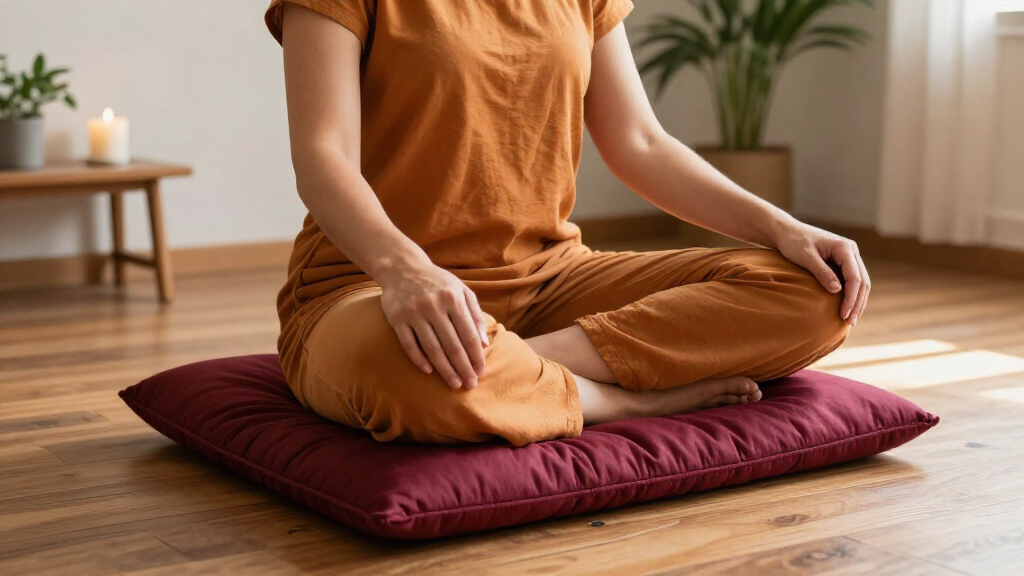

Choosing between a zafu and a zabuton is really a choice about what needs support during meditation. A zafu is a compact cushion that raises your hips; a zabuton is a broad, flat mat that cushions your knees, ankles, and feet against the floor. They are often used together, but they solve different problems.

Turn your quiet moments into listening time
- Thousands of audiobooks, podcasts and originals
- Listen on your phone, tablet or Echo — also offline
- Cancel anytime

Retrospec Sedona Zafu Meditation Cushion with Buckwheat Hulls
- ✔ Shape: Zafu
- ✔ Dimensions: 17 × 10.5 × 5.5 in
- ✔ Fill: Buckwheat hulls

Hihealer Crescent Meditation Cushion with Buckwheat Filling
- ✔ Shape: Crescent
- ✔ Dimensions: 25.2 × 9.5 in
- ✔ Thickness: 1 in

Hihealer Meditation Cushion, Large Velvet Floor Pillow for Yoga, Meditation
- ✔ Shape: Round
- ✔ Dimensions: 36 × 36 × 9 in
- ✔ Weight: 3 lb
If sitting cross-legged feels restrictive or your lower back rounds, a zafu is usually the more useful first purchase. If your posture already feels stable but your joints press painfully into a hard floor, a zabuton may bring more relief. The right choice depends less on spiritual symbolism or appearance than on your body, sitting position, and practice space.
At a Glance
| Criteria | Zafu meditation cushion | Zabuton meditation mat | Winner |
|---|---|---|---|
| Primary support | Raises the pelvis and supports seated posture | Adds padding between the sitter and the floor | Depends |
| Posture and hip comfort | Often helps the hips sit above the knees and reduces strain | Does not meaningfully raise the hips or correct a low seat | A |
| Knee and ankle cushioning | Limited; covers only the area beneath the seat | Broad surface cushions knees, ankles, and feet | B |
| Portability and storage | Compact and relatively easy to carry or store | Bulkier and takes more storage space | A |
| Practice versatility | Useful for cross-legged, kneeling, and some seated practices | Useful beneath a zafu, bench, or other floor seat | Depends |
| Typical cost and value | Usually the less expensive single item; strong value if elevation is the main need | Can cost more than a small cushion; worthwhile when floor pressure is the problem | Depends |
Retrospec Sedona Zafu Meditation Cushion with Buckwheat Hulls
The Retrospec Sedona Zafu earns our top spot because it gives meditators a way to adjust the seat itself. Its buckwheat hulls can be added or removed through an adjustable inner compartment, which makes it easier to tailor firmness and height to a preferred posture than either Hihealer option, whose fills are described as fixed. That matters when we are still learning what support feels right or our comfort needs change between sessions.At 17 × 10.5 × 5.5 inches, the Sedona is much more compact than the 36-inch Hihealer floor pillow and less expansive than the crescent cushion. Its built-in handle supports carrying it between rooms or to a studio. The cotton cover is machine washable, a practical advantage over both velvet models, which call for spot cleaning. The tradeoff is the smaller seating area: compared with the broad Hihealer pillow, it may feel restrictive to anyone who shifts position or wants space for floor stretching. Its zafu profile is also less specifically contoured for knee and ankle clearance than the crescent.For a spiritual practice that values a tunable, portable seat over decorative scale, this is the clearest all-round fit. We should look elsewhere if we need a very broad cushion or want a crescent-shaped support surface.
Pros:
- Adjustable buckwheat filling lets us change the cushion’s firmness.
- Machine-washable cotton cover simplifies routine care.
- Built-in handle and 16-ounce listed weight support portability.
- Compact zafu dimensions suit dedicated seated meditation.
Cons:
- The 17 × 10.5-inch footprint may feel small for some seating preferences.
- Buckwheat support is a firmer, more structured feel than the Hihealer memory foam pillow.
Best for: Meditators who want to tune firmness, carry their cushion, and wash the cover regularly.
Not ideal for: People who need a wide surface for changing positions or want a crescent shape around the legs.
Bottom line: Choose the Sedona when adjustable, washable, portable support matters more than a wide or contoured seat.
“Choose the Sedona when adjustable, washable, portable support matters more than a wide or contoured seat.”
Hihealer Crescent Meditation Cushion with Buckwheat Filling
Where the Sedona provides a conventional zafu seat, the Hihealer Crescent makes its strongest case through shape. Its curved profile is intended to support seated posture while leaving room around the knees and ankles, making it the more targeted option for meditators who find a straight-edged cushion awkward. Firm buckwheat hulls are described as conforming to the body while maintaining stability, a distinct feel from the softer, medium-firm memory foam in Hihealer’s large floor pillow.The crescent is listed at 25.2 × 9.5 inches, so it has a longer, narrower footprint than the Sedona and a far smaller overall presence than the 36 × 36-inch pillow. A carry handle helps move it indoors, but the listing specifies indoor use only. We also have to weigh the stated thickness of just one inch: despite the intended posture and pressure benefits, that specification may mean limited cushioning for people who need a substantial lift or a softer landing. The velvet cover is spot-clean only, less convenient than the Sedona’s washable cotton.This is the lineup’s most specialized design. It makes sense when the curved shape addresses a real fit issue; if we mainly want adjustability, the Sedona is more flexible, and if we want a plush, spacious surface, the large Hihealer pillow is the better match.
Pros:
- Crescent shape is intended to support seated posture and reduce pressure around knees and ankles.
- Buckwheat filling conforms while retaining firm support.
- Carry handle makes it easier to move between indoor practice spaces.
- Velvet cover gives the cushion a soft surface.
Cons:
- Listed one-inch thickness may provide limited cushioning.
- Indoor use only, according to the product details.
- Spot-clean-only velvet requires more careful maintenance than the Sedona’s cotton cover.
Best for: Meditators seeking a curved buckwheat seat designed to create room around the knees and ankles.
Not ideal for: Anyone who wants thick cushioning, machine-washable care, or an outdoor meditation cushion.
Bottom line: Pick the Crescent when its curved shape suits your seated posture and you are comfortable with a thin, firm cushion.
“Pick the Crescent when its curved shape suits your seated posture and you are comfortable with a thin, firm cushion.”
Hihealer Meditation Cushion, Large Velvet Floor Pillow for Yoga, Meditation
The Hihealer Large Velvet Floor Pillow is the lineup’s roomiest pick, with a generous 36 × 36 × 9-inch profile and medium-firm memory foam filling. That broad surface gives us more freedom to settle into different seated positions than the Sedona’s compact zafu, and the round shape can also serve as a bolster for stretching and relaxation. Its floral purple velvet brings a decorative, soothing presence to a meditation corner, so this cushion can work as part of the room as well as a seat.Its scale is also the central compromise. At three pounds, it is not especially heavy by the listed weight, but its footprint can be difficult to store in a small room or move out of the way between sessions. Unlike the Sedona’s buckwheat fill, the memory foam is not described as adjustable, so we have less ability to tune support to our preferred height or firmness. Its spot-clean-only care also makes routine maintenance less convenient than a removable, machine-washable cotton cover. The Crescent is a more focused choice if knee and ankle clearance is the main concern; this pillow prioritizes surface area and a softer, versatile feel instead.We would choose it for a spacious home practice area where changing positions and visual warmth matter more than portability or easy washing. For a compact daily meditation seat, the Sedona is the more practical first choice.
Pros:
- Large 36 × 36-inch surface accommodates varied sitting positions.
- Nine-inch profile and medium-firm memory foam offer a cushioned alternative to buckwheat zafus.
- Round shape can double as a bolster for stretching and relaxation.
- Floral velvet cover adds a decorative accent to a meditation space.
Cons:
- Bulky footprint can be difficult to store in a small room.
- Spot-clean-only care is less convenient than the Sedona’s machine-washable cover.
- Memory foam filling is not described as adjustable.
Best for: People with a roomy meditation space who want a broad cushion for seated practice and occasional floor relaxation.
Not ideal for: Small-space users, frequent movers, or anyone who needs adjustable fill and easy machine-washable care.
Bottom line: Choose this floor pillow when spacious, decorative comfort matters more than compact storage and easy cleaning.
“Choose this floor pillow when spacious, decorative comfort matters more than compact storage and easy cleaning.”
As an Amazon Associate we earn from qualifying purchases.
Key Differences
The most meaningful difference is where each cushion places its support. A zafu lifts the pelvis, which can make it easier to tilt the hips forward and keep the spine upright in a cross-legged position. It is often the better starting point for people who feel compressed at the hips or struggle to sit tall. A zabuton leaves the sitting height largely unchanged; its broad padding protects the knees, ankles, and feet from a hard surface.
That means a zabuton is not a substitute for a zafu when the main problem is hip tightness or a low seat. Likewise, a zafu alone may not solve discomfort where the knees or ankles touch the floor. For longer sessions on a hard floor, using both can make sense: the zafu supports posture while the zabuton cushions the lower body. But the added cost and bulk are useful only if both kinds of support address a real discomfort.
For a first purchase, start with the problem you notice during practice. Choose the zafu for elevation and posture; choose the zabuton for floor cushioning. If you sit on a chair, neither may be necessary. A folded blanket or existing pillow can also help you test what kind of support you want before buying dedicated meditation gear.
Detailed Comparison
Primary support (major difference)
A zafu concentrates support under the pelvis and lifts the sitter above the floor. A zabuton spreads padding over a larger area beneath the legs. There is no universal winner: the better option is the one that supports the part of your body causing discomfort. If you are unsure, notice whether the problem begins at your hips and lower back or where your legs meet the floor.
Posture and hip comfort (Zafu meditation cushion wins — major)
The zafu wins by a moderate to major margin for cross-legged sitters whose hips feel tight or whose back rounds. A raised seat can let the knees fall more easily below the hips, though cushion height and individual flexibility matter. A zabuton provides floor padding but does little to change hip position. If you already sit upright comfortably, that advantage may not matter.
Knee and ankle cushioning (Zabuton meditation mat wins — major)
The zabuton is the clear winner for cushioning joints and feet that press against a hard floor. Its broad footprint covers more than the seat area, while a zafu offers little padding under the legs. The practical difference is major during longer sessions on tile, wood, or another firm surface. On carpet or a soft rug, the gain may be smaller.
Portability and storage (Zafu meditation cushion wins — moderate)
The zafu wins by a moderate margin because it is smaller and easier to tuck away or carry. A zabuton needs more storage space and is less convenient for travel, although its weight and packability vary by construction. If you attend a studio, practice in different rooms, or live in a small space, the zafu is easier to manage.
Practice versatility (moderate difference)
This depends on how you sit. A zafu can support cross-legged or kneeling meditation and may work alongside a bench, depending on its shape and firmness. A zabuton can cushion the floor beneath different seats, including a zafu, but does not provide elevation on its own. For one compact item that supports a range of seated postures, the zafu has a slight edge; for a flexible floor layer, the zabuton does.
Typical cost and value (moderate difference)
A zafu is commonly the more affordable single purchase, while a larger zabuton can cost more because it uses more material. That does not make the zafu better value for everyone. If knees or ankles hurt against the floor, paying for a zabuton can directly solve the problem; if you need elevation, a larger mat may add little. Buying both makes sense only when you benefit from both supports.
Zafu meditation cushion: Pros and Cons
Pros:
- Raises the hips to support a more upright cross-legged posture
- Compact and easier to store or carry
- Often the lower-cost first purchase
- Can suit several floor-seated positions
Cons:
- Does not broadly cushion knees, ankles, or feet
- The wrong height or firmness can feel uncomfortable
- May not help much if posture is already comfortable
- Does not replace a chair for people who need chair seating
Zabuton meditation mat: Pros and Cons
Pros:
- Cushions knees, ankles, and feet over a broad area
- Works beneath a zafu, bench, or other floor seat
- Can make hard-floor practice more comfortable
- Useful when leg contact with the floor is the main concern
Cons:
- Does not raise the hips or directly improve a low seated posture
- Larger and less convenient to store or transport
- May cost more than a compact cushion
- Can be unnecessary on carpet or when using a chair
Who Should Choose What
Choose Zafu meditation cushion if:
- You sit cross-legged and your hips feel tight or your lower back rounds.
- You want one compact cushion to try before buying a larger setup.
- You carry your meditation seat between home, work, or a studio.
Choose Zabuton meditation mat if:
- Your posture is comfortable, but your knees, ankles, or feet hurt against a hard floor.
- You already own a raised seat and want to cushion the space beneath your legs.
- You meditate for longer periods on tile, wood, or another firm surface.
Skip both if: You meditate on a chair, already have comfortable floor support, or find that neither cushion changes the discomfort affecting your practice.
Value for Money
Pay more for a zabuton when broad floor cushioning is the specific comfort problem you want to solve, especially if you already have a seat that raises your hips. It is poor value if you expect a flat mat to correct a low or uncomfortable sitting posture. A zafu is usually the better-value first purchase for someone who needs elevation, since it is compact and addresses a common cross-legged seating issue. Buying both is worthwhile for long floor sessions when both posture and joint pressure need support. If you are uncertain, try a folded blanket under your hips or legs before spending on a dedicated cushion.
Final Verdict
For most people choosing just one cushion for cross-legged meditation, start with the zafu: it addresses hip height and posture, is easier to store, and typically costs less. Choose the zabuton instead if your seat already feels stable and your knees, ankles, or feet need padding against a hard floor. The deciding factor is where discomfort starts. Pay for both only when you need elevation and broad floor cushioning; otherwise, the second item may add bulk without improving your practice.
Frequently Asked Questions
Can I use a zabuton without a zafu?
Yes. A zabuton cushions the floor and can sit beneath any comfortable floor seat. It does not raise your hips much, so it may not help if your main difficulty is sitting upright cross-legged.
Do I need both a zafu and a zabuton?
No. Use a zafu if elevation helps your posture, a zabuton if your legs need floor padding, and both if each solves a separate comfort problem during your sessions.
Which cushion is better for beginners?
For beginners sitting cross-legged, a zafu is often the more practical first choice because it raises the hips. If your posture feels fine but the floor hurts your knees or ankles, start with a zabuton instead.
Can I meditate on a chair instead?
Yes. A chair is a reasonable option if floor seating is uncomfortable or unsuitable for you. Neither cushion is required for meditation, and a stable chair with your feet supported may be the better fit.