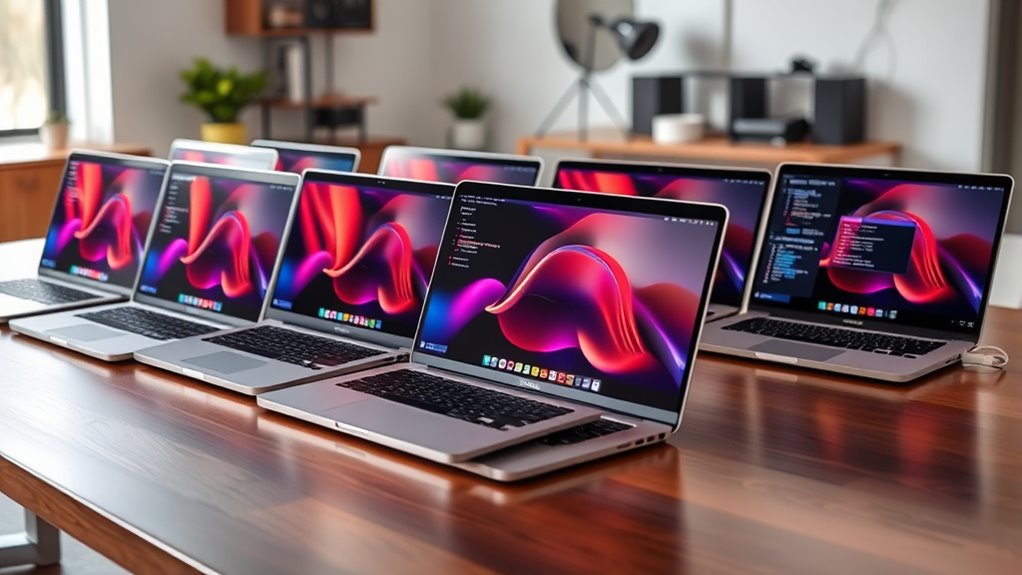

Among these 14-inch MacBook Pro configurations, my best overall pick is the M5 Pro model with 48GB memory and a 1TB SSD: it balances demanding workloads with practical storage. The M5 Pro 24GB/1TB option suits lighter professional work, while the 64GB/2TB configuration is better for large projects and heavier multitasking. The main tradeoffs are memory versus storage, newer performance versus refurbished value, and how much power your workload can use. A larger spec sheet is not automatically a better fit if your work is mostly browsing, documents, and everyday apps. Read on for the full breakdown and guidance on choosing the configuration that matches your needs.

Turn your quiet moments into listening time
- Thousands of audiobooks, podcasts and originals
- Listen on your phone, tablet or Echo — also offline
- Cancel anytime
Key Takeaways
- M5 Pro with 48GB memory and 1TB storage is the roundup’s clearest all-rounder, appearing in several listings; compare the exact listing details before choosing.
- The 64GB/2TB M5 Pro configuration is the strongest fit here for memory-heavy work and large local project files, but many buyers will not use its extra capacity.
- The 24GB/1TB M5 Pro keeps the newer chip generation while trimming memory, making it a more restrained choice for moderate workloads.
- The renewed M4 and M1 Pro models can appeal to buyers prioritizing an earlier generation, but condition, seller terms, and battery health deserve close attention.
- Several M5 Pro listings share the same headline chip and memory; differences such as SSD capacity, finish, and listing details matter more than the repeated configuration label.


| inch macbook pro configuration | Memory | Storage | Color | Display |
|---|---|---|---|---|
| Apple 2024 MacBook Pro with M4 | 16GB | 512GB SSD | Space Black | 14-inch Liquid Retina XDR |
| Apple 14-inch MacBook Pro with | 64GB | 2TB SSD | Space Black | 14.2-inch Liquid Retina XDR |
| Apple 14-inch MacBook Pro with | 48GB | 1TB SSD | Space Black | 14-inch Liquid Retina XDR |
| Apple 14-inch MacBook Pro with | 48GB | 1TB SSD | Space Black | — |
| Apple MacBook Pro 14-inch Lapt | 48GB unified memory | 2TB SSD | Silver | 14-inch Liquid Retina XDR |
| Apple 2024 MacBook Pro 14-inch | 24GB | 512GB SSD | Silver | 14.2-inch Liquid Retina XDR |
| Apple 14-inch MacBook Pro with | 64GB | 1TB SSD | Space Black | 14.2-inch Liquid Retina XDR |
| Apple 14-inch MacBook Pro with | 24GB | 1TB SSD | Space Black | 14-inch Liquid Retina XDR |
| Apple MacBook Pro 14-inch 2021 | 16GB | 512GB SSD | Space Gray | 14-inch Liquid Retina XDR |
| Apple 14-inch MacBook Pro with | 48GB unified memory | 1TB SSD | Space Black | 14-inch Retina display |
More Details on Our Top Picks
Apple 2024 MacBook Pro with M4 Chip (14-inch, 16GB RAM, 512GB SSD) Space Black (Renewed)
For buyers who want the 14-inch Pro display and chassis without stepping up to an M5 Pro configuration, this renewed M4 model offers a more modest, practical starting point. Its 16GB of memory and 512GB SSD suit everyday work, coding, and moderate creative projects, while the Liquid Retina XDR screen gives it a stronger display experience than a basic laptop. Compared with the M5 Pro 48GB/1TB configuration, it has much less memory and storage headroom for large projects or heavy multitasking. The tradeoff is the renewed condition: the battery is specified to exceed 80% capacity, but its exact condition may vary, and accessories or packaging may not be original. I’d choose it for core MacBook Pro features, not for maximum longevity under demanding workloads.
Pros:- M4 chip provides capable performance for everyday work and moderate creative tasks
- Liquid Retina XDR display offers high resolution and strong visual contrast
- Compact 14-inch design is suited to commuting and desk-to-desk use
- Renewed inspection and testing provide a defined check of the device before resale
Cons:- 16GB RAM and 512GB storage leave less room for demanding projects than the M5 Pro configurations
- Battery capacity is only specified as exceeding 80%, so remaining capacity may vary
- Accessories may not be original and packaging may be generic
Best for: Students, office users, and occasional creators who want a 14-inch MacBook Pro display and M4 performance in a renewed configuration.
Not ideal for: Video editors, developers running multiple memory-heavy tools, and buyers who require a new device or a battery close to full capacity.
- Chip:Apple M4
- Memory:16GB
- Storage:512GB SSD
- Display:14-inch Liquid Retina XDR
- Resolution:3024 x 1964 pixels
- Operating system:macOS 15.1
- Color:Space Black
- Renewed battery condition:Exceeds 80% capacity
- Warranty:90 days
Our verdict“Choose this renewed M4 configuration for everyday work and the 14-inch XDR screen, but pick an M5 Pro model if your workload needs more memory or storage.”
Apple 14-inch MacBook Pro with M5 Pro chip, 64GB RAM, 2TB SSD, Space Black
This is the lineup’s clearest fit for professionals whose work regularly pushes memory limits: the M5 Pro is paired with 64GB RAM and a 2TB SSD, giving large creative projects, complex builds, and heavy multitasking more room to run locally. Compared with the M5 Pro 48GB/1TB option, this configuration adds both memory and storage, a useful difference for people who keep large assets and several demanding applications open. Its 14.2-inch 120Hz Liquid Retina XDR display preserves a portable footprint while supporting detailed, fluid visuals. The tradeoff is that these generous specifications are unnecessary for most browsing, office work, or light editing, and the listing does not specify weight. I’d select it when capacity is a working requirement, rather than buying extra headroom for tasks that will not use it.
Pros:- 64GB RAM gives demanding multitasking and large projects substantial memory headroom
- 2TB SSD accommodates sizable project files and local media libraries
- M5 Pro chip pairs a 18-core CPU with a 20-core GPU
- 14.2-inch 120Hz Liquid Retina XDR display combines detailed visuals with a compact laptop format
Cons:- The 64GB and 2TB capacity may go unused by everyday users
- Weight is not specified, making portability comparisons harder
- The 14-inch screen may feel limiting for professionals who need a large built-in workspace
Best for: Video editors, 3D and design professionals, and developers who routinely work with large projects or memory-intensive tools on the go.
Not ideal for: General office users and students whose workloads fit comfortably within lower memory and storage configurations.
- Chip:Apple M5 Pro, 18-core CPU and 20-core GPU
- Memory:64GB
- Storage:2TB SSD
- Display:14.2-inch Liquid Retina XDR
- Resolution:3024 x 1964 pixels
- Refresh rate:120Hz
- Battery life:Up to 24 hours
- Color:Space Black
- Connectivity:USB-C and MagSafe 3
Our verdict“Choose this configuration if your professional work can use 64GB of memory and 2TB of storage; otherwise, the 48GB/1TB M5 Pro option is a more restrained fit.”
Apple 14-inch MacBook Pro with M5 Pro Chip, 48GB RAM, 1TB SSD, Space Black
This M5 Pro configuration pairs 48GB of memory with a 1TB SSD, landing between the renewed M4 model’s everyday capacity and the 64GB/2TB M5 Pro configuration’s heavier-duty provision. That balance makes sense for creative professionals and developers who need room for demanding applications but do not routinely manage enormous local libraries. The listed 15-core CPU and 16-core GPU support a capable professional setup, while the Liquid Retina XDR display keeps fine detail and contrast central to the 14-inch experience. Compared with the 48GB/2TB Silver M5 Pro, this one gives up half the listed storage but keeps the same stated memory and chip core counts. The product information is sparse on battery, ports, and refresh rate, so I’d choose it for its stated core configuration rather than assumed extras.
Pros:- 48GB memory supports demanding multitasking and larger creative projects
- 1TB SSD offers more working space than the renewed M4’s 512GB drive
- M5 Pro is specified with a 15-core CPU and 16-core GPU
- Liquid Retina XDR display provides a high-resolution screen in the 14-inch form
Cons:- 1TB storage is less accommodating than the 2TB M5 Pro configurations for large local libraries
- Product details do not specify battery life, ports, or display refresh rate
- Space Black is the only listed color
Best for: Creative professionals and software developers who need substantial memory for sustained workloads but can work with a 1TB internal drive.
Not ideal for: Users with extensive local video, photo, or audio libraries who would benefit from the 2TB storage in the Silver M5 Pro configuration.
- Chip:Apple M5 Pro, 15-core CPU
- GPU:16-core GPU
- Memory:48GB
- Storage:1TB SSD
- Display:14-inch Liquid Retina XDR
- Color:Space Black
Our verdict“Pick this model for a balanced M5 Pro setup with 48GB memory, and choose a 2TB configuration if local storage is a regular constraint.”
Apple 14-inch MacBook Pro with M5 Pro Chip, 48GB RAM, 1TB SSD, Space Black
On paper, this configuration shares its headline M5 Pro, 48GB memory, and 1TB SSD setup with the B0GSX5YTW3 model, but its listing provides more detail about the display and battery. A stated 120Hz refresh rate and maximum brightness of 1600 nits help clarify its appeal for users who value fluid motion and vivid HDR viewing; the listed battery life reaches up to 24 hours. Against the 48GB/2TB Silver configuration, it offers half the storage, so it is a better match for work kept on external drives or cloud storage than large local media libraries. The listing’s use of “LED” display wording is less specific than the Liquid Retina XDR description elsewhere, and it does not provide a weight. I’d favor it when the stated display and battery details matter more than extra SSD capacity.
Pros:- 48GB memory supports substantial multitasking and creative workloads
- 1TB SSD gives more local space than the 512GB renewed M4 configuration
- Listing specifies a 120Hz refresh rate and up to 1600 nits maximum brightness
- Battery life is listed as up to 24 hours
Cons:- 1TB SSD provides less capacity than the 2TB M5 Pro alternatives
- Weight is not specified, limiting portability comparisons
- Display is described as LED in the specs, leaving less clarity than an explicit XDR panel description
Best for: Mobile professionals who want a 48GB M5 Pro setup and place particular value on a specified high-refresh display and long stated battery life.
Not ideal for: Creators who keep extensive media libraries on the laptop, or buyers who need confirmed weight and fully consistent display specifications before choosing.
- Chip:Apple M5 Pro, 18-core CPU and 20-core GPU
- Memory:48GB
- Storage:1TB SSD
- Display size:14 inches
- Display resolution:3024 x 1964 pixels
- Maximum brightness:1600 nits
- Refresh rate:120Hz
- Battery life:Up to 24 hours
- Color:Space Black
Our verdict“Choose this 48GB/1TB M5 Pro listing if its stated display and battery details are priorities, but select a 2TB model for larger onboard media needs.”
Apple MacBook Pro 14-inch Laptop (Early 2026) with M5 Pro Chip, 48GB RAM, 2TB SSD, Liquid Retina XDR Display, Silver
This Silver configuration keeps the 48GB memory of the balanced 1TB M5 Pro models while doubling their listed internal storage to 2TB. That makes it a strong fit for photographers, video editors, and other creators who want extensive project files on the laptop without stepping up to the 64GB configuration. Its M5 Pro has a 15-core CPU and 16-core GPU, and the listed ports—Thunderbolt 5, HDMI, MagSafe 3, and SDXC—make it easier to connect displays and camera media. Compared with the 64GB/2TB Space Black model, this one trades some listed memory capacity for a matching 2TB drive and a more detailed connectivity list. The listing does not provide battery life or weight, and the Silver finish is the only color specified. I’d choose it when storage and ports matter more than maximum memory.
Pros:- 2TB SSD provides twice the listed storage of the 1TB M5 Pro configurations
- 48GB unified memory suits substantial creative and multitasking workloads
- Thunderbolt 5, HDMI, MagSafe 3, and SDXC are listed for varied connections
- 12MP Center Stage camera is specified for video calls
Cons:- The 48GB memory capacity is lower than the 64GB M5 Pro alternative
- Battery life and weight are not provided in the listed specifications
- Silver is the only listed color
Best for: Photographers, video editors, and mobile creators who need 2TB of local storage, 48GB memory, and direct connections for displays or camera cards.
Not ideal for: Professionals whose workloads regularly need more than 48GB of memory, or buyers who want documented battery life and weight before deciding.
- Chip:Apple M5 Pro, 15-core CPU and 16-core GPU
- Memory:48GB unified memory
- Storage:2TB SSD
- Display:14-inch Liquid Retina XDR
- Ports:Thunderbolt 5, HDMI, MagSafe 3, SDXC card slot
- Wireless connectivity:Wi-Fi 7 and Bluetooth 6
- Camera:12MP Center Stage
- Color:Silver
Our verdict“Choose this Silver M5 Pro configuration if 2TB storage and built-in connection options matter more than the 64GB memory in the higher-capacity alternative.”
Apple 2024 MacBook Pro 14-inch with M4 Pro or M4 Max, 24GB RAM, 512GB SSD, Silver (Renewed)
This renewed 14-inch configuration suits buyers who want a professional-grade display and ports without choosing a newer M5 Pro model. The listed M4 Pro or M4 Max processor is a major distinction, but the exact chip can change the performance picture, so I would confirm which version is being sold before choosing it for demanding workloads. Its 24GB of memory is a more capable starting point than the 16GB in the renewed M1 Pro model, while the 512GB SSD is less spacious than the 1TB drives in the M5 Pro options. Thunderbolt 5, HDMI, SDXC, and MagSafe 3 make it easier to connect a creative workstation without relying on as many adapters. The tradeoff is renewal status: warranty coverage may be less generous, and storage is modest for large media libraries.
Pros:- 24GB RAM offers more multitasking headroom than the renewed M1 Pro configuration with 16GB.
- Liquid Retina XDR display supports high-brightness, high-contrast creative work.
- Thunderbolt 5, HDMI, SDXC, and MagSafe 3 provide useful built-in connectivity.
- M4 Pro or M4 Max silicon offers a newer performance tier than the M1 Pro option.
Cons:- The listing names two possible chips, so buyers should verify the exact processor before purchase.
- 512GB storage may fill quickly with high-resolution media and project files.
- Renewed condition may come with less warranty coverage than a new M5 Pro configuration.
Best for: Creative professionals seeking an XDR display, broad built-in connectivity, and a newer-generation chip in a renewed 14-inch MacBook Pro, after confirming whether the listing includes M4 Pro or M4 Max.
Not ideal for: Buyers who need predictable maximum performance, a clearly specified chip, a fresh full warranty, or more than 512GB of internal storage.
- Processor:M4 Pro or M4 Max
- Display:14.2-inch Liquid Retina XDR
- Memory:24GB
- Storage:512GB SSD
- Color:Silver
- Ports:Three Thunderbolt 5, MagSafe 3, SDXC, HDMI, headphone jack
- Battery life:All-day
Our verdict“Choose this renewed M4 configuration for its display, ports, and potential chip performance only if the exact processor and warranty terms are clear.”
Apple 14-inch MacBook Pro with M5 Pro chip, 64GB RAM, 1TB SSD, Space Black
I’d pick this M5 Pro configuration when memory capacity matters more than minimizing the specification. Its 64GB of RAM gives demanding multitasking and large creative projects more room than the 24GB M5 Pro model, while the 1TB SSD matches that option’s storage rather than expanding it. The listed 18-core CPU and 20-core GPU provide a defined chip configuration, unlike the renewed M4 listing, which may ship with either an M4 Pro or M4 Max. A 14.2-inch Liquid Retina XDR display keeps this a portable workstation, and the stated battery life of up to 24 hours may help users who work away from an outlet. The cost of this headroom is that many everyday workflows will not need 64GB; buyers with lighter workloads can choose the 24GB version and keep the same listed storage.
Pros:- 64GB memory offers substantial headroom for large projects and concurrent professional applications.
- M5 Pro configuration specifies an 18-core CPU and 20-core GPU.
- 1TB SSD provides more working space than the 512GB renewed M4 and M1 Pro options.
- Up to 24 hours of stated battery life supports extended work away from a charger.
Cons:- The 64GB memory capacity may be unnecessary for common productivity and lighter creative work.
- Storage remains 1TB, matching the 24GB M5 Pro option rather than providing a larger project library.
- The 14.2-inch screen offers less workspace than a larger external or desktop display.
Best for: Video editors, software developers, and other professionals who routinely run memory-intensive applications or large projects and want a specified M5 Pro configuration.
Not ideal for: Students, general office users, or creators whose applications fit comfortably in 24GB of memory and who would prefer to avoid paying for unused capacity.
- Processor:M5 Pro, 18-core CPU
- GPU:20-core GPU
- Memory:64GB
- Storage:1TB SSD
- Display:14.2-inch Liquid Retina XDR
- Battery life:Up to 24 hours
- Color:Space Black
Our verdict“Choose this configuration if your professional workload can use 64GB of memory; otherwise, the 24GB M5 Pro model is a more balanced fit.”
Apple 14-inch MacBook Pro with M5 Pro Chip, 24GB RAM, 1TB SSD, Space Black
This is the straightforward choice for buyers who want an M5 Pro MacBook Pro without moving up to the 48GB or 64GB memory configurations. The 24GB of memory is a useful step beyond entry-level capacity for many creative and development workflows, while the 1TB SSD offers twice the listed capacity of the renewed M4 and M1 Pro options. Its 18-core CPU and 20-core GPU match the chip configuration described for the 64GB M5 Pro model, so the meaningful difference between those two listings is memory—not a higher stated core count here. That makes this configuration easier to justify for users whose projects do not demand unusually large memory pools. Buyers running several heavy applications or huge datasets may prefer the 64GB model; lighter users should also weigh whether they need an M5 Pro at all.
Pros:- M5 Pro listing specifies an 18-core CPU and 20-core GPU.
- 24GB memory offers a practical middle ground between the renewed 16GB M1 Pro and higher-memory M5 Pro options.
- 1TB SSD provides more internal workspace than the renewed 512GB configurations.
- Liquid Retina XDR display is suited to detailed photo and video work.
Cons:- 24GB may constrain workflows involving very large projects or many demanding apps at once.
- It has less memory than the 48GB and 64GB M5 Pro configurations.
- The listing gives limited information about battery life and included accessories.
Best for: Photographers, developers, and creative professionals who want the listed M5 Pro CPU/GPU configuration, 1TB of storage, and a more moderate memory capacity than 48GB or 64GB options.
Not ideal for: Professionals with unusually large memory demands, or everyday users who do not need an M5 Pro-class processor and could choose a less demanding configuration.
- Processor:Apple M5 Pro, 18-core CPU
- GPU:20-core GPU
- Memory:24GB
- Storage:1TB SSD
- Display:14-inch Liquid Retina XDR
- Color:Space Black
Our verdict“Choose this M5 Pro configuration if 24GB is enough for your workload and you want 1TB storage without stepping up to a larger memory tier.”
Apple MacBook Pro 14-inch 2021 with M1 Pro chip, 16GB RAM, 512GB SSD – Space Gray (Renewed)
This renewed 2021 model is the older, simpler route into the 14-inch Pro format: it pairs an M1 Pro chip with a strong display, built-in connectivity, and a six-speaker audio system. For established editing, photography, and music-production workflows, those features can matter more than having the newest chip generation. Compared with the renewed 2024 M4 listing, though, it has 16GB of RAM rather than 24GB and a much older processor generation; compared with the M5 Pro options, it also has less memory and only 512GB of storage. Its 1080p camera and spatial-audio speakers remain useful for calls and media work, but the renewed condition brings warranty uncertainty. I’d reserve it for buyers whose applications fit its memory and who value the Pro display and ports over newer performance headroom.
Pros:- M1 Pro chip remains aimed at professional workflows such as video editing, photography, and music production.
- Liquid Retina XDR display provides high contrast and brightness.
- Six-speaker system with spatial audio adds capable built-in sound for editing and media.
- 1080p FaceTime HD camera and a wide range of ports support calls and peripheral connections.
Cons:- 16GB RAM is less than the 24GB renewed M4 and all listed M5 Pro configurations.
- 512GB SSD offers less space than the 1TB M5 Pro options.
- Renewed condition may mean limited warranty coverage, and the model is from 2021.
Best for: Budget-conscious creative professionals or students who need a 14-inch MacBook Pro display and ports for established workflows and are comfortable buying renewed hardware.
Not ideal for: Buyers handling large modern projects, running memory-heavy applications, or seeking a new device with clearly stated warranty coverage and longer-term performance headroom.
- Model year:2021
- Processor:Apple M1 Pro
- Display:14-inch Liquid Retina XDR
- Memory:16GB
- Storage:512GB SSD
- Color:Space Gray
- Camera:1080p FaceTime HD
- Audio:Six-speaker system with spatial audio
- Ports:Wide range of ports for connectivity
Our verdict“Choose this renewed M1 Pro if your workload is well suited to 16GB and you value its display, audio, and ports more than newer silicon.”
Apple 14-inch MacBook Pro with M5 Pro Chip, 48GB RAM, 1TB SSD
This 48GB M5 Pro configuration sits between the 24GB and 64GB options, giving buyers a larger memory buffer without choosing the highest listed capacity. Its 15-core CPU and 16-core GPU are specified differently from the 18-core CPU and 20-core GPU listed for the other M5 Pro models, so I would not treat the extra memory alone as proof that it is the faster configuration. The 48GB unified memory is the draw for multitasking and projects that outgrow 24GB, while a 1TB SSD matches the storage on the 24GB and 64GB models. Compared with the 64GB version, this listing has less memory and fewer stated CPU/GPU cores; compared with the 24GB version, it offers a wider memory margin. The display is described as Retina rather than Liquid Retina XDR, so buyers should verify the precise panel details.
Pros:- 48GB unified memory provides more capacity than the 24GB M5 Pro configuration.
- 1TB SSD matches the storage capacity of the other listed M5 Pro configurations.
- 15-core CPU and 16-core GPU are specified in the product details.
- 14-inch format keeps the system more portable than a larger-screen workstation.
Cons:- The listed 15-core CPU and 16-core GPU have fewer cores than the 18-core CPU and 20-core GPU configurations elsewhere in this group.
- The 48GB memory capacity is below the 64GB M5 Pro option.
- Display details say Retina rather than Liquid Retina XDR, so panel specifications are less clear.
Best for: Professionals who have outgrown 24GB memory but do not need 64GB, and who want a 14-inch M5 Pro laptop with 1TB storage.
Not ideal for: Buyers who need the highest listed CPU/GPU core counts, want the 64GB configuration, or require confirmed Liquid Retina XDR display specifications.
- Processor:Apple M5 Pro, 15-core CPU
- GPU:16-core GPU
- Memory:48GB unified memory
- Storage:1TB SSD
- Display:14-inch Retina display
- Color:Space Black
- Power adapter:70W USB-C
Our verdict“Choose this model if 48GB memory suits your workload and you accept its lower stated core counts and less-specific display description.”

How We Picked
I ranked these configurations by how well their stated chips, memory, and storage align with distinct buyer workloads—not by treating the largest numbers as automatic winners. I gave weight to headroom for demanding creative and development tasks, useful local storage, and whether the configuration seems proportionate for everyday productivity. A 48GB/1TB M5 Pro setup leads because it offers a broad workload fit without the extra capacity of the 64GB/2TB option; the lower-memory M5 Pro models follow for buyers with lighter demands.
I placed listings with repeated specifications near each other rather than inventing performance differences the supplied details do not establish. Renewed M4 and M1 Pro configurations are lower because they involve an earlier chip generation and added uncertainty around condition; they may still fit buyers who value those tradeoffs. Product titles do not provide full information about battery condition, warranty, or seller terms, so I treat those as purchase checks rather than assumed strengths.
| inch macbook pro configuration | Chip | Color | Processor |
|---|---|---|---|
| Apple 2024 MacBook Pro with M4 | Apple M4 | Space Black | — |
| Apple 14-inch MacBook Pro with | Apple M5 Pro, 18-core CPU and 20-core GPU | Space Black | — |
| Apple 14-inch MacBook Pro with | Apple M5 Pro, 15-core CPU | Space Black | — |
| Apple 14-inch MacBook Pro with | Apple M5 Pro, 18-core CPU and 20-core GPU | Space Black | — |
| Apple MacBook Pro 14-inch Lapt | Apple M5 Pro, 15-core CPU and 16-core GPU | Silver | — |
| Apple 2024 MacBook Pro 14-inch | — | Silver | M4 Pro or M4 Max |
| Apple 14-inch MacBook Pro with | — | Space Black | M5 Pro, 18-core CPU |
| Apple 14-inch MacBook Pro with | — | Space Black | Apple M5 Pro, 18-core CPU |
| Apple MacBook Pro 14-inch 2021 | — | Space Gray | Apple M1 Pro |
| Apple 14-inch MacBook Pro with | — | Space Black | Apple M5 Pro, 15-core CPU |
Factors to Consider When Choosing 14 Inch Macbook Pro Configurations
These choices share a compact Pro design, but the right configuration depends on what fills your workday and what you keep on the internal drive. I would start with workload and storage habits, then decide how much memory headroom you need and whether a renewed machine suits your risk tolerance.
Match the Chip to Work You Actually Run
A Pro-tier chip makes the most sense when your regular tasks can use sustained processing or graphics capacity, such as editing, compiling, or handling demanding creative projects. For email, office documents, web apps, and light photo work, a newer Pro chip may feel like more machine than the workload needs. Compare your busiest routine, not an occasional project that you could handle another way. If a task is limited by an app’s own features or an external service, a more powerful chip may not change the result much. Buyers choosing between M5 Pro and renewed M4 or M1 Pro systems should weigh generation against condition and support details, not chip labels alone.
Choose Memory for Concurrent Work, Not as a Status Spec
Memory affects how comfortably a Mac can keep multiple demanding apps and large working files active at once. The 24GB M5 Pro listing is a reasonable place to start for moderate professional work, while 48GB gives more room for heavier multitasking and complex projects. The 64GB options make the most sense when your software and project scale already call for that capacity. A common mistake is paying for maximum memory based on a vague possibility of future needs, rather than identifying a real workload bottleneck. Since memory is not a casual later upgrade, decide from your expected ownership period and the apps you use most.
Estimate Storage From Your Active Projects
A 1TB SSD offers more breathing room than 512GB for large applications and files kept on the Mac, while 2TB helps when active media libraries or project assets need to stay local. Storage needs vary sharply: cloud-based documents occupy little space, but video footage, sample libraries, and large datasets can fill a drive quickly. Look at how much space your current projects use and leave room for new work, app data, and system files. External drives can stretch a smaller internal SSD, though they add equipment to carry and manage. The 48GB/1TB and 64GB/2TB M5 Pro options show why memory and storage should be chosen separately rather than bundled into one idea of “more power.”
Treat Renewed Status as a Separate Buying Decision
Renewed M4 and M1 Pro models are not direct equivalents to new M5 Pro listings just because they share the 14-inch size. Their appeal depends on the specific condition, battery status, included accessories, return window, and warranty offered by the seller. Read those terms before comparing specifications, and check whether the listing identifies the exact chip configuration; the renewed M4 title allows either M4 Pro or M4 Max. A lower-generation machine can still suit familiar workflows, but uncertainty about its history changes the ownership equation. If predictable condition and support matter more than acquiring an earlier-generation configuration, prioritize a listing with clear protections.
Check the Exact Listing When Specs Repeat
Multiple products in this roundup have the same M5 Pro, 48GB, and 1TB headline configuration, so the title alone may not explain why one listing differs from another. Confirm the chip description, storage, memory, finish, model year, and included seller or warranty terms on the actual product page. One listed 48GB/1TB model is identified as an early-2026 laptop with a Silver finish, while several others specify Space Black. Do not assume duplicate-looking listings have identical fulfillment or support conditions. When the core configuration matches your needs, choose based on verified listing details rather than expecting a meaningful performance gap from the same headline specs.
Spend More Only When the Capacity Solves a Real Constraint
Moving from 24GB to 48GB or 64GB is useful when memory pressure slows work or limits the scale of projects you can keep open. Choosing 2TB over 1TB matters when local files regularly crowd your drive or external storage would disrupt your routine. If neither issue affects your work, extra capacity may bring little practical benefit. A sensible way to decide is to identify the constraint you hit most often—slowdowns from concurrent tasks, or a drive that is continually full—and direct your configuration choice there. Buyers who cannot name a recurring constraint should lean toward a balanced setup instead of maxing out every specification.
Frequently Asked Questions
Is the M5 Pro with 24GB memory enough for a 14-inch MacBook Pro?
It can be a suitable configuration for everyday productivity and moderate creative or development work, especially when you do not keep many demanding applications open at once. The 1TB SSD also gives it more local storage than the 512GB options listed here. Choose 48GB instead if your regular work involves large projects, heavy multitasking, or software that benefits from extra memory. Because memory is difficult to change later, make the decision around your recurring workload rather than a single occasional task. If your work is mostly documents, browsing, and video calls, the 24GB option is the more measured M5 Pro choice in this lineup.
Should I choose 48GB memory with 1TB storage or 64GB with 1TB?
Pick 48GB if it already covers the applications and project sizes you use; it is the more balanced configuration represented repeatedly in this roundup. The 64GB/1TB option is better suited to workloads that actively benefit from more memory, such as unusually heavy concurrent tasks or large working sets. More memory does not solve a drive that is too small, so check your storage habits separately. If you need both extra memory and room for substantial local files, the listed 64GB/2TB configuration addresses both needs. Avoid choosing 64GB solely because it is the highest memory figure here.
Is the 2TB M5 Pro configuration worth choosing over 1TB?
It is a stronger fit if your active projects, media libraries, or large datasets need to remain on the laptop and routinely take up substantial space. For smaller files or workflows built around cloud storage and external drives, 1TB may be enough and can leave capacity for other priorities. External storage can reduce pressure on the internal drive, but it adds another device and may be less convenient when traveling. The 64GB/2TB model also pairs its larger SSD with more memory, so it is most compelling for buyers who can use both. Estimate your current storage use and likely project growth before selecting it.
What should I verify before buying a renewed MacBook Pro?
Check the seller’s definition of renewed condition, battery-health policy, return period, warranty, and what accessories are included. Confirm the exact chip and memory configuration: the renewed 2024 listing in this roundup describes an M4 Pro or M4 Max option, while the renewed 2021 listing specifies an M1 Pro. Read the listing for signs that the configuration is explicit rather than inferred from a product-family title. A renewed laptop can be a reasonable fit for someone comfortable with an earlier generation, but the condition terms affect its value and risk. If those terms are unclear, compare it with a listing that states them plainly.
Which configuration makes the most sense for someone new to professional Mac workloads?
The M5 Pro with 24GB memory and a 1TB SSD is the most restrained newer-generation option in this selection, and it offers a useful starting point for moderate work. Beginners doing only everyday tasks may not need a Pro-class configuration at all, so consider whether your software benefits from this level of hardware. If you are learning video editing, software development, or design, 24GB can work for moderate projects, while 48GB provides more room as projects grow. Avoid paying for 64GB or 2TB until you can identify a workload that needs the extra capacity. Keep in mind that memory is a longer-term choice, so choose based on the kind of work you expect to do regularly.
Conclusion
For most demanding users, my best overall recommendation is the M5 Pro with 48GB memory and 1TB storage: it balances headroom and capacity without going straight to the largest configuration. My best value in capability is the M5 Pro with 24GB and 1TB for moderate workloads, while the best premium fit is the 64GB/2TB M5 Pro for buyers who can use both upgrades. For beginners moving into professional work, the 24GB/1TB M5 Pro is the easiest configuration to justify; everyday users should first check whether they need a Pro model at all. The renewed M4 and M1 Pro listings suit buyers willing to weigh an earlier generation against seller condition and support terms. If two listings share the same core specs, I would choose only after confirming the exact configuration and purchase protections.
Fall Picks
fall essentials
As an affiliate, we earn on qualifying purchases.